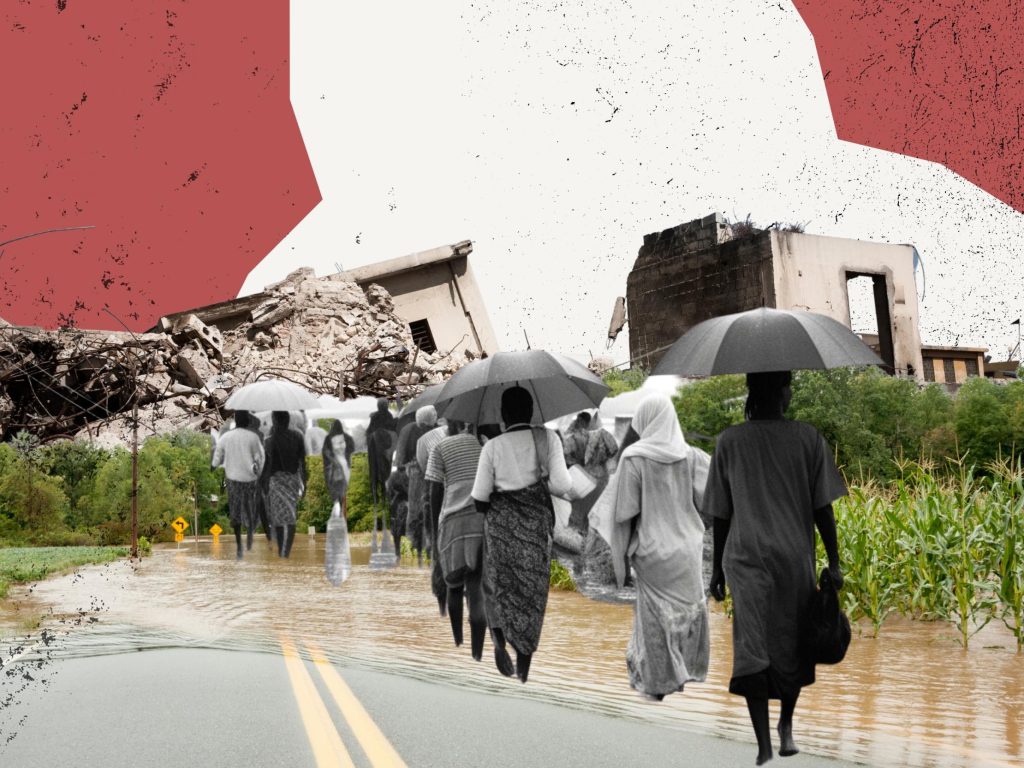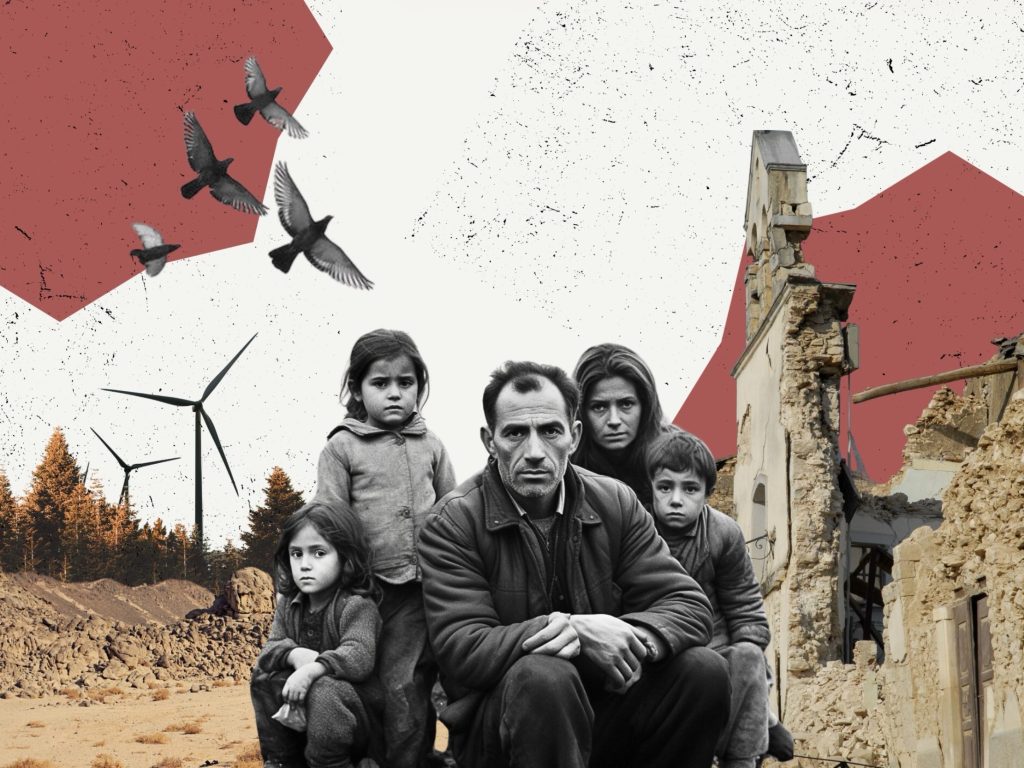
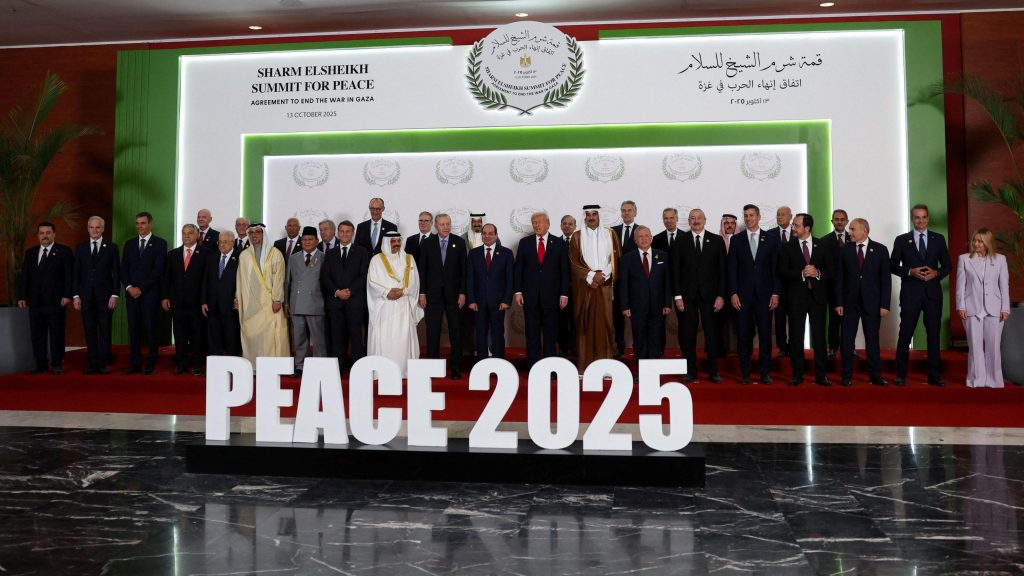
The war in Gaza has raged for years, but the current architecture of negotiation and stabilization is now at a critical hinge. On 9 October, Israel and Hamas reached an agreement in principle under a deal advanced by Donald Trump (his widely‑publicised “twenty‑point plan”) whose first phase involves a truce, a hostage‑prisoner exchange, a partial Israeli withdrawal, and expanded aid access into Gaza.
What is now happening is that the United States is trying to bring the Council into the picture not as an afterthought but as a central actor: on 5 November, the U.S. Permanent Representative to the United Nations, Mike Waltz, presented a draft resolution to the ten elected members of the Council. The draft endorses Trump’s plan, but more importantly seeks the Council’s endorsement of two major new institutions: an international “Board of Peace” to take overarching responsibility for Gaza’s governance, reconstruction and humanitarian regime; and an International Stabilization Force (ISF) to be stationed in Gaza under the strategic guidance of the Board, working in concert with Israel and Egypt.
Why the U.S. wants the Council’s imprimatur is straightforward: only the Council can confer the kind of international legitimacy and legal status that provides donor confidence, troop‑contributor assurance and the political cover for Israel, regional states and multilateral institutions alike. In that sense, the Council is being asked not merely to “note” the deal but to become a principal architect of a new governance/security architecture for Gaza.
But therein lies the rub: other Council members and regional actors are uneasy. The draft resolution, in its latest form, leaves key questions vague and unresolved. The Board’s membership and accountability are unspecified; the ISF’s mandate, composition, legal basis (notably absence of explicit Chapter VII language) and rules of engagement remain under‑defined; the role of the Palestinian Authority (PA) is marginalised or put behind conditional reform benchmarks; the political horizon for Palestinian self‑determination is amorphous. The Council is being asked to sign off on an arrangement that looks bold and dramatic, but built on many weak links.
Who Will Rule Gaza; And How?
One of the most striking innovations in the draft is the “Board of Peace”. The draft resolution endorses the creation of this Board (as per the Trump plan) which would exercise broad oversight of Gaza’s governance, reconstruction and aid delivery, and would supervise a technocratic Palestinian administration to run everyday services. The idea of placing Gaza under a new governance architecture is not in itself unprecedented: the UN has in the past authorised transitional administrations (for example in Bosnia in the mid‑1990s, Kosovo in the early 2000s) when conflict-producing entities were defeated and governance vacuums existed. What makes the Gaza case distinct is the combination of urgency, partial war‑ongoing context, contested sovereignty, the centrality of Israel, the fractured nature of Palestinian governance and the magnitude of destruction on the ground.
The draft envisions that once the PA completes a reform programme and secures “effective control” over Gaza, the Board will transition responsibilities back, but that is conditioned. Until then, the Board runs oversight. There are two interlocking problems with this. First, the legitimacy problem: Palestinian participation is notably weak in the current draft. The PA is not automatically given a seat on the Board; its return is conditioned on unspecified benchmarks. Hamas, which remains the de facto actor in the populated areas of Gaza, is effectively excluded from governance. Absent meaningful local voice, the Board’s authority may be seen as externally imposed rather than locally rooted. This generates risk: governance without local legitimacy is more fragile, more exposed to resistance, and less capable of long‑term durability.
Second is the accountability problem; the draft leaves major mechanics unspecified. Who picks the Board’s members, how are they held responsible, what legal or administrative recourse exists, what is the rule of law foundation? In previous transitional administrations authorised by the Council (e.g., the international transitional authority in East Timor), the mandate, chain of command, reporting lines, exit triggers and review processes were clearly laid out. In the Gaza draft, many of these remain ambiguous. That matters because authority without clear accountability enables governance failures, corruption risks, or a sense among the population that powers are being exercised from above with minimal oversight.
The financial dimension compounds the governance issue. One recent analysis emphasises that unless international actors exercise meaningful control over Gaza’s finances such as tax revenues, contracts, key appointments, the disarmament of militant groups (such as Hamas) will likely fail. Without this fiscal and administrative leverage, the stabilisation design risks enabling militants to rebuild under cover of reconstruction, or otherwise retain leverage. The draft hints at donor‑managed reconstruction and an international trust body, but does not yet secure a full architecture for financial oversight or a transparent accountability system.
In essence, the governance axis of the plan asks the Council to endorse a hybrid model: locally staffed services executed under the supervision of an international Board, with a path to a restored Palestinian governance role. That model has theoretical appeal. But the devil lies in the details: the absence of clear parameters for legitimacy, oversight, local participation and financing may fatally weaken the arrangement.
What Force Under What Rules?
Security is the other major pillar. The draft seeks to authorise the International Stabilization Force (ISF) for an initial mandate of two years (through December 2027), though with an option for extension. The ISF is explicitly described as an enforcement force, not a traditional UN blue‑helmet peacekeeping mission with lightly armed observers. The envisioned tasks include securing Gaza’s borders (with Israel and Egypt), training a Palestinian police force, protecting civilians, facilitating humanitarian relief, and crucially, overseeing demilitarisation of the territory: destruction of “military, terror, and offensive infrastructure,” prevention of rearmament, and permanent decommissioning of weapons held by non‑state armed groups. The draft says the ISF would operate under “unified command” acceptable to the Board of Peace and in close consultation with Israel and Egypt.
That is a heavy mandate. The operational, legal and political challenges are enormous. One immediate concern from several Council diplomats is the absence of an explicit Chapter VII legal basis in the U.N. Charter wording of the draft. Chapter VII is the standard mechanism through which the Council authorises binding enforcement measures, including the use of force. Without that anchor, contributor states may hesitate, rules of engagement may be disputed, the force may lack clear legal backing, and insurance/risk concerns may limit deployment. States such as the UAE have signalled that they cannot deploy personnel without a firmer legal foundation.
Another challenge is force composition and command. The U.S. hopes Arab and Muslim‑majority states will provide the bulk of the troops, but many of those states have made clear they prefer the traditional peacekeeping paradigm, lighter engagement, neutral monitor role, not front‑line enforcement in a hostile urban warfare setting. If the ISF arrives with weak force numbers, unclear rules of engagement, or limited autonomy, it risks being ineffective. Moreover, Israel claims it will not accept a force whose mandate compromises its control over Gaza’s borders or airspace. If Israel retains border control and the ISF is confined to limited “green‑zone” areas, the mission may become a largely symbolic presence rather than a transformative actor.
Operationally, demilitarising Hamas and other armed groups is arguably the toughest task. Israel has for years attempted to degrade Hamas’s military infrastructure and failed to fully dismantle its tunnel systems, its local support networks or its arms flows. A multinational force entering Gaza will confront the same structural conditions: readily available small‑arms networks, tunnel infrastructure, local support for militancy, an urban war‑zone terrain, and a political environment characterised by displacement, trauma and shattered governance. Without a coherent strategy that integrates security, governance and political process, the ISF risks embedding a freeze rather than creating transition.
In short, the security architecture asks the Council to endorse an ambitious enforcement mission whose success is contingent on a range of uncertain variables: troop contributor willingness, legal legitimacy, coordination with Israel and Egypt, alignment with Palestinian governance structures, and integration with aid and reconstruction flows. If any of these are weak, mission failure becomes a serious danger.
“Self‑Determination,” Two‑State or Transition Limbo?
The question of Palestinian political rights is the third dimension. In the draft as revised, the U.S. added language referencing a “credible pathway to Palestinian self‑determination and statehood” conditional on the PA’s reforms and redevelopment of Gaza. This is arguably a major concession. That such language appears at all signals U.S. recognition that stabilisation without politics is hollow. But the way the conditions are drafted raises core issues: the pathway is vague; the benchmarks are unspecific; the decision‑makers for when the PA has done “satisfactorily” its reform task are unclear; the timeline is unspecified. In other words, the architecture implicitly posits a transitional period whose end‑state remains ambiguous.
For the Palestinians, this is existential. If Gaza is stabilised, rebuilt and then transferred to a Palestinian entity that lacks statehood or sovereignty, the result may be a governed enclave divorced from a viable political horizon, a model of managed dependency rather than self‑governance. Many analysts argue that without justice, agency and political rights, stability remains fragile. Critics suggest that the plan may in effect institutionalise a prolonged transitional regime in which Gaza is governed from above for years, while the broader Israeli‑Palestinian political question is deferred indefinitely.
For Israel, stabilization is in part about disarming threats, reducing border pressure and normalising Gaza’s relationship. For regional Arab states, the stabilisation window presents an opportunity to re‑engage, showcase influence, and shape the reconstruction paradigm. But from the Palestinian viewpoint the concern is that the arrangement will entrench external oversight, delay or deny genuine sovereignty, and marginalise the PA or other legitimate local institutions.
Thus the political horizon is both the linchpin and the weakest link. If the Council signs off on the resolution but the political dimension remains fuzzy, the entire architecture risks becoming a security‑governance shell with no internal anchor.
It is vital to understand that what is occurring in New York is not simply a technical drafting of words but a high‑stakes multilateral negotiation over vision, power, legitimacy and future roles. The U.S. has leveraged the fact that the truce currently holds (but remains fragile) and that reconstruction momentum may shrink if not anchored soon. The draft circulated on 3 November (via Axios) seeks to formalise the ISF, the Board of Peace and transition administration. The U.S. is pushing for a vote as early as the end of November so as to deploy troops by January 2026. At the same time Russia on 13 November introduced a counter‑text that removes the Board of Peace entirely and reframes things around the Secretary‑General submitting options for implementation. The significance is clear: Russia (and by extension China) are signalling they prefer the Council retain a lighter role, vet the architecture rather than authorise it in full, and perhaps keep the UN in control rather than cede it to a U.S.‑led design.
Non‑permanent Council members are also weighing their options carefully. Many are wary of endorsing a text that gives sweeping authority to a Board and ISF without local accountability, but also understand the risk that if they push too hard they may be sidelined as stabilisation proceeds outside the UN framework. From a tactical standpoint the U.S. is saying: this is our deal, we want the Council to endorse it so we can move quickly. Others are saying: we need revisions, stronger accountability, stronger Palestinian participation, firmer legal basis for the force.
The question for the Council is whether to vote and ratify the U.S. design (with modest amendments) or delay and risk the U.S. moving ahead with a coalition outside the UN. That choice is not between “action” and “inaction” in the abstract: it is between endorsing a deeply flawed but functional framework or preserving multilateral norms and risk irrelevance in the field. Many diplomats phrase it as a choice between “rubber‑stamping a plan we did not design” and “losing the chance to shape the future of Gaza”.
Given all of this, there are multiple potential failure modes. One is operational: the ISF arrives late or under‑equipped, the Board lacks staffing or legitimacy, reconstruction funds falter, Palestinian services erode, and the security environment remains hostile. In that scenario Gaza slips into “not war but not peace” — a limbo state where law and order are fragile, governance weak, militant groups regenerate, Israeli security fears persist, donors withdraw, and ultimately conflict reignites.
Another risk is legitimacy and local ownership: if Palestinian actors (PA, civil society, armed groups) feel excluded, an imposed governance model becomes a flashpoint, resistance grows, parallel institutions operate, local unrest intensifies, and the mission becomes a target rather than a stabilising force.
Third is the political horizon risk: if the pathway to Palestinian self‑determination remains open‑ended or conditional without real progress, stabilization may be mistaken for peace. Over time, Gaza might be governed externally indefinitely — a semi‑autonomous enclave dependent on external oversight, rather than a restored part of a Palestinian polity with meaningful sovereignty. That outcome would provoke frustration and undermine long‑term legitimacy.
Fourth, legal/command risk: if the ISF lacks Chapter VII authorization, troop contributors may delay deployment, rules of engagement may be contested, Israel or other actors may act unilaterally, coordination collapses, and the force becomes ineffective or even entangled in hostilities. If Israel retains de facto control of key border, air and sea access, the ISF may be deployed in areas that are controlled by Israel anyway — eroding its independence and undermining its role.
Fifth, donor fatigue and reconstruction collapse: the plan hinges on major reconstruction (some estimates suggest tens of billions of dollars). If donor countries withdraw, if infrastructure funds are mismanaged, if service delivery fails, then the stabilisation will lose credibility and Gaza may revert to humanitarian crisis rather than reconstruction success.
Finally, regional/geopolitical risk: if the Board and ISF are perceived as extensions of U.S./Israeli policy, rather than neutral multilateral instruments, they may become contested by states like Iran, Turkey, or Islamist groups, or trigger proxy conflict. If Russia, China or key Arab states feel sidelined, they may under‑cut the mission’s legitimacy. And if Hamas refuses to disarm or retreats into non‑state networks, the stabilisation may unravel.
What Must Be in Place?
For this architecture to stand a chance it must incorporate certain non‑negotiable elements. First, the ISF must be grounded in a credible legal mandate ,Chapter VII authorization or equivalent, so that it has clear rules of engagement, accountability and legitimacy. Second, the Board of Peace must be transparent in membership, mandate, oversight, and must include meaningful Palestinian participation — not just technocrats, but legitimate representatives with authority. Third, the transition to Palestinian governance must be clearly linked to timetables, benchmarks for PA reform, local institutional development, and a defined hand‑over process. Fourth, reconstruction and finance must be structured so that donor funds are managed transparently, oversight is robust, contracts and revenues are not captured by militant or corrupt actors, and local economic agency is enabled rather than simply imported. Fifth, the ISF, Board, reconstruction actors, the PA and NGOs must coordinate operationally — security, humanitarian, governance and development must proceed in tandem, not sequentially and disconnected. Sixth, there must be a visible marker for exit strategy, not open‑ended mandates but explicit time‑frames and conditions for the Board’s dissolution, ISF withdrawal/transition, and PA assumption of full authority.
If these elements are missing or weak, the risk is that the whole enterprise ends up as a sprawling, ambiguous, donor‑dependent “transition zone” rather than a genuine path towards Palestinian self‑rule and regional stability.
Why This Matters for the Israeli‑Palestinian Conflict — And Beyond?
By endorsing the resolution, the Security Council would be setting a precedent for how post‑conflict territories are stabilised and governed when a major power intervenes, a non‑state actor holds territory, and governance is collapsed. For Gaza, it might represent a last best chance to avoid further immediate war, to rebuild the enclave, to provide relief to millions of Palestinians, to reduce hostilities at Israel’s border.
But the long‑term stakes are even higher. If Gaza is stabilised under a hybrid international‑local governance model without a genuine political resolution, then the broader Israeli‑Palestinian conflict may shift into a new paradigm: Gaza becomes externally administered but not sovereign; the two‑state horizon slips further; Palestinian political rights become subordinate to stabilization mechanics. That would not just reshape Gaza, it would reshape the entire conflict architecture in the Middle East.
For the U.S., the plan is also a test of whether it can reassert multilateral frameworks or whether it will increasingly rely on unilateral or coalition‑of‑the‑willing constructs. The Council’s role in this moment becomes a symbol of whether international institutions matter or whether major powers bypass them. If the Council endorses this draft with weak safeguards, its credibility suffers. If it fails and the U.S. moves ahead outside of it, the Council is sidelined and multilateral norms are further eroded.
My assessment is that the resolution will likely pass but with significant amendments and caveats. The U.S. will pressure for endorsement by the end of November; at the same time Russia, China, and some Arab states will extract changes on the Board’s composition, stronger legal language for the ISF, and clearer Palestinian participation. The most probable scenario is a “qualified adoption”: the Council authorises a version of the plan, the ISF is deployed in limited zones (“green zones”), the Board is formed but with less sweeping powers, Palestinians retain symbolic governance roles but not full authority immediately, reconstruction begins, but the transfer to Palestinian control is delayed.
In that scenario the real question is how the years 2026‑2027 unfold: will the ISF be able to stabilise Gaza, will the Board achieve meaningful reconstruction, will the PA reform and assume authority, will donors sustain funding, will Israeli security concerns be met, will Hamas decline to violent resurgence? If the answers are positive, the architecture could deliver a fragile but real stabilisation. If the answers are negative, Gaza risks entering a long‑term transitional limbo — neither war nor peace, yet rife with risk of relapse.