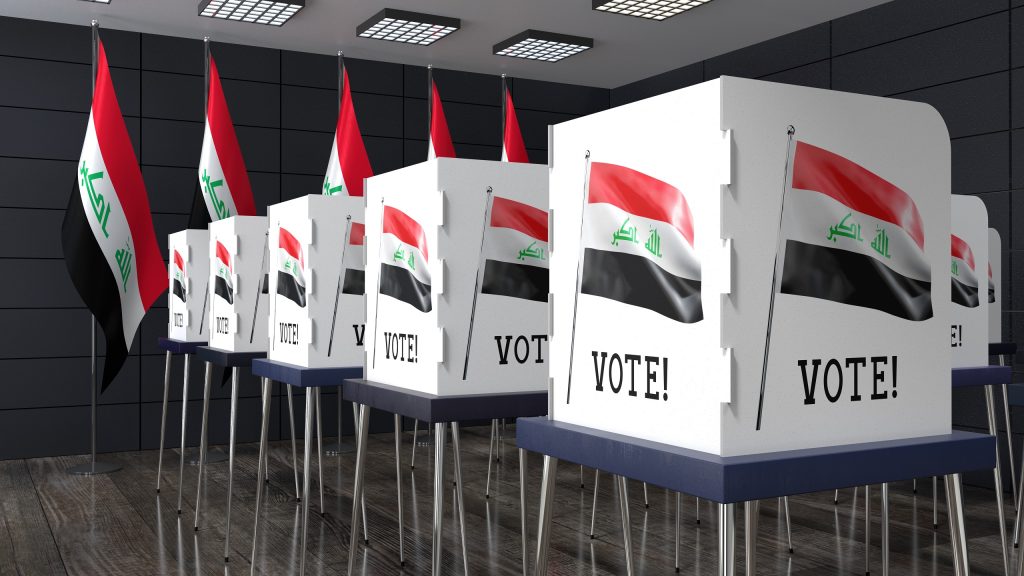
The November 11 parliamentary election did not decide whether Iraq falls into the American or the Iranian column. That binary stopped matching reality long ago. What the vote did was reset the operating system that will govern how both powers push, probe, and bargain inside Iraq for the next cycle.
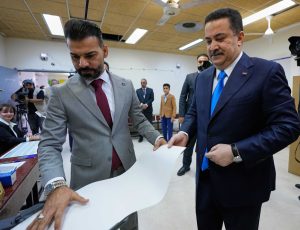
The basic arithmetic is clear enough. The Reconstruction and Development coalition aligned with Prime Minister Mohammed Shia al-Sudani has come out ahead with forty six seats in a three hundred twenty nine member parliament. It is followed by a cluster of established forces: Takadum as the main Sunni vehicle, State of Law under Nouri al Maliki, the Kurdistan Democratic Party, Badr, Sadiqoun, the Patriotic Union of Kurdistan and others. Turnout a little above fifty six percent is respectable by current Iraqi standards and higher than many expected.
No one has anything close to a majority. That is the first strategic fact that matters for Washington and Tehran. Neither camp can rule without others. Both foreign actors now have to work through a coalition architecture in Baghdad that is fragmented but not collapsing, and that contains players who want neither an Iranian protectorate nor a second round of American tutelage.
What Iran is trying to protect?
For Iran, Iraq is not simply another neighbour that happens to host Shia parties. It is strategic depth against the United States and Israel, a buffer that complicates any military campaign against Iranian territory, and an economic lung that helps Iran survive sanctions.
On the security side, key Popular Mobilization Forces that sprang up in the war against the Islamic State have become the backbone of an Iraqi network aligned with the Islamic Revolutionary Guard Corps Qods Force. Badr, Kataib Hezbollah, Asaib Ahl al Haq and similar formations give Tehran the ability to apply pressure on US forces and Gulf states without firing from Iranian soil. These groups are now woven into the official PMF structure, on paper subordinate to the Iraqi commander in chief, in practice tied by history, finance and ideology to Tehran.
On the economic side, the picture is just as important. For years, electricity and gas deals allowed Iran to receive payment through accounts in Iraq even while US sanctions were in place. The Biden administration’s last waiver, renewed in late 2024, gave Iran continued access to roughly ten billion dollars in frozen funds via arrangements routed through Iraq and Oman. When Trump returned to office and restarted his maximum pressure campaign, he made clear that these waivers would end. In March 2025, the State Department followed through and declined to renew the waiver that permitted Iraq to pay Iran for electricity imports.
The US Federal Reserve’s role in clearing Iraqi oil receipts adds a further layer. Every barrel sold ultimately produces dollars that pass through a system Washington can monitor and sometimes restrict. Concerns that Iraqi banks were serving as conduits for Iranian actors led the Central Bank of Iraq, under US pressure, to ban first eight and then another five local banks from dollar transactions in 2024 and 2025. These measures were aimed at money laundering and sanctions evasion, but from Tehran’s vantage point they look like targeted attempts to constrict arteries that feed Iran’s sanctioned economy.
Add all that together and the stakes in Baghdad become obvious. A parliament and cabinet that are willing to cooperate with US financial clean-up, restrict suspect banks, and gradually unwind energy dependence on Iran will tighten the screws on Tehran. A parliament that prefers drift and compromise, that leaves PMF budgets largely intact and treats US concerns about banking as negotiable rather than binding, will keep much of the current ecosystem alive.
That is why Iran cares less about one specific prime minister than about the shape of the coalition. Its ideal outcome is a Shia led government in which the Coordination Framework retains enough weight to protect PMF interests and shield key economic channels, but which still has sufficient legitimacy with Washington and Arab capitals to unlock investment and avoid outright dollar strangulation. Iran needs Baghdad to breathe, and it needs Baghdad not to become the launch pad for the next in a series of crises with the United States.
What Washington is actually doing?
American power in Iraq today is measured less by the number of bases than by the reach of the Treasury Department and the Federal Reserve. Trump’s second term has not brought back large scale troop deployments, but it has brought a sharper use of financial tools.
On 9 October 2025 the Treasury’s Office of Foreign Assets Control sanctioned a network of eight Iraqi individuals and entities linked to Iran aligned militias. The centrepiece of that designation was Muhandis General Company, a sprawling construction and logistics conglomerate controlled by Kataib Hezbollah commander Abu Fadak in his capacity as PMF chief of staff. Treasury made explicit that Muhandis uses subcontracting to siphon Iraqi government contracts, and that under its cover as an agricultural firm, Baladna Agricultural Investments, it had helped move weapons to militia groups through ties to the Qods Force.
In parallel, the United States has pushed Baghdad hard on banking reform. Meetings in Dubai between Iraqi officials, the Treasury and the Fed this year produced a decision by the Central Bank of Iraq to bar five more banks from access to dollars, on top of previous bans. Western legal and compliance briefings on that decision are blunt: the banks were seen as part of a pattern in which Iraqi institutions had been used to move hard currency to sanctioned actors in Iran and Syria.
Ending the electricity waiver has added another lever. Washington now treats Iraqi payments for Iranian power not as a regrettable necessity but as a problem to be eliminated. Public statements describe the policy as an attempt to force Iraq to build its own capacity and diversify suppliers, and to remove any residual economic relief Iran might gain from those sales.
All this is happening while American energy companies are taking larger stakes in Iraqi oil and gas, including projects to capture flared gas and feed domestic generation rather than rely on imports. Washington is trying to shape an Iraqi energy sector that both meets Iraqi demand and narrows Iran’s leverage.
The line that US policymakers are walking is narrow. Push too softly and Iran’s networks continue to operate through Iraqi fronts with little cost. Push too hard and Iraqi elites may conclude that the United States is willing to sacrifice their economy to hurt Tehran, which would accelerate pressure to remove US forces and intensify appeals to alternative patrons.
The new parliament matters because it will either partner with this approach, drag its feet, or actively obstruct it.
The PMF as the hinge of the system
The Popular Mobilization Forces sit at the centre of the problem. They are at once guardians of Shia communities, spoils machines, political parties in uniform and forward operating bases for Iranian influence.
Over the last few years the strongest factions have begun to shift from overt militia identity toward a more ambiguous status. They run ministries, hold parliamentary seats, and control companies that win tenders in construction, agriculture and logistics. Their men still carry arms, but their commanders speak as politicians and businessmen. This is partly by design. Tehran has encouraged a model in which armed wings recede from public view while political and commercial structures become the primary instruments of influence. It lowers the chances of direct US retaliation and makes it harder for Iraqi reformers to isolate them.
The sanctions on Muhandis General Company and Baladna were a recognition by Washington that the battlefield has moved. These entities are not separate from the PMF; they are how parts of the PMF have embedded themselves into the Iraqi state’s economic wiring. The latest election will decide who sits across the table from them when budgets are drafted, tenders awarded and audits demanded.
Full demobilisation of the PMF is not realistic unless Iraq is prepared to risk another round of internal conflict, something the political class has no appetite for. Nor is full normalization acceptable to many Iraqis, since that would mean accepting a permanent armed state within the state. The path that is actually available lies between those poles: a gradual shift in which some brigades are more tightly folded into the army and police, others are nudged into reserve status under a legal facade, and their commercial empires face more scrutiny and competition.
Parliamentary committees and cabinet portfolios are the tools through which that slow work either happens or stalls. A security committee dominated by Coordination Framework figures close to the PMF will see little reason to question inflated payrolls or opaque procurement. A finance committee where Kurdish and Sunni parties have real weight and technocratic Shia members hold the swing vote might be more willing to insist on audits. Control of the interior ministry, the National Security Council, and key economic ministries will be contested in exactly this light.
Iran’s minimum requirements are clear. Core formations must not be stripped of their capacity or rebranded in ways that truly remove them from Tehran’s orbit. Access to Iraqi budgets and contracts must be kept sufficient to pay cadres and maintain patronage. Iraqi legislation must not empower outsiders to track too closely how these structures intersect with sanctions evasion.
American and European officials are moving in the opposite direction. They want to encourage Sudani or any successor to professionalise regular Iraqi forces, to confine PMF units to barracks, to prevent their deployment in cross border adventures and to tighten control over who gets to sign off on contracts. The election does not hand those officials a partner on a plate. It gives them a parliament in which influence has to be built committee by committee.
Elections as a reset of bargaining power
The temptation is to treat this vote as a replay of earlier cycles, just with different party names. That misses how the structure of bargaining has shifted.
The Sadrists, still popular among large segments of the Shia poor, chose once again to stay out of the race at the national level. That leaves a gap in formal representation but not in street power. Coordination Framework parties know that if they overplay their hand and appear to monopolise benefits, they risk protests that could again take on an anti establishment hue. Sunni leaders, weakened by internal feuds and corruption scandals, still have enough seats that they cannot be ignored in coalition talks. Kurdish parties must balance their own rivalry with the need to secure budget shares and influence over the federal oil and gas file.
At the same time, the space for open US Iran confrontation on Iraqi territory has shrunk. The memory of the period when rockets hit Embassy compounds and militias were struck by American aircraft is still fresh. Iran’s regional posture has taken serious blows since October 2023. Its networks in Syria and Lebanon are under pressure, and its own economy is more fragile after successive rounds of sanctions and domestic unrest.
These factors give Baghdad a little more freedom to say no. The next prime minister, almost certainly Sudani again if coalition arithmetic holds, can push back against some Iranian demands by pointing to US red lines on dollar access and to the risk of being hit by sanctions or strikes. He can also push back against some US asks by invoking the risk of militia backlash, cabinet collapse or renewed violence. The election has not made Iraq sovereign in the strong sense, but it has given Iraqi leaders more veto points and more opportunities to trade concessions across files.
From Washington’s perspective, this means that trying to use the election to reset Iraq as a platform for a frontal campaign against Iran would be self defeating. A sustained attempt to twist Baghdad into compliance, for example by threatening the bulk of oil revenues or insisting on wholesale PMF dismantlement, would probably produce either paralysis or a backlash that strengthens Tehran’s most committed clients.
From Tehran’s perspective, any push to use the new parliament as a tool to force US withdrawal or to openly defy sanctions enforcement on a large scale would invite the sort of targeted financial and military retaliation that has already hurt Iranian assets in Syria and Iraq. The lesson of recent years has been that the United States is willing to strike when it sees targeted provocations, but also that it is unwilling to pay the price of reoccupation. The competition has settled into a pattern of friction managed at medium intensity. The new Iraqi parliament is likely to preserve that pattern, not break it.
What this implies for the next phase
The election does not end US Iran competition in Iraq. It supplies a new frame within which it will be conducted.
If Sudani re emerges as prime minister at the head of a broad but shallow coalition, expect a government that talks about national sovereignty while quietly managing three realities. First, continued engagement with Washington on banking reform, dollar access and energy diversification, because that is necessary to keep the economy functioning and to attract investment. Second, continued accommodation of Iran’s core security interests, including protection for major PMF actors and avoidance of any alignment with US sanctions that looks like a strategic betrayal. Third, a messy internal balancing act in which Sunni and Kurdish partners are given enough to stay in the tent but not so much that they threaten the Shia establishment’s grip.
That equilibrium will feel unsatisfactory to both Washington and Tehran. It is also the most stable path available that does not involve a sharp break. Over time, small shifts can still accumulate. Each Iraqi bank removed from dollar auctions makes it a little harder to run sanctions busting schemes. Each new gas capture project reduces Iraq’s reliance on Iranian imports. Each audit that pries open a PMF front company’s books narrows the margins for graft.
The danger lies in miscalculation. If a PMF faction decides that the best way to reassert relevance is to harass American forces or to respond to events in Gaza or Lebanon by opening a new front from Iraqi soil, it will generate pressure in Washington for targeted strikes and tougher sanctions. If Trump’s team decides that slow erosion of Iranian influence is too little and tries to force decisive choices on Baghdad, it may discover that neither Sudani nor any alternative can deliver what is being asked without tearing the system apart.
Iraq is not a prize waiting to be claimed. It is a thick web of institutions, militias, parties, courts, banks and ministries that both the United States and Iran now need to keep half functioning even as they try to weaken each other’s hold. The November vote has refreshed that web and shuffled who sits where inside it. For a while, that is enough to shape the next round of competition.