
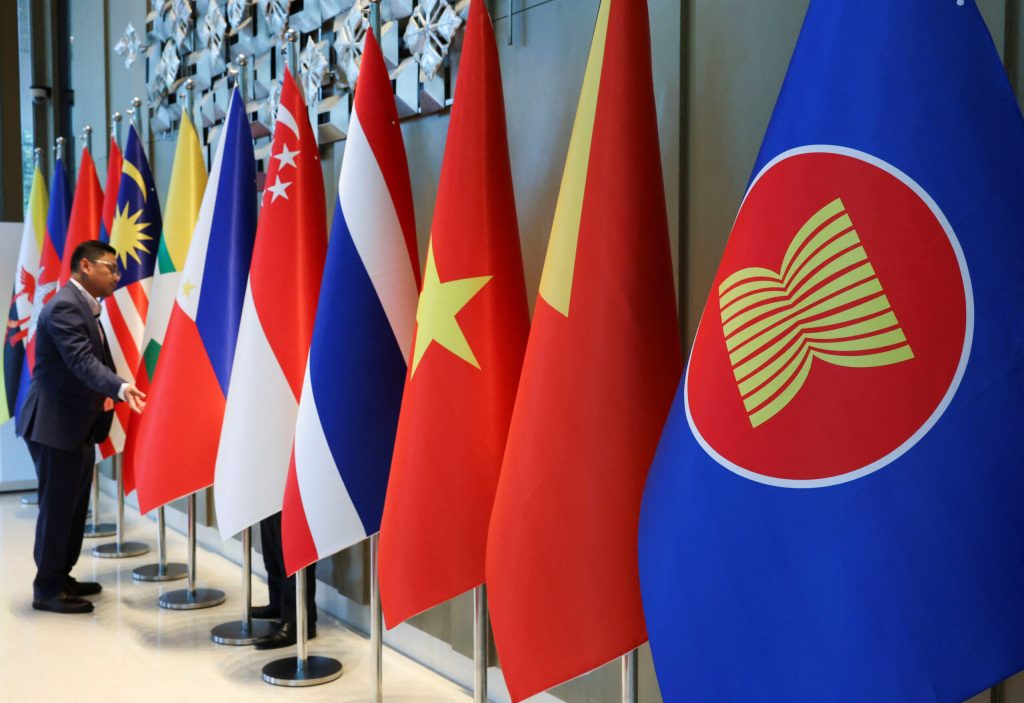
Southeast Asia’s defence landscape is no longer organised around a single anchor. The United States still supplies the most advanced exercises and much of the high-end hardware; China has become an unavoidable security presence on the mainland and at sea; a group of middle powers has moved from the margins into the core of regional defence planning. The region’s governments are not just “hedging” between two giants. They are building layered, functionally distinct networks of partnerships that are already shaping how any crisis in the South China Sea, around Taiwan, or in the eastern Indian Ocean would unfold.
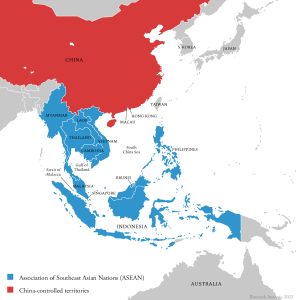
The strategic question is not whether Southeast Asia can avoid being drawn into major-power competition. That phase has passed. The question now is whether the way countries structure their defence relationships gives them more leverage over that competition, or leaves them exposed as logistics hubs, staging areas and bargaining chips for others.
To answer that, it helps to move beyond the usual labels and look at what states are actually doing: who they sign agreements with, who they talk to regularly, who they train with in realistic scenarios, and who they buy from. Once those layers are mapped, several hard trends come into focus.
If one tallies defence agreements, structured dialogues and combined exercises since the late 2010s, the United States still sits at the centre of Southeast Asia’s external defence web. Across the region it has more formal dialogue mechanisms, participates in more complex drills, and has deeper arrangements for logistics and information sharing than any other outside power. Research covering 2017–24 shows the US involved in roughly 40 per cent of all bilateral and multilateral exercises with Southeast Asian militaries.
China, by contrast, ranks in the lower half if all forms of engagement are aggregated. It has built a larger profile than a decade ago but still lags US partners in overall volume and sophistication of activity. On raw counts it sits behind the United States, Japan and Australia as an exercise partner and behind several middle powers in terms of the number of formal dialogues.
Those aggregate numbers disguise stark variation. In maritime Southeast Asia – Indonesia, the Philippines, Singapore, Malaysia, Brunei and Timor-Leste – the United States and its close allies dominate the top tier. Indonesia, the Philippines and Singapore are, by some margin, the most active regional participants in combined exercises with outside powers, and most of those drills are with the United States, Japan and Australia.
On the mainland, the picture looks very different. China is now the single most active external military partner for Cambodia and Laos, and often the only one that offers regular exercises and training. Russia retains pockets of influence, especially in arms supply to Vietnam and Myanmar, but its overall share of Southeast Asian arms imports has fallen sharply in line with its global decline. SIPRI estimates that Russia’s arms exports worldwide dropped by 64 per cent between 2015–19 and 2020–24, while US exports rose and France overtook Russia as the number-two exporter. Southeast Asia reflects that swing: Russian systems remain significant in Thai and Vietnamese inventories, but new contracts increasingly go to Western, Korean and, to an extent, Chinese suppliers.
Middle powers have used this opening with determination. One study of agreements signed since 2017 shows that Australia, India and Japan together concluded more defence cooperation documents with Southeast Asian countries than the United States and China combined, with South Korea and Canada adding further weight. These are not just political declarations; they underpin arms deals, technology transfer, training pipelines and access arrangements.
The result is a dense network where no single extra-regional actor can credibly claim to be “the” security provider. Instead, partners occupy niches. The United States offers combat-credible presence and advanced joint training; China provides proximity, political cover and low-visibility assistance; Japan and Australia focus on maritime domain awareness and constabulary capabilities; South Korea and France push industrial cooperation; India mixes training with targeted arms sales; Russia clings to legacy markets.
For Southeast Asian governments, this diversification is intentional. It allows them to avoid the classic dependency traps of the Cold War. But it also forces sharper choices about where to deepen cooperation and where to hold back, because not all relationships are interchangeable.
The instruments of defence cooperation look alike on paper, agreements, dialogues, exercises, but they perform different strategic functions depending on the counterpart.
When Southeast Asian forces train with the United States, Japan or Australia, the primary aim is to build high-end capability and interoperability. Balikatan 2024 in the Philippines, for instance, involved around 16,000 US and Philippine troops, plus smaller contingents from Australia and France. The exercise rehearsed multi-domain operations, including coastal defence with HIMARS and naval strikes near flashpoints in the South China Sea. Super Garuda Shield in Indonesia has grown from a modest bilateral drill into one of the region’s largest multinational exercises, with nearly 7,000 participants from eleven countries in 2024, practising amphibious operations, air assault, cyber defence and combined arms live fire. FPDA exercises such as Bersama Lima and Bersama Shield routinely place Malaysian and Singaporean units inside joint command structures with Australian, British and New Zealand forces, exposing them to NATO-grade planning processes and communications procedures.
Those environments are demanding by design. They require forces to operate with shared tactics, techniques and procedures, common data formats, and compatible electromagnetic practices. In practical terms, that means that in a real contingency – a blockade, a clash with Chinese vessels, a major natural disaster – US, Japanese, Australian and selected Southeast Asian units would be able to plug into each other’s command networks quickly, at least in certain domains.
Exercises with China serve almost the opposite function. Cambodia’s Golden Dragon series, Laos’ Friendship Shield drills and bilateral exercises with Indonesia and Malaysia are typically framed around counter-terrorism, peacekeeping, humanitarian assistance or internal security. Live fire is limited, command arrangements are kept simple and Chinese officers are careful about what they reveal. Regional officers who have participated describe these drills as politically useful but tactically shallow. The message to their own systems is often that China is a partner that must be engaged but remains outside their most serious planning.
Dialogue mechanisms show a similar dual logic. Strategic and 2+2 talks with the United States, Japan or Australia often feed directly into planning documents and procurement choices. Agreements like the US Acquisition and Cross-Servicing Agreements with Malaysia, Singapore and Thailand, or Japan’s defence equipment transfer and security assistance arrangements with the Philippines, are backed by concrete logistics and technology flows.
New 2+2 structures with China, such as those announced with Malaysia and Indonesia, are more about signalling and risk management. They create channels to discuss incidents in the South China Sea or around the Natuna Islands, and to maintain high-level contact even when rhetoric is heated. They do not, so far, embody shared planning or deep technology cooperation.
From a Southeast Asian point of view, that division is deliberate. Robust military relationships with Western partners provide insurance against worst-case scenarios; smoother, lower-level cooperation with China reduces the risk that insurance has to be used.
The geometry of these partnerships is starting to split ASEAN into distinct security spaces.
In maritime Southeast Asia, the cluster around the US alliance network has deepened faster than many expected. The Philippines, after years of vacillation, has moved to treat defence ties with Washington, Tokyo and Canberra as central pillars of its strategy. Expanded access to bases under the US–Philippines Enhanced Defense Cooperation Agreement, the regular presence of US surveillance assets, and the involvement of allies in Balikatan and other activities make the archipelago a forward node in the first-island-chain approach that frames US and Japanese thinking.
Indonesia speaks the language of equidistance but behaves as a state that wants options with everyone and overcommitment to no one. It drills with China and Russia to underline a non-aligned identity, yet its most sophisticated joint work and its most ambitious industrial projects are with Western and Korean partners. The revised deal to co-develop and purchase the KF-21 fighter, which cut Indonesia’s financial contribution to roughly 600 billion won while preserving its role in production and securing 48 aircraft, locks Jakarta into a long-term technological relationship with South Korea that no Chinese offer currently matches. The same is true of submarine cooperation with France and US-linked combat training.
Singapore operates as a quiet enabler. Its facilities are crucial for US and allied navies; its own forces train extensively with Western militaries; and it maintains disciplined, limited engagement with China to keep channels open without blurring red lines on sovereignty or operational security.
In mainland Southeast Asia, the weight of Chinese influence is more visible. Cambodia’s defence relationship with Washington withered after the 2010s; military engagements with China have expanded around the Golden Dragon exercises and the reconstruction of Ream Naval Base with Chinese funding. Two Chinese warships have been present there for extended periods, officially for training and joint drills, fuelling concern in Washington and elsewhere that the base could provide peacetime support and wartime access for the People’s Liberation Army Navy in the Gulf of Thailand and approaches to the Malacca Strait.
Laos, heavily indebted and landlocked, has turned to China for support in building and equipping its forces, including joint drills that provide modest training while cementing political ties. Thailand is the most complex case: a US treaty ally whose officers still value American training and Cobra Gold, yet a major purchaser of Chinese systems and an increasingly important participant in bilateral exercises such as Falcon Strike. Because Thailand’s air force is Western-trained, Falcon Strike gives Chinese pilots rare opportunities to operate against tactics derived from US practice, while keeping Thai F-16s and F-5s out of sight to avoid awkward questions from Washington.
Vietnam sits somewhere between the two spaces. It has stepped up defence dialogues and some practical cooperation with the United States, Japan, India and Europe, including naval visits and technology discussions. At the same time, it remains careful not to allow any partnership to be read as an anti-China alliance, given the sensitivity of its land border and the history of conflict.
If these trends intensify, ASEAN will not formally fracture, but its members will live in increasingly different strategic climates. Maritime states will plan around US–allied naval presence, forward-deployed assets and joint command arrangements. Mainland states will live with the reality that their principal external security partner is also the strongest mainland power and the main benefactor of their infrastructure. In such a setting, vague appeals to “ASEAN centrality” will matter less than the practical question of whose ships, aircraft and missiles are likely to show up in a crisis, and under what conditions.
Underneath the drills and dialogues, Southeast Asian governments are also using defence relationships to shape their own industrial base and technological options.
Indonesia’s approach is the most explicit. It has stated a goal of raising domestic content in defence equipment from around 40 per cent to 70 per cent over time, and is using cooperative programmes to get there. Co-production of KF-21 fighters with South Korea, local construction of French-designed submarines, and joint work on armoured vehicles and artillery all serve this wider goal. The Indonesian leadership wants foreign partners not just to sell finished kit, but to bring designs, tooling and training that will allow local firms eventually to compete.
Malaysia and the Philippines are more cautious but still attach importance to local work-share and technology transfer, whether in shipbuilding, coastal surveillance or aviation. Vietnam combines legacy Russian industrial links with exploratory projects with India, South Korea and European firms, looking to avoid single-supplier dependence.
Japan’s move into security assistance marks a structural shift. Under the Official Security Assistance programme, Tokyo has committed to provide coastal radar, RHIBs and associated equipment worth around 1.6 billion yen to the Philippine Navy, building on earlier transfers of air-surveillance radar. Similar support to Malaysia and other states is under discussion. These packages bring hardware, training and long-term maintenance relationships, and they plant Japanese standards and systems in the region’s emerging network of maritime domain awareness.
South Korea’s surge as an exporter has an industrial logic as well. It offers systems that are often cheaper and faster to deliver than US or European equivalents, with fewer political strings than Chinese equipment. The KF-21, K9 howitzers, frigates and basic trainers have all found eager audiences. Once a country buys into these families of systems, follow-on support and upgrades keep the relationship alive for decades.
China, for its part, blends industrial motives with strategic ones. Drone sales, small arms, patrol boats and armoured vehicles provide entry points into local markets and create dependence on Chinese supply chains. Joint exercises and logistics deals facilitate access for Chinese technicians and trainers. When paired with broader infrastructure finance; ports, roads, data networks; the result can be a web of dependencies that goes well beyond the military.
The industrial strand of defence partnerships is strategic for two reasons. It fixes interoperability choices in hardware and software over the long term, and it gives suppliers leverage. A state that depends on a single country for key spares, munitions or code updates has less freedom of action in a crisis. Southeast Asia’s effort to diversify suppliers is meant to dilute that leverage; the reality is that some choices, once made, are hard to unwind.
How this shapes real contingencies?
All of this activity would matter less if the region were quiet. It is not.
The South China Sea has become a daily arena of coercion. Chinese coastguard vessels and maritime militia regularly use ramming, water cannon and aggressive manoeuvres to disrupt Philippine and Vietnamese operations inside their own exclusive economic zones. Chinese naval and air activity around the Natuna Islands keeps Indonesian planners acutely aware that “we are not a claimant” is not a shield. The Taiwan Strait and the Bashi Channel sit a short flight from Philippine territory. The Bay of Bengal and Malacca Strait are central to Indian, Chinese and Japanese energy security.
In a serious crisis – an extended blockade of Philippine outposts, a violent clash around Second Thomas Shoal, a Taiwan contingency that spills south – the pattern of defence partnerships will govern practical questions.
First, whose forces can physically reach the scene in time and operate effectively there. The United States, Japan and Australia have rehearsed deployment and sustainment routes through Balikatan, Super Garuda Shield, FPDA exercises and others. Their logisticians know which ports and airfields in the Philippines, Indonesia, Singapore and Malaysia can handle which loads, under what political conditions. China, meanwhile, has access arrangements and training familiarity in Cambodia, Laos and Thailand that would help it secure its own approaches or complicate any Western moves in the Gulf of Thailand and lower South China Sea.
Second, who has the legal and political basis to operate from partner territory. Agreements on status of forces, mutual logistics support, access and classified information sharing matter here. The US–Philippines EDCA sites, Japanese and Australian reciprocal access arrangements, and emerging dialogue structures with Indonesia and Malaysia will determine how quickly and under what constraints allied forces can deploy. Chinese relationships in Cambodia and Laos offer less immediately obvious warfighting advantages, but they do give Beijing staging and sanctuary options in peacetime and low-intensity crises.
Third, which regional forces are genuinely prepared to fight alongside whom. A navy that has spent years practising complex anti-submarine warfare and air-defence drills with US and Japanese ships is different from one that has done mostly low-end counter-piracy with China. Air forces that have flown dissimilar air combat training against US or Korean jets, and integrated refuelling and AEW, will be of different value in a coalition than those that have stuck to scripted intercepts and fly-pasts. The content of exercises matters at least as much as their slogans.
These practical realities will not dictate political decisions, but they will shape the menu of credible options. A government whose forces have never rehearsed complex operations with foreign partners will find it harder to commit to joint action when events move quickly. Conversely, militaries that know each other’s procedures and have personal relationships across command chains will find it easier to improvise.
The strategic trade-offs for Southeast Asia
For Southeast Asian governments, the evolving pattern of defence partnerships presents three linked dilemmas.
The first is how far to deepen practical cooperation with the United States and its closest allies without being locked into their worst-case assumptions about China. Joint planning and high-end exercises bring real gains in capability and deterrence. They also make it more likely that regional forces would be involved in any US-led operation around Taiwan or in the South China Sea. Some states, such as the Philippines, now see that as an acceptable cost of ensuring their own survival. Others, such as Indonesia and Malaysia, are trying to push the envelope on capability while keeping doctrine and basing short of explicit alignment.
The second is how to manage relations with China without granting it veto rights over their security choices. Most Southeast Asian economies depend heavily on Chinese trade and investment. Governments know that overt alignment with an anti-China coalition could trigger economic punishment or sharper behaviour at sea. At the same time, a purely accommodating posture invites more pressure. Hence the preference for carefully calibrated cooperation with China on lower-sensitivity exercises and dialogues, combined with quiet but steady investment in ties to other powers.
The third is how to maintain some cohesion inside ASEAN. The association’s mechanisms – ADMM-Plus, the East Asia Summit, the ASEAN Regional Forum – remain useful convening platforms. But they were not designed to manage a situation where member states are building very different kinds of external security relationships. If maritime states continue to move closer to the US alliance network while mainland states drift further into China’s orbit, ASEAN statements on the South China Sea or regional order will ring increasingly hollow.
None of these dilemmas has a neat answer. They are being negotiated incrementally, contract by contract, exercise by exercise, visit by visit.
What a more strategic approach would require?
There is still room for Southeast Asian states to shape this landscape in ways that protect their autonomy rather than erode it.
One requirement is sharper prioritisation. Not every invitation to an exercise or dialogue merits acceptance; not every offer of equipment or co-production is worth the downstream dependencies it creates. Defence ministries need to decide where interoperability with particular partners is essential, and where symbolic participation is enough. That implies mapping capabilities and partnerships against specific scenarios – serious maritime incidents, blockades, cyber attacks on critical infrastructure, natural disasters – rather than treating all engagement as good in itself.
A second requirement is more serious intra-regional cooperation on the unglamorous but important tasks: shared maritime picture, search and rescue, disaster response, deconfliction mechanisms. Those activities can be insulated, to some extent, from the larger rivalry and can build habits of collaboration even among states that make different choices about big-power relationships. They also make it harder for any outside actor to exploit gaps between neighbours.
A third is investment in their own industrial and technological base, even if that means fewer shiny platforms in the short term. Local ability to maintain, repair and modify systems, to run sovereign command-and-control networks and to protect data will matter more than the flag on the side of a particular ship or aircraft. That implies using foreign partnerships to build real knowledge transfer and indigenous engineering capacity, not just as procurement channels.
For external partners, the strategic lesson is simple and uncomfortable. Access, influence and order-building in Southeast Asia will not be won by a single grand initiative or a one-off arms package. They will be the product of steady, credible engagement over decades, adapted to the region’s determination to keep options open. States that understand that and are willing to do the patient work – training, information sharing, industrial cooperation, respect for local constraints – will find their forces welcomed and their views heard. Those that treat Southeast Asia as a chessboard where moves against China or the United States are all that count will find themselves surprised by how often the pieces move on their own.