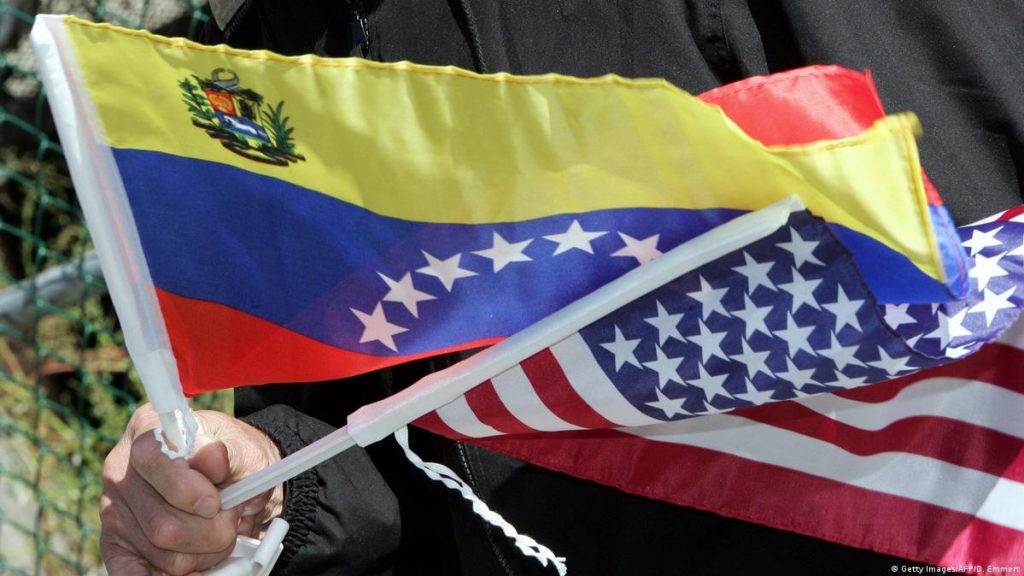
Washington has put a carrier strike group off Venezuela’s coast, branded Nicolás Maduro’s inner circle a terrorist cartel, and quietly authorised covert operations on Venezuelan soil. The USS Gerald R. Ford, the most advanced carrier in the US fleet, is now in the Caribbean with escorts, aircraft, and 15,000 troops in what Pentagon officials describe as an expanded “counter-narcotics” and “force protection” posture. Days earlier, the administration announced its intention to designate the Cartel de los Soles which is a loose network of senior officers and officials accused of drug trafficking, as a Foreign Terrorist Organization, formally treating parts of the Venezuelan state as a terrorist entity.
This is not just another sanctions ratchet or a bit of theatrics ahead of an election year. It is the most serious move toward overt, kinetic involvement in Venezuela since the crisis began. It comes after the United States recognised opposition candidate Edmundo González as the real winner of the July 2024 presidential election, rejecting Maduro’s claim to a third term, and after opposition leader María Corina Machado received the Nobel Peace Prize for her role in leading the democratic movement. Washington is now combining a narrative of stolen elections, narco-terrorism and humanitarian collapse into a single frame that can justify almost any tool, up to and including strikes on Venezuelan soil.
The strategic question is not whether Maduro deserves intense pressure. He presides over a devastated petro-state where more than 7.7 million people have fled, one of the largest displacement crises on the planet.The question is whether the mix of tools the Trump administration is assembling can plausibly produce a transition that is both more democratic and more stable – or whether it is steering the United States and the region toward another open-ended confrontation with no workable political endgame.
The architecture of Trump’s Venezuela strategy
Beneath the noise of presidential one-liners and cable-news soundbites, three elements define the current US approach: militarised signalling, criminalisation of the regime, and coercive diplomacy backed by migration politics. Each is understandable on its own terms. Together, they form a strategy that points toward regime change without saying the words, while leaving the hardest part – the day after – largely unaddressed.
Militarised signalling is the most visible layer. The Ford strike group’s deployment, the presence of destroyers and support ships, and a pattern of lethal strikes on small boats allegedly linked to drug trafficking are meant to convey both capability and willingness to escalate. A running timeline of these actions shows at least several dozen fatalities since early September, with many of the victims described by local communities as fishermen rather than cartel operatives. That record matters because it signals to Venezuelan elites that the United States is prepared to use force in Venezuela’s near seas and may be prepared to push further ashore.
The second layer is the terrorism frame. By designating the Cartel de los Soles as a Foreign Terrorist Organization and linking it explicitly to Maduro and his senior leadership, the administration is trying to shift Venezuela from the category of “corrupt authoritarian state” into something closer to a hybrid of narco-state and terrorist sponsor. The earlier decision to label the same network a Specially Designated Global Terrorist group under Treasury authorities laid the groundwork; the FTO step opens the door to a broader use of military force under counter-terrorism doctrines and expands criminal liability for anyone dealing with Venezuelan military or security elites.
This framing does three things at once. It raises the reputational and financial cost for officers who continue to back Maduro. It provides a legal and political narrative for kinetic strikes that might otherwise look like classic regime-change operations. And it plays directly into domestic US politics, where “terrorist cartels” and Venezuelan gangs such as Tren de Aragua feature heavily in the administration’s rhetoric about crime and the border.
The third layer is coercive diplomacy intertwined with migration politics. Trump entered his second term after campaigning on a promise to “shut the border” and dismantle his predecessor’s humanitarian protections for Venezuelans. Temporary Protected Status has been revoked, deportations have resumed on a significant scale, and hundreds of Venezuelans have been sent to third countries such as El Salvador to be detained under harsh conditions, while others were briefly held at Guantánamo’s migrant facility before being deported to Venezuela. The administration’s message to voters is that Venezuelan state collapse is not an abstract tragedy; it is an immediate driver of migration and crime in US cities.
Pressure on Maduro is therefore presented not only as a matter of democracy and human rights but as a border-security imperative. Any future bargain with Caracas (on deportation flights, migration management or prisoner exchanges) will be framed domestically as capitulation or vindication. That narrows the political space for a negotiated settlement and makes escalation more tempting whenever talks stall.
The theory of change behind this architecture is straightforward. If the regime’s key figures are rebranded as terrorists, their assets frozen and their travel curtailed, while a highly visible show of force sits off Venezuela’s shores and strikes nibble away at their economic networks, the top brass will begin to see Maduro as a liability, not a shield. In that reading, the goal is not an invasion but an engineered palace coup: Madurismo without Maduro, followed by a managed transition in which figures from the current inner circle cut deals with the opposition and foreign actors to secure their own safety and some continuity of state functions.
The problem is not that this theory is incoherent. It is that it rests on assumptions about information, incentives and control that bear little resemblance to the Venezuelan reality.
Why Venezuela is not a replay of Panama?
The analogy most often invoked in Washington is the 1989 ouster of Manuel Noriega in Panama: a dictator deeply involved in drug trafficking, running a small state tied to a vital waterway, removed in a relatively short operation that restored a civilian government. That template still exerts a powerful hold on parts of the US security establishment, particularly when dealing with medium-sized, ostensibly weak Latin American regimes accused of narco-corruption.
The differences are more important than the parallels.
Venezuela’s size, social structure and security ecosystem are fundamentally different. The country is close to thirty million people, spread over a territory larger than Texas and Oklahoma combined, with vast urban sprawls, jungle, porous borders and a multiplicity of armed actors. The armed forces are more heavily penetrated by Cuban security services than Noriega’s Panamanian Defence Forces ever were. Paramilitary colectivos, Colombian guerrilla remnants from the FARC and ELN, the Venezuelan-origin gang Tren de Aragua and foreign criminal organisations have all woven themselves into the country’s security and economic fabric.
The regime’s survival strategy has evolved accordingly. Maduro presides over a hybrid system in which the formal state, party structures, security services and criminal networks are mutually implicated. The Cartel de los Soles is less a hierarchical cartel than a shorthand for the way senior officers skim profits from illicit economies. That makes decapitation far harder. Removing a few marquee names does not dismantle an ecosystem in which hundreds of colonels, mayors, judges and governors have a stake.
Intelligence is another weakness. US collection on Venezuela has been patchy for years. Embassies were downgraded or closed, formal military-to-military links disintegrated, and covert assets have limited reach into the full spectrum of actors that matter on the ground. The pattern of mistaken or contested small-boat strikes already suggests significant gaps in target discrimination. A strategy that assumes pin-point knowledge of who moves which shipments, who controls which port and who can influence which battalion is operating with thinner information than its proponents imply.
Finally, the political and regional environment is different from the late Cold War. The US no longer enjoys uncontested legitimacy as a security arbiter in Latin America. Brazil and Colombia both sit in a complicated position: deeply uncomfortable with Maduro’s authoritarianism and the refugee flows it generates, yet deeply sceptical of unilateral US military action that would violate a neighbour’s sovereignty and likely push more people across their borders. Analysts at places like the International Crisis Group and CFR have already warned that a slide toward regime change would fracture regional diplomacy and risk a long, messy conflict that neither Latin American states nor the United States are prepared to manage.
The Trump administration is therefore trying to reproduce some of the psychological effects of the Panama operation – fear among insiders, a sense of inevitability, a belief that the United States will keep escalating until the dictator goes – in a context where the military balance, regional politics and global scrutiny are all very different.
Domestic politics and the escalation trap
No strategy toward Venezuela can be separated from the domestic US context that shapes it. Trump 2.0 governs with a political coalition for whom Venezuela is not a remote crisis but a symbol: of socialism’s failures, of uncontrolled migration, of perceived Democratic softness, and of what they view as a broader hemispheric battle against “narco-terrorists” and leftist regimes.
Three dynamics follow from that.
First, escalation has its own constituency. Secretary of State Marco Rubio has staked much of his political identity on a hard line toward Caracas, Havana and Managua. Others around Trump see a chance to reverse what they describe as Biden-era appeasement and to demonstrate that this administration is willing to use force south of the Rio Grande. Once the USS Ford is on station, the State Department has formally labelled an arm of the Venezuelan state a terrorist organisation, and covert action is under way, the domestic political costs of restraint rise. If ship bombings continue with limited visible impact on Caracas, demands for “real action” will grow louder in Washington.
Second, migration management is now fused to Venezuela policy in a way that incentivises short-term theatrics over long-term stability. The administration has sharply reduced refugee admissions overall and centred Venezuelans in its messaging on border security and deportations. A messy transition that sends hundreds of thousands more Venezuelans onto regional migration routes is not a price this White House wants to pay. Yet military strikes that destabilise coastal areas, refineries or state institutions are likely to do just that, regardless of the intent.
Third, Trump’s personal aversion to extended occupations coexists with his comfort with discrete, high-profile uses of force – missile strikes, targeted raids, visible but limited operations that can be sold as strength without triggering images of quagmires. That creates a bias toward action that is sharp but shallow: hit a few high-value targets, declare that Maduro’s days are numbered, move on. The gap between such episodic strikes and the sustained political engagement a Venezuelan transition would require is enormous.
From deterrence to regime change by drift
Taken together, these pressures mean that what is framed as coercive diplomacy is structurally prone to drift toward regime change, even if the administration insists that it does not seek an Iraq-style invasion.
A plausible sequence looks like this. The Ford group and associated assets continue to interdict vessels and conduct over-the-horizon strikes against what are described as drug-trafficking and terrorist targets. The FTO designation allows US planners to treat a widening circle of Venezuelan military and intelligence sites as legitimate objectives. At some point, whether in response to a provocation or as part of a deliberate choice, strikes move inland: radar sites, air-defence nodes, maybe a compound associated with a key figure such as the head of military counter-intelligence.
If those blows do not generate visible cracks in the regime – defections, signs of coup plotting, paralysis in Caracas – pressure builds to attack more central nodes. Maduro himself becomes an explicit target. Strikes on his security entourage or residence are framed as counter-terrorism operations. A decapitation attempt succeeds or fails; either way, the system that has grown up around him, integrating armed colectivos, criminal networks, regional party bosses and Cuban advisers, scrambles to survive.
In the best-case version of this narrative, an insider such as the vice-president or the head of the National Assembly moves quickly to assume control, negotiates a ceasefire of sorts with the US, and begins bargaining with the opposition under international auspices. In the more likely versions, local commanders improvise, rival factions scramble for territory and rents, and armed groups seize the opportunity to expand their fiefdoms.
None of this resembles the clean transition scenario that many in Washington evoke: Maduro flies out, the opposition walks in, institutions recover. The structure of incentives points elsewhere, toward either a fragmented authoritarian succession or a long period of hybrid conflict in which the formal state, criminal actors and foreign sponsors all continue to operate.
Strategic costs beyond Venezuela
Even if one brackets the human cost for Venezuelans themselves, the wider strategic implications of a mis-managed escalation are serious.
In the region, Brazil and Colombia would have to absorb new migration waves at a time when budgets are already stretched and patience in host communities is wearing thin. UN agencies and NGOs, already struggling to cope with more than seven million Venezuelan refugees and migrants, would face new pressures just as US foreign-aid budgets are being curtailed. The message to Latin American partners would be that Washington is willing to destabilise a neighbour in ways that directly impact them without a serious plan to share the burden. That would undercut years of quiet work to build joint responses to displacement and organised crime.
Globally, a US move to treat an entire segment of a foreign state apparatus as a terrorist entity and then strike it would erode already fragile norms around the use of counter-terrorism labels. Others would draw the lesson and apply similar labels to their own adversaries, with Russia’s treatment of parts of the Ukrainian state as “Nazi terrorists” or of opposition groups as extremists an obvious example. The narrative battle over who legitimately invokes counter-terrorism would tilt further away from law and toward raw power.
Venezuela would also become another arena in which China, Russia and Iran calibrate their responses to US coercion. Moscow has already used Venezuela as a platform for symbolic deployments and as a client for arms sales; Beijing has commercial and strategic stakes in Venezuelan oil and infrastructure; Iran has used ties with Caracas for sanctions evasion and political signalling. None of these actors has an interest in direct conflict with US forces in the Caribbean. All have an interest in exploiting a messy US intervention to showcase Washington’s hypocrisy, incompetence or unreliability.
Finally, there is the impact on the broader debate over democracy promotion and regime change. Ukraine, Sudan, Myanmar and other crises already fuel scepticism in the Global South about Western selectivity and double standards. A US-engineered transition in Venezuela that produces more chaos than stability would feed that narrative for a generation, including in Latin America’s own democracies, where publics are wary of both authoritarian populism and perceived US meddling.
An alternative strategic frame
Rejecting a rush toward militarised regime change does not mean accepting an indefinite status quo. Maduro’s third term, built on a stolen election and entrenched repression, is not sustainable. Nor is a humanitarian situation in which a fifth of the population has left and many of those who remain face chronic shortages and insecurity. The challenge is to construct a pathway that aligns the use of pressure with a clear political logic, rather than confusing signalling with strategy.
That starts with reframing US objectives. Instead of treating Maduro’s physical removal as the primary test of success, Washington should define its strategic aim as a negotiated transition in which civilian opposition figures gain real power over time and in which the security apparatus is restructured rather than simply decapitated. That sounds obvious, yet it cuts against the grain of much current rhetoric, which swings between maximalist demands and vague talk of “free and fair elections” with little about how to get from here to there.
Such a reframing would take Machado’s Nobel Peace Prize seriously not as a moral trophy but as a political resource. Her international legitimacy and personal courage are undisputed. What she lacks is leverage over the men with guns. The role of external actors – the United States, the European Union, key Latin American governments – should be to help construct incentives and guarantees that make it possible for at least parts of the security apparatus to contemplate a future in which they neither run the country nor face blanket retribution.
That implies putting amnesty, lustration and transitional justice on the table in a more explicit way, however uncomfortable that is. The analogy to Iraq’s de-Baathification is often invoked; the point is not to replicate it but to avoid its mistakes. A transition that purges every officer with a connection to illicit economies or repression will leave no one to command the remaining forces and will incentivise spoilers to fight to the end. A transition that grants blanket impunity will poison the legitimacy of any new government. The balance between the two has to be negotiated, but it will not even be discussed meaningfully if the overriding signal from Washington is that senior figures are “terrorists” to be hunted down.
Regionally, the most promising path does not run through a US-led contact group but through a Latin American-centred framework in which Brazil, Colombia, Mexico and a small number of Caribbean states take the lead, with US and European backing. These actors are the ones who absorb the bulk of migration and have direct stakes in avoiding a failed state on their doorstep. They also have more credibility with parts of the Venezuelan elite who might be prepared to contemplate a transition but fear being treated as pariahs by Washington.
In that context, military tools should be subordinated to political sequencing. Maritime and aerial assets can be used for intelligence, interdiction of genuine drug shipments and deterrence of foreign military deployments, but open-ended “surgical” strikes on ambiguous targets at sea or ashore should be seen as escalatory exceptions, not a default setting. The FTO designation, once made, will be hard to reverse, but its operational use can be calibrated – for example by focusing prosecutions and financial sanctions on a narrower ring of truly central figures rather than casting an ever-wider net.
Finally, any serious strategy must integrate the humanitarian and migration dimension. That means accepting that some form of legal protection for Venezuelans in the United States will remain necessary for years, regardless of what happens in Caracas; working with Brazil, Colombia and others to fund education, health and labour-market integration for refugees; and designing any sanctions-relief package in a way that tangibly improves conditions in Venezuela rather than simply freeing up cash for the regime. Pressure without pathways out is not strategy; it is venting.
A choice about the kind of power the United States wants to be
What is unfolding in the Caribbean is not just a confrontation with a discredited autocrat. It is also a test of how the United States uses power after two decades of mixed or disastrous experiments with regime change.
Trump’s current course seeks to square a circle: avoid a ground invasion, satisfy domestic demands for toughness, leverage the symbolism of Nobel-winning dissidents and stolen elections, and rely on pressure plus a few sharp blows to catalyse a transition. It is an approach built for headlines and short-term leverage, not for the long slog of rebuilding a state and a society.
The alternative is less dramatic and harder to sell politically, but more likely to produce outcomes that serve both Venezuelans and US interests: a strategy that treats military instruments as supports for a negotiated transition rather than as the main engine; that recognises the limits of decapitation in a system as fragmented and criminalised as Venezuela’s; that places regional actors at the centre of diplomacy; and that aligns rhetoric about democracy with sustained investment in the people who have borne the brunt of Maduro’s misrule.
Venezuela will not be fixed by an afternoon’s firepower off the Caribbean coast. The real measure of strategy here is not how quickly Maduro feels pressure, but whether the forces that will shape Venezuela after him – inside and outside the country – are being engaged in ways that make something better than a narco-authoritarian succession or a failed state plausible. Right now, Washington is moving toward a contest of wills with a regime that has already demonstrated an extraordinary capacity to survive disaster. If it wants a different ending this time, it needs a different script.