The contest over rare earth elements is no longer a technical subplot of globalisation. It has become one of the central theatres of strategic rivalry between China and the West. Rare earths sit at the junction of the green transition, advanced electronics and modern warfare. They are baked into F-35 radar systems and missile guidance, into Tesla drivetrains and offshore wind farms. That entire stack of technologies rests on a supply chain where China refines close to 90 percent of the world’s rare earths and virtually all heavy rare earths, and still supplies about 70 percent of US rare earth imports.
The language of “independence” captures the anxiety but obscures the deeper problem. The issue is not whether the United States, Europe and their allies can cut China out of their supply chains altogether. They cannot, at least not on any realistic time horizon. The real question is whether they can move from a situation of asymmetric dependence, where Beijing can credibly threaten to switch off key inputs, to one of managed interdependence in which China’s leverage is constrained and the West can ride out shocks without political capitulation.
That shift is technically demanding, capital intensive and politically fraught. It is also unavoidable. The experience of repeated Chinese export controls in the past decade, culminating in new restrictions on gallium, germanium and a cluster of heavy rare earths, has made it clear that Beijing treats critical minerals as strategic instruments, not just commodities. The West is now scrambling to respond with its own brand of industrial strategy, alliance-building and resource diplomacy. Whether that response succeeds will help determine not only the trajectory of US-China competition but also the way developing resource states are folded into the emerging order.
How Beijing built a choke point?
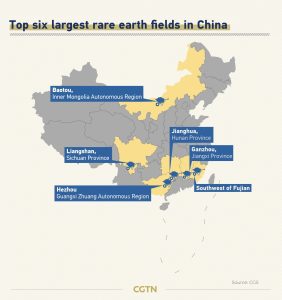
China’s dominance did not emerge accidentally. It reflects three decades of deliberate industrial policy, executed with more patience than any Western government was willing to muster. In the 1990s and 2000s, Beijing combined cheap credit, subsidised energy and permissive environmental regulation with tight administrative control over export quotas and licenses. Extraction was concentrated in a few giant complexes such as Bayan Obo in Inner Mongolia, while separation and refining capacity were progressively consolidated into a small group of state backed firms.
The crucial move came in the mid-stream of the value chain. Separation and refining plants are the most capital intensive and technically complex element of the mine-to-magnet process. One detailed study estimates that they can account for around 80 percent of total capital costs and the majority of operating costs in a rare earth project. Western investors were happy to offload that messiest part of the chain just as environmental standards tightened at home. Mountain Pass in California, once the world’s leading producer, found itself squeezed between regulatory pressure and a flood of low-priced Chinese material. It closed in 2002 after a series of waste spills and never recovered its former commercial edge.
Beijing then began to knit its industrial dominance into strategic leverage. The 2010 halt of certain rare earth exports to Japan, in the context of a maritime dispute, was widely understood as a political signal to Tokyo and Washington. Prices spiked worldwide. A decade later, export rules were rewritten again. New Rare Earth Management Regulations, layered on existing licensing and quota systems, created a legal framework that gives Chinese authorities wide discretion to throttle exports or tighten standards for particular elements or end uses.
The latest round of controls has moved beyond rare earths to adjacent materials such as gallium, germanium and high grade graphite, all of them central to semiconductors, batteries and radar. Restrictions imposed in 2023 and tightened in 2024 forced US and European firms into emergency stockpiling and supplier hunts. Beijing’s subsequent decision in late 2025 to suspend these bans temporarily, as part of a broader trade truce with Washington, only highlighted how deeply these flows have been fused with high politics.
This pattern is the textbook case of weaponised interdependence. China’s leverage does not arise from absolute control. Other producers exist. It arises from network centrality: Beijing sits at the critical junction in a supply chain where substitution is extremely difficult, particularly for heavy rare earths such as dysprosium and terbium, which until recently were processed almost entirely in China.
When and How The Western awakening is happening?
For years Western governments treated this situation as a nuisance rather than a structural risk. The US Department of Defense occasionally funded niche projects. The European Commission issued strategy papers about “critical raw materials”. None of that changed the basic picture: miners extracted ores in Australia or the United States, shipped concentrates to China for separation, and bought back refined oxides or magnets at competitive prices.
Only in the past five years has that complacency begun to crack. Three shocks pushed rare earths up the political agenda. First, the cumulative evidence of Chinese export controls convinced policymakers that reliance on Chinese processing was not merely commercially risky but strategically untenable. Second, Russia’s invasion of Ukraine and the subsequent weaponisation of energy flows made resource security a tangible national security concern, not an abstraction. Third, the green transition created visible forward demand for permanent magnets and other rare earth-intensive technologies, which investors could no longer ignore.
Washington’s response has been the most assertive. It now treats rare earths as part of a broader critical minerals portfolio that also includes lithium, cobalt and nickel. The US Defence Production Act has been used to channel hundreds of millions of dollars into domestic mining and processing projects. The most emblematic initiative is the deepening partnership with MP Materials, owner of Mountain Pass. In mid-2025 the Pentagon committed around 400 million dollars in preferred equity and a ten year price floor for neodymium-praseodymium, tied to a long term offtake arrangement for magnets produced in the United States.
That support underwrites a plan to build a second large magnet facility by 2028 and lift US magnet capacity to roughly ten thousand tonnes per year, which would still be a fraction of global demand but a significant anchor for allied supply chains. At the same time, Apple has signed a 500 million dollar multiyear agreement to source magnets produced at MP’s new Independence plant in Texas, using recycled feedstock from Mountain Pass. The symbolism is obvious: one of the world’s most valuable firms is betting that customers will pay something for magnets that are both domestic and recycled.
Washington is also extending its reach abroad. The US International Development Finance Corporation has begun to act as an outward-facing arm of critical minerals policy, most recently with a 465 million dollar loan to Brazil’s Serra Verde ionic clay project, which aims to become the only significant producer of heavy rare earths from such deposits outside China in the near term. Similar, smaller packages have been assembled for projects in Africa. These moves are not charity. They are designed to diversify away from Chinese supply and build the foundation for future non-Chinese processing networks.
Europe has preferred to approach the problem through regulation and targets. The Critical Raw Materials Act, agreed in 2024, sets quantified goals for 2030: at least ten percent of the bloc’s annual consumption of strategic raw materials should be extracted within the EU, at least forty percent processed there, and a quarter sourced from recycling, with no more than sixty-five percent coming from any single third country. Brussels has also pre-selected around sixty “strategic projects” that will benefit from streamlined permitting and access to public guarantees. The logic is to create bankable projects that private capital can scale up, while maintaining Europe’s environmental standards.
Yet the EU’s approach is constrained by domestic politics. New mines in Sweden or Portugal run headlong into local opposition movements. Refineries that handle radioactive waste face legal and political challenges. The Act cannot suspend these tensions; it can only try to compress approval timelines and pool risk. The result is a race between the urgency of geopolitical diversification and the inertia of European environmental and fiscal politics.
In the Indo-Pacific, the response has been led by middle powers. Japan emerged from the 2010 export episode with a clear understanding that depending on Chinese rare earths was untenable. Tokyo financed Lynas in Australia and backed its processing facility in Malaysia, which remains the largest non-Chinese rare earth refinery in the world. That plant has lately begun to handle heavier rare earths and is now a crucial node in allied supply chains, even as it faces domestic scrutiny in Malaysia over its environmental footprint. Canberra has designated critical minerals as a strategic sector and is courting US, Japanese and Korean investment in new projects.
India, traditionally a marginal player in this sector, is also seeking a role. The state owned miner IREL has opened negotiations with Japanese and South Korean firms over technology transfer for magnet production and is exploring mining opportunities in countries such as Malawi, Myanmar and Argentina. New Delhi’s decision to suspend a long standing rare earth export arrangement with Japan in order to build domestic reserves signals that it, too, sees rare earths as a strategic asset rather than a simple export commodity.
Is the Global South’s new bargaining power Strong enough?
For resource rich developing countries, the rare earth scramble presents both opportunity and danger. Africa and Latin America in particular are now central to the next phase of the contest. Chinese overseas investments in metals and mining reached around nineteen billion dollars in 2023, much of it channelled through Belt and Road Initiative projects in mineral rich states. Beijing is now proposing to formalise some of these relationships in an “international economic and trade co-operation initiative on green minerals”, launched at a recent G20 summit in South Africa with the participation of at least nineteen countries and UNIDO.
The pitch is straightforward. China offers finance, infrastructure and access to its vast processing capacity. In return it secures long term supply arrangements and embeds its firms in the host country’s political economy. Studies of Chinese investment in cobalt in the Democratic Republic of Congo, lithium in Latin America and rare earths in Africa show a consistent pattern: state owned or closely connected firms move early into risky jurisdictions, underwrite infrastructure and gradually accumulate control over upstream assets.
Western actors, late to the game, are now trying to offer alternatives. The DFC loan to Serra Verde is one prominent example, but the pattern is broader: the US, EU, Japan and others are piecing together an informal “coalition of the willing” that links resource states in Africa and Latin America with processing and manufacturing centres in the OECD. Think tank and government reports now routinely talk of “critical minerals partnerships” with countries such as Brazil, Namibia, Zambia or Indonesia.
For host governments, this scramble creates space to exercise agency. The language of “resource diplomacy” is not empty. Malawi or Burundi can now play Chinese, Western and regional investors off against each other. Chile’s efforts to renegotiate the terms of lithium extraction, and Indonesia’s ban on nickel ore exports combined with a drive for domestic processing, are signals that producer states will not simply accept old extractive bargains.
The risk, however, is that competition degenerates into a new form of minerals mercantilism. Without careful governance, high levels of foreign capital in mining and processing can exacerbate corruption, inequality and environmental degradation. Local communities often bear the cost of tailings, water contamination and land grabs, while most of the value is captured in distant refineries and manufacturing plants. Civil society networks focused on scrutinising Chinese projects have begun to organise, and similar efforts are emerging in response to Western backed mining ventures.
If rare earth diversification is to be politically sustainable, it cannot simply reproduce earlier extractive relationships with a different flagship country. Producer states will demand better terms: higher local content, more processing at home, a clearer role for their state owned enterprises and stronger social safeguards. Western governments cannot credibly criticise Chinese investment practices while ignoring these demands in their own partnerships.
Independence, interdependence and the politics of time
In light of these constraints, full “independence” from Chinese rare earths is a mirage. The question is how far and how fast dependence can be reduced, and how much residual vulnerability Western governments are willing to tolerate.
Consider the numbers. Today, estimates suggest that China handles roughly sixty percent of extraction and close to ninety percent of processing of rare earths globally, with an even higher share for heavy rare earths. Even if every announced non-Chinese project were built on schedule, Chinese processors would still likely account for a majority of global capacity in 2030. The EU’s 40 percent processing and 25 percent recycling targets are ambitious. They also assume that member states will accept refineries in their backyards and that capital will flow on a large scale into facilities whose economics remain sensitive to Chinese pricing decisions.
The US timeline is no less demanding. MP Materials’ expanded facilities, Lynas’ planned Texas refinery and a handful of smaller projects could raise US and allied processing capacity significantly by the late 2020s. But building new separation plants typically takes several years from permit to commissioning, and further years to reach stable, cost effective operation. Workforce and technological learning curves are steep. Many of the hardest bottlenecks lie in heavy rare earths, where only a handful of projects outside China, such as Serra Verde, are even close to production.
Recycling and substitution can soften the edge of dependence but not eliminate it. The technology to recover rare earths from end-of-life magnets, wind turbines and electronics is improving. Apple’s deal with MP Materials, which is explicitly built around recycled feedstock, is one of the first commercial scale attempts to integrate circular flows into a major supply chain. Analysts suggest that with sustained investment, recycling could cover perhaps twenty to thirty percent of rare earth demand in advanced economies by the mid-2030s. That would be significant, but the underlying demand for magnets in electric vehicles, grids and data centres is likely to grow faster.
Substitution research is more uncertain. Engineers are developing motors that use fewer rare earths or rely on alternative magnet designs, as well as batteries that reduce the need for specific materials. In civilian sectors, modest performance trade-offs may be acceptable. In defence and aerospace, where weight, temperature tolerance and reliability are critical, full substitution is much harder. Heavy rare earths will remain embedded in key weapons systems for decades.
In practice, therefore, the most plausible 2035 outcome is a world in which China is still the largest single player in the rare earth system but its dominance has been eroded. Instead of a near monopoly on heavy rare earth processing and an overwhelming position in magnet production, Beijing might control something closer to half of global processing and a somewhat smaller share of high end magnet manufacturing. Western and allied producers would supply a significant minority of the market, enough to cover much of their own strategic demand and some share of global consumption. Interdependence would remain, but Beijing’s ability to exert unilateral pressure on US or European industries would be narrower.
The politics of this transition are delicate. On one side, Western industries fear that aggressive diversification will raise costs for their products, undermining competitiveness just as they are asked to race Chinese firms in electric vehicles, batteries and grid equipment. On the other side, security establishments argue that the price of resilience is worth paying, particularly when the alternative is exposure to abrupt export suspensions scripted in Beijing. The outcome will depend on how credibly governments can signal long term commitment to their industrial policies. If firms suspect that subsidies or price floors will evaporate after one electoral cycle, they will hesitate to invest in large scale separation and magnet projects.
Time cuts in another direction as well. Beijing is not standing still. Its new alliance proposal on green minerals, its record overseas mining investments and its ongoing consolidation of domestic processing indicate that Chinese leaders plan to keep their country at the centre of the critical minerals map even as others diversify. The rare earth contest is therefore not a one-off “decoupling” exercise. It is a rolling competition in capacity building, technology and coalition management.
What are the Strategic choices for the West?
If independence is an illusion, what should Western governments aim for? Three priorities stand out.
First, they need to treat rare earths as part of a broader geoeconomic portfolio rather than a standalone issue. The same firms and countries that process rare earths are often involved in other critical minerals. China’s export controls already blur the boundaries between those categories. Western industrial strategies should do the same, integrating policies across semiconductors, batteries, magnets and grid equipment. That implies closer coordination between trade ministries, defence departments, climate agencies and development finance institutions, rather than the fragmented approaches that prevailed in the 2010s.
Second, they must recalibrate their approach to producer states. The old model in which Western firms arrived with capital and technology, extracted ores and shipped them home cannot carry the political weight now placed on critical minerals. Governments from Brasília to Jakarta expect a greater share of value added at home, stronger community protections and credible climate commitments. Western policymakers routinely criticise China for locking developing countries into unequal deals under the Belt and Road Initiative, yet they risk replicating elements of that pattern if they use their own financing tools purely to secure preferential offtake.
That means accepting that some processing will be located in the Global South, even when that complicates industrial planning at home. It also means working with multilateral institutions to raise governance standards for mining and refining, not just to crowd Chinese firms out. Proposals for a global framework on critical minerals, such as ideas for a minerals treaty or a collective stockpile mechanism, will remain aspirational unless they are backed by serious political capital.
Third, Western states must confront their own domestic political constraints. It is not credible to demand that African or Latin American communities live next to tailings ponds and acid leach facilities while voters in Europe or North America mobilise successfully against local projects. Without some willingness to host extraction and processing at home, talk of “de-risking” will ring hollow. The EU’s Critical Raw Materials Act is a step in the right direction, but its targets will remain aspirational if member states continue to block projects on their own territory.
There is a political opportunity here. Well regulated, transparently managed rare earth projects can be framed not only as national security assets but also as contributors to local economic revival and climate policy. The symbolism of recycled magnets in American made iPhones is not trivial. It offers voters a tangible link between green technology, supply chain resilience and domestic employment.
Managing rivalry rather than abolishing it?
The most dangerous outcome in the rare earth contest is not Chinese dominance per se. It is a world where both sides treat minerals policy as a zero sum instrument of coercion, repeatedly threatening or deploying export controls without guardrails. A cycle of tit-for-tat restrictions could amplify mistrust, fuel domestic nationalist narratives and spill over into other sectors. The recent decision by Beijing to suspend some export bans as part of a broader trade truce with Washington underlines how easily these levers can be tied to unrelated negotiations.
Avoiding that trap requires two parallel tracks. On one track, Western governments must press ahead with diversification, public-private partnerships and technological innovation to narrow China’s margin of coercive leverage. On the other track, they should quietly explore whether elements of restraint can be introduced into the competition, perhaps through informal understandings not to target supply for emergency hospital equipment, grid stability or other clearly humanitarian uses, and through dialogue at the WTO and other fora over transparency in export licensing.
Such arrangements will not eliminate rivalry. They might, however, reduce the odds that a crisis over Taiwan or the South China Sea spirals into a full commodity embargo that shatters the global green transition. Critical minerals sit at the heart of that transition. Both China and the West need them to meet their climate goals. That shared vulnerability could, in principle, become a source of mutual restraint rather than a one sided weapon.
For now, the balance of power in rare earths remains tilted toward Beijing, but no longer unchallenged. Lynas’s refineries in Malaysia and prospective plants in Texas, MP Materials’ new magnet factories in the United States, the EU’s nascent processing projects and a patchwork of mines from Brazil to Burundi are the early architecture of a more plural system.
Whether that architecture evolves into a stable, resilient network or fragments into rival spheres of influence will turn on choices made in the next decade. If Western governments treat “breaking China’s monopoly” as a slogan and neglect the deep work of building institutions, funding research and sharing risks with partners, they will fail. If they approach rare earths as one strand in a wider project of managing strategic interdependence with a powerful rival, they may not achieve independence, but they can achieve something more realistic and more important: the ability to say no when Beijing tries to squeeze.