The next industrial revolution is being negotiated in budgets, trade disputes, and security strategies, not only in factory control rooms. The labels “Industry 4.0” and “Industry 5.0” sound like neutral technical milestones. In practice they describe rival political projects for how advanced economies will automate work, decarbonize production, and compete with China while holding together fragile social contracts.
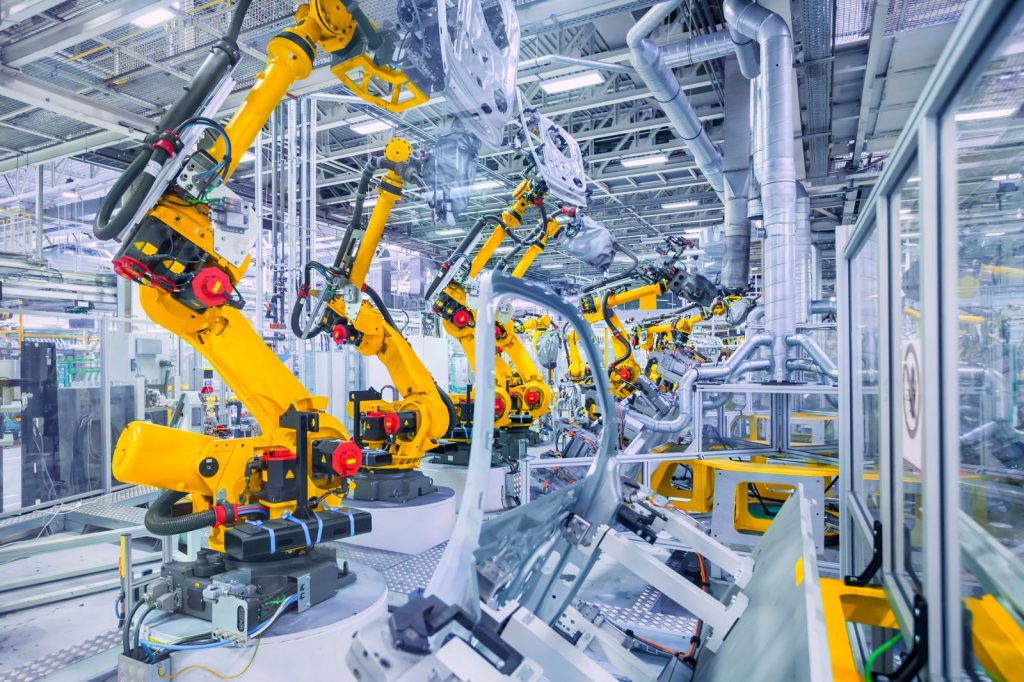
Industry 4.0 began as a German strategy in 2011 to protect high value manufacturing through digitalisation. It has since spread across advanced and emerging economies through policies that fund cyber and physical systems, industrial internet of things, robotics, and cloud-based factory management. A decade on, the results are visible in numbers that have geopolitical weight. Global annual installations of industrial robots have more than doubled in ten years. In 2024 alone factories installed over half a million new robots, with an operational stock of more than four million. China accounts for most of that growth. Its plants installed around 295,000 industrial robots in 2024, roughly as many as the rest of the world combined, and Chinese manufacturers now hold the majority of their home market.
Industry 5.0 arrives in this context. It is not an entirely new technological stack. It is an attempt, led above all by the European Union, to redirect the digital transformation of production toward three additional goals: human well-being, environmental limits, and resilience in an era of geopolitical shocks. The European Commission’s 2021 report on Industry 5.0 frames it as a complement to Industry 4.0 that should move industrial policy away from a narrow focus on shareholder returns and toward a broader conception of stakeholder value. Consultants and market forecasters have translated that vision into numbers. One widely cited estimate puts the global Industry 5.0 market at around 65 to 70 billion dollars in 2024 and projects it to reach roughly 250 to 330 billion dollars by the end of the decade.
These figures suggest that the fifth industrial transformation is no longer speculative. The question now is who will shape its rules, and what that will mean for the distribution of power between states, firms, and workers.
Industry 4.0 was built around a clear technical logic. Factories would become dense networks of connected machines and sensors. Data streams from those networks would feed digital twins and advanced analytics. Decisions about scheduling, maintenance, and quality control would be delegated to software where possible. The outcome would be shorter lead times, reduced downtime, and a tighter integration into global supply chains.
That model was politically attractive in the early 2010s. It offered export-oriented economies such as Germany, Japan, and Korea a way to defend manufacturing against lower wage competitors by substituting capital and code for labour. It also fit the assumptions of a period when energy was cheap, global trade was expanding, and the political risks of deeper cross-border supply chains still looked manageable.
Three shocks broke that confidence. The global financial crisis triggered a decade of social and political turbulence in many advanced democracies. The COVID-19 pandemic exposed the fragility of lean, hyper-extended supply chains. Russia’s full-scale invasion of Ukraine then added an energy shock and a security crisis to the mix. Each episode revealed how strongly industrial capacity is entangled with state power. Hospitals without masks or ventilators, armies without ammunition, and grids without transformers are not abstract risks.
In that environment, the unadorned optimisation logic of Industry 4.0 looks politically insufficient. It promises productivity but says nothing about how that productivity will be shared, how it will fit within climate constraints, or how it will reduce dependence on rival powers. Industry 5.0 is an attempt to retrofit answers to those questions onto the digital factory.
The European Commission gives that effort its clearest expression. It describes Industry 5.0 as human-centric, sustainable, and resilient. The phrase “human-centric” signals a reversal of the old assumption that workers must adapt to technologies. In the Commission’s framing, technologies should be deployed in ways that expand workers’ capabilities and autonomy, improve safety, and support meaningful work. “Sustainable” means aligning industrial activity with the European Green Deal, from climate neutrality targets to circular economy measures that reduce material throughput. “Resilient” points to the ability of industrial systems to withstand and recover from shocks in supply chains, energy, and finance.
Taken seriously, this is more than a branding exercise. It implies that industrial policy must take on tasks that used to be treated as externalities: the quality of work, the stability of regional economies, and the compatibility of production with ecological limits.
Three models of the fifth revolution
The same technologies sit at the core of every serious Industry 5.0 strategy. They include industrial sensors, AI-enhanced control systems, collaborative robots, augmented reality tools for maintenance and training, digital twins, and advanced materials. What differs are the political choices about who pays, who decides, and who gains. Three models are emerging.
The first is the European model, which is the most explicit in its normative aims. Brussels treats Industry 5.0 as part of a larger project that blends climate policy, social rights, and strategic autonomy. The Industry 5.0 framework sits alongside the Green Deal Industrial Plan, the Net-Zero Industry Act, and initiatives on skills and just transition. Policy instruments combine regulation with targeted subsidies and tax credits.
Italy’s Transition 5.0 plan illustrates this approach in detail. The program, part of the revised National Recovery and Resilience Plan and RePowerEU package, provides tax credits for investments made in 2024 and 2025 in digital and energy-efficient equipment. To qualify, firms must show that the investment yields at least a three percent reduction in overall energy consumption at the plant level or five percent at the level of the process concerned. The eligible assets are recognisably Industry 4.0: interconnected machinery, software for process control, digital twins. The policy goal, however, has shifted. Digitalisation is treated as a means to cut energy use, reduce emissions, and stabilise firms against future price shocks. Large financial institutions, such as Intesa Sanpaolo, then layer their own credit lines and advisory services on top, steering clients toward CleanTech and ClimaTech investments and using open innovation programs to match smaller manufacturers with startups and research centres.
The second model is the American variant. Washington has not adopted the Industry 5.0 label, but the combination of the Inflation Reduction Act, the CHIPS and Science Act, and the infrastructure law amounts to a massive industrial policy bundle. These acts mobilise hundreds of billions of dollars in tax credits, loans, and grants for semiconductors, clean energy, electric vehicles, and grid components. Conditionality is lighter than in the European case. Domestic content and wage rules exist, and some programs tie support to emissions performance, but there is less emphasis on explicit human-centric norms and circularity, and more on restoring manufacturing capacity and strategic leverage.
Recent developments highlight the fragility of this model. Policy shifts under the new administration and in Congress, including efforts to pare back certain clean energy credits and tighten restrictions on foreign supply chains, have led firms to delay or cancel projects in sectors such as batteries and electric vehicles. The underlying lesson is that fiscal reliance on tax expenditures can produce fast investment surges, but it also leaves industrial transformation exposed to partisan swings.
The third model is China’s state-capitalist approach. It predates Industry 5.0 and continues under different labels, from Made in China 2025 to successive plans for intelligent manufacturing and digital economy development. Chinese authorities use subsidised finance, public procurement, and local industrial policy to accelerate the adoption of robotics and AI systems and to nurture domestic suppliers. The results are visible. China now accounts for more than half of all new industrial robot installations and holds an operational stock of over two million robots, supported by a domestic market share for Chinese robot makers that has risen from roughly one quarter to more than half in a decade.
China’s strategy is not centred on human-centric rhetoric. Official narratives present automation as a response to labour shortages and as a way to keep labour-intensive exports competitive despite rising wages. Some policy documents emphasise the creation of new “purple collar” technical jobs in programming, maintenance, and integration of robots, but the dominant logic is to maintain export growth and upgrade the technological content of production. Environmental objectives are present, yet they are consistently balanced against growth and trade performance.
For the rest of the world these three models create a landscape of incentives and constraints. Smaller industrialised states and emerging economies can try to align with one of them, mix elements, or carve out a niche. None of these choices are technocratic. Each involves decisions about social protection, regulation, and security.
Labour politics in the age of cobots
Industry 5.0 places human-machine collaboration at its centre. That phrase can mean several different things.
At the granular level it refers to collaborative robots, augmented reality tools, and AI-driven decision support systems that operate alongside workers instead of replacing them entirely. In some assembly plants, cobots handle repetitive or ergonomically risky tasks while workers carry out fine adjustments and quality checks. In maintenance, technicians use augmented reality glasses that overlay digital instructions on physical equipment and connect them to remote experts.
At the organisational level, human-machine collaboration shows up in algorithmic management. Software allocates tasks, monitors throughput, and predicts when components will fail. Predictive maintenance and just-in-time supply systems already form part of Industry 4.0 portfolios. Under Industry 5.0 those tools are advertised as supporting workers by removing drudgery and reducing surprises. Firms claim that AI can handle planning and diagnostics, freeing humans to focus on design, improvement, and interaction with customers.
The reality is more contested. Algorithmic control can just as easily intensify work, reduce autonomy, and blur the line between support and surveillance. The same data that allows early detection of machine failure also allows supervisors to track individual performance at a granular level. Without guardrails, the human-centric promise of Industry 5.0 collapses into a new form of Taylorism, driven by software.
This tension has direct foreign policy implications. Advanced democracies present their models of industrial transformation as an alternative to authoritarian digital capitalism. That claim will ring hollow if workers experience the fifth industrial transformation mainly as a loss of control and an erosion of bargaining power. The European debate on Industry 5.0 has therefore started to intersect with questions about algorithmic accountability and AI regulation more broadly. The EU’s Artificial Intelligence Act, although not tailored to factories, sets limits on high-risk AI systems and requires transparency and human oversight in key decisions. National governments and social partners are beginning to explore how those principles might apply to industrial settings.
Labour market structure matters as well. Regions with strong vocational training systems and dense intermediate institutions are better placed to turn automation into higher quality jobs. Germany’s experience with co-determination in manufacturing and its entrenched apprenticeship system have given it more instruments to manage technology adoption than countries where industrial relations are fragmented. Italy’s emerging Industry 5.0 policies will test whether similar approaches can be scaled in a more heterogeneous business landscape dominated by small and medium enterprises.
Here strategic competition intrudes again. If China can combine rapid automation with a large pool of relatively low cost technicians, and if the United States can attract capital with generous tax breaks, European and other mid-sized economies can only remain attractive locations for advanced manufacturing if they offer a distinctive social compact: safe conditions, meaningful roles, and credible paths for workers to benefit from productivity gains. That is not sentimental. It is a foreign economic policy that treats social cohesion as a competitive asset.
Green factories and fractured trade
The environmental dimension of Industry 5.0 is not a decorative addition. It is one of the main reasons the concept has taken root in Brussels. The EU has set a legally binding target of climate neutrality by 2050 and an intermediate target of at least 55 percent emissions reduction by 2030. Meeting those goals requires deep changes in industrial energy use, materials, and logistics. Manufacturing is responsible for a large share of final energy demand and industrial emissions in Europe, especially in sectors such as steel, cement, chemicals, and machinery.
Industry 5.0 is the industrial branch of that climate strategy. Circular economy practices, waste minimisation, reuse, and recycling all depend on data-rich production systems and traceable supply chains. Digital twins and life-cycle analysis tools rely on the same sensors and data platforms as predictive maintenance. The skills and institutions that Industry 4.0 assembled for efficiency can thus be repurposed for environmental targets.
Trade policy is moving in parallel. The EU’s Carbon Border Adjustment Mechanism will gradually impose a carbon price on imports of selected carbon-intensive goods, tied to the emissions embedded in those goods. If fully implemented, CBAM will pressure exporting countries to decarbonise their industries or risk losing competitiveness in the European market. In effect it links access to trade with the greening of industrial processes, making climate policy a condition for participating in advanced manufacturing value chains.
Other advanced economies are considering similar moves, whether through carbon tariffs, clean procurement rules, or differential treatment in trade agreements. These measures signal that the industrial norms associated with Industry 5.0 will shape the trade regime. Factories that cannot document their emissions and resource use will find it harder to sell into rich markets.
Emerging economies view these developments ambivalently. For middle-income states seeking to build their own manufacturing bases, Industry 5.0 technologies can in principle offer shortcuts to cleaner, more efficient production. At the same time, new environmental and data standards can look like disguised protectionism. They raise the cost of exporting and may lock latecomers into subordinate roles if they cannot access key technologies on fair terms.
Whether Industry 5.0 becomes a tool of inclusion or exclusion will depend on how advanced economies handle technology transfer, climate finance, and trade rules. A cooperative approach would pair CBAM-style pressures with concessional finance for industrial decarbonisation and with open technology platforms that allow local adaptation. A confrontational approach would rely on unilateral measures and defensive alliances, fragmenting the trading system into rival techno-industrial blocs.
Automation, security, and the China question
The distribution of industrial robots gives a concrete measure of the security stakes. According to the International Federation of Robotics, global installations reached around 542,000 units in 2024. China accounts for more than half, with roughly 295,000 units installed that year and an operational stock exceeding two million. Recent analysis suggests that Chinese factories now install nearly ten times as many robots annually as US factories. Chinese robot makers have steadily increased their domestic market share, overtaking foreign suppliers in their own market for the first time.
This shift is part of a broader strategy. Beijing has used cheap credit and targeted subsidies to move investment away from overheated real estate into manufacturing, particularly in export-oriented sectors. The result has been a surge in Chinese exports of manufactured goods, including “mid-tech” products such as machinery, electric vehicles, and components where automation compensates for rising wages.
For other states the security implications run in two directions. On one side, China’s automation drive strengthens its capacity to sustain military production and economic coercion. On the other, it threatens to hollow out industries in countries that cannot match Chinese productivity or shelter their markets behind tariffs and non-tariff barriers. The recent escalation of tariffs on Chinese goods by the United States, including hikes in duties on electric vehicles and batteries, reflects that anxiety.
Industry 5.0 enters this picture as both a defence and a counter-strategy. By tying industrial support to energy efficiency, emissions reductions, and human-centric design, European policies attempt to make reshoring and friend-shoring attractive without sliding into pure protectionism. The idea is that factories located in allied or domestic territories can trade lower geopolitical risk and access to stable regulation for somewhat higher labour and energy costs, provided that they have superior productivity and quality derived from advanced automation.
That balance will be hard to sustain. If Chinese firms keep driving down the cost of robots and industrial AI, and if their domestic market scale allows them to amortise R&D faster than Western rivals, then the technological core of Industry 5.0 may itself become dependent on Chinese hardware and software. In that scenario, attempts to reduce reliance on Chinese EVs or solar panels could simply shift the dependence to Chinese robot arms and AI chips embedded in “smart” factories.
Avoiding that outcome will require more than slogans about sovereignty. It demands investment along the full stack: sensors, actuators, industrial communication standards, chips, AI models, and the cloud infrastructure that ties them together. The CHIPS Act in the United States and various European semiconductor initiatives are first steps in that direction. Whether they will be enough to reverse a decade of under-investment remains unclear.
Governing the fifth industrial revolution
If Industry 5.0 is to deliver on its promise rather than deepen existing vulnerabilities, advanced democracies will have to solve at least four governance problems.
First, they need credible standards for human-machine interaction at work. These standards should address not only safety but also autonomy, privacy, and accountability. If AI systems allocate tasks, evaluate performance, and recommend disciplinary action, workers must have ways to challenge decisions and to understand the criteria behind them. Applying the logic of the EU’s AI Act to industrial contexts is one route. Collective agreements that regulate data use and algorithmic management are another.
Second, they need a stronger regulatory grip on industrial data. The same data platforms that optimise factories can be used to map entire supply chains and to track the behaviour of firms and workers. Governments will be tempted to demand access for purposes ranging from crisis management to export control enforcement. Firms will seek to monetise data across borders. Without clear rules about ownership, access, and localisation, industrial data could become a new arena for conflict between privacy, security, and competition policy.
Third, they need to align financial regulation with industrial goals. The scale of investment required for Industry 5.0, especially when tied to decarbonisation, cannot be borne by public budgets alone. It requires significant private capital, which in turn depends on regulatory signals. Green taxonomy frameworks, disclosure rules, and prudential treatment of climate-related risks can all steer capital toward or away from Industry 5.0 projects. The risk is that such frameworks become so complex or restrictive that they slow investment rather than accelerating it.
Fourth, they need international arrangements that prevent the fifth industrial revolution from collapsing into a zero-sum race. The rivalry between the United States and China sets the tone, but most states have no interest in choosing between incompatible technical standards or closing their markets. Forums such as the G7, the Trade and Technology Council between the EU and the US, and the OECD can play roles in coordinating norms on AI safety, data governance, and green trade measures. Whether they will move fast enough is another question.
Strategic outlook
Looking ahead to the mid-2030s, three broad trajectories for Industry 5.0 can be sketched.
In the first, convergence dominates. Advanced economies gradually align standards around human-centric AI, industrial data, and climate-linked trade. Subsidy races continue but are tempered by disciplines to avoid beggar-thy-neighbour outcomes. Emerging economies plug into these frameworks, using concessional finance and technology partnerships to adopt Industry 5.0 practices that fit their circumstances. China remains competitive but adapts enough to retain access to key markets. Under this scenario Industry 5.0 becomes a shared, if contested, global project.
In the second, fragmentation deepens. The United States and its allies tighten controls on technology exports and investment into China, which responds by doubling down on indigenous development and by building parallel standards with willing partners. Trade splits into blocs that use their own industrial cloud platforms, data regimes, and AI architectures. Industry 5.0 in this world is a label applied to incompatible systems, and firms must duplicate investments to serve different markets. Costs rise and late industrialisers struggle to find room in the new order.
In the third, drift prevails. Political cycles, fiscal constraints, and social resistance slow the implementation of Industry 5.0 in democracies. Robots and AI spread, but without the accompanying investments in skills, social protection, and green infrastructure. China continues to scale automation. The gap between ambitious narratives of human-centric industry and the lived reality in many factories widens. Public support erodes and industrial policy becomes another field for short-term clientelism.
None of these paths is predetermined. They will be shaped by choices that foreign and economic policymakers make over the next few years.
For governments that want to retain agency, three priorities stand out.
They must treat Industry 5.0 as a whole-of-state project, not a niche for technology ministries. Finance, labour, climate, security, and foreign affairs portfolios all have stakes in how factories are automated and where value chains run.
They must link industrial support firmly to measurable outcomes in emissions, energy use, and work quality, while keeping rules simple enough for firms without large compliance departments. Italy’s Transition 5.0 is an early attempt at such conditionality. Its success or failure will offer lessons for others.
And they must be honest about the distributional effects. Industry 5.0 will not automatically generate good jobs or stable regions. It can amplify inequalities just as easily as it can reduce them. The promise of a human-centric industrial future will only be credible if citizens see tangible improvements in security, opportunity, and the environment rather than only new slogans.
The passage from Industry 4.0 to Industry 5.0 is often presented as a smooth technological evolution. In reality it is one of the main arenas in which the contest over the next international order is being fought. How states choose to organise work, emissions, and machines inside their factories will shape their leverage outside them.