
The gradual rearrangement of American grand strategy has finally taken form, and it is now possible to see how decisively the United States has repositioned its hierarchy of interests. The shift did not unfold through a single dramatic announcement. It accumulated over time through changes in domestic political expectations, through the pressures of competition with China, through the rise of hemispheric security concerns, and through a visible fatigue with the long maintenance of Europe as the principal arena of American statecraft. The new US National Security Strategy reflects these pressures and binds them into a new conceptual order. What emerges is not isolationism but a narrowing of focus, a redefinition of where American power is essential and where it is discretionary. In this new configuration, Europe occupies the lowest rung among the major regions of American interest, trailing the Western Hemisphere, the Indo Pacific, and the Middle East.
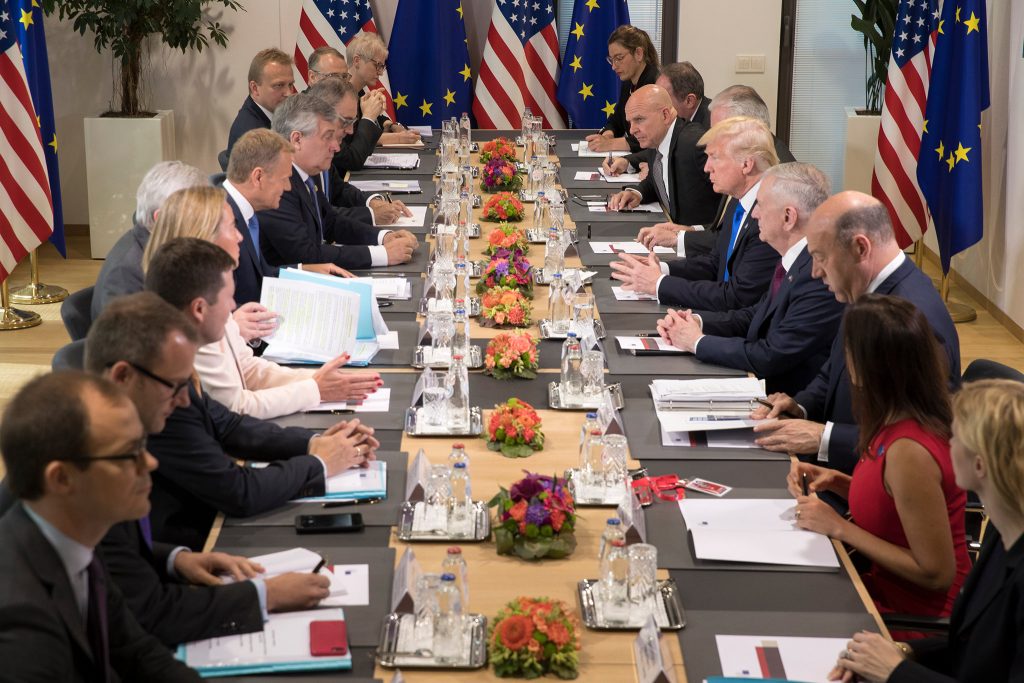
Several years ago, it would have seemed unlikely that Europe could fall so far in the American strategic imagination. Yet the conditions for this change were present long before the current moment. The generation for whom the Atlantic alliance was an emotional and ideological anchor is now leaving public life, and younger cohorts inside the United States do not see the continent as a necessary extension of American identity. Their understanding of national security is shaped more by border pressures, domestic instability, economic dislocation, and the perception that the most consequential international challenges originate either in China or in the Western Hemisphere. The Cold War narrative that once linked American security to the European balance of power has dissolved, replaced by the belief that geographical distance and nuclear deterrence reduce the risks that once justified heavy US engagement.
This drift gained momentum when American policymakers began reconsidering the distribution of resources required for long term competition with China. The assumption that the United States could maintain primary commitments in Europe while simultaneously countering Beijing in the Indo Pacific has quietly been replaced by a recognition that resources cannot stretch indefinitely. The Western Hemisphere was then folded into this reassessment as a zone where non state actors, criminal economies, and external adversaries such as China could exploit governance weaknesses in ways that undermine the stability of the United States from within. Once the hemisphere was elevated to a central strategic concern, Europe inevitably lost status. The American belief that a secure and prosperous future begins at home has been sharpened into a doctrine that privileges territorial integrity, industrial renewal, and economic leverage as the foundations of national power.
The new strategic hierarchy becomes clearer when examining the way Washington now views the Indo Pacific. The principal concern there is no longer ideological but structural. The contest with China is defined as a race for technological ascendancy, industrial depth, and supply chain influence. It is a field in which Europe has limited strategic value, since European governments cannot deliver meaningful defense capabilities in the region and remain divided in their approach to Beijing. American policymakers no longer see Europe as a force multiplier in Asia but as a region whose commercial interests often diverge from those of the United States. Cooperation is still possible, but it is not regarded as essential.
A similar pattern appears in the Middle East. The United States has chosen not to withdraw from the region, but its engagement has become highly instrumental. The focus lies on crisis containment, energy stability, and calibrated intervention to prevent local conflicts from undermining global markets. The region is approached with a pragmatic understanding that local political orders will persist regardless of American preferences. Europe has little operational influence in this environment, and Washington sees no strategic advantage in coordinating closely with it. The Middle East retains priority because of the potential for sudden disruption, not because it strengthens the Atlantic partnership.
Europe’s fall in this hierarchy has been accelerated by something more profound than resource competition. A growing ideological gap separates American political currents from the European mainstream. The American debate has become entangled with cultural anxieties, migration politics, and quarrels over national identity. These themes infuse parts of US foreign policy with suspicion toward European institutions and skepticism about their political and cultural direction. As a result, Europe is no longer viewed as a stable companion with shared assumptions about order. Instead, it appears to many in Washington as a region preoccupied with internal disputes, hesitant about power, and unable to act with strategic clarity. This shift in perception matters because grand strategy is not only an assessment of external threats but also a judgment about which partners enhance or dilute national purpose.
The consequences for European security are significant and immediate. Washington no longer regards the war in Ukraine as a core American interest. Statements that the ocean shields the United States from European conflict reveal how far the conceptual ground has moved away from the logic that shaped American policy after 1945. Earlier administrations believed that security in Europe was inseparable from global stability. The new strategic outlook approaches the conflict as a regional issue that becomes consequential only if it escalates into a direct confrontation between nuclear powers. Meanwhile, the oscillations in American support for Ukraine, including attempts at negotiated settlements that concede substantial ground to Russia, demonstrate that Washington does not consider the war decisive for its long term strategic posture.
For Europe, the Ukraine war is the axis upon which the continent’s future turns. But that conviction is no longer shared across the Atlantic. Europe now faces the possibility that the United States may scale back its role not only in military aid but in the broader political and diplomatic architecture that has so far shaped the Western response. If this trajectory continues, the credibility of extended deterrence will erode, and the burden of protecting the European security order will fall overwhelmingly on European capitals.
The deeper implication is that American strategic thinking has revived the logic of spheres of influence. The Western Hemisphere is treated as a zone where outside powers must be curtailed, while the Indo Pacific is recognized as the primary theater of global competition. In this framework, parts of Eastern Europe are implicitly regarded as peripheral to essential US interests. Washington does not explicitly consent to Russian dominance in the region, yet it is increasingly clear that the United States does not view the defense of eastern European territory as vital in the way earlier generations did. Europe must now confront the fact that the assumptions underpinning its security architecture for three decades are dissolving.
The path ahead requires Europe to reimagine its own strategic identity. It must assume responsibility for defending its territory, sustaining Ukraine, and managing the balance of power on the continent. That requires a transformation in funding, procurement, planning, and political cohesion. Military spending must increase, but more importantly, Europe must overcome its fragmented industrial ecosystem. Without integrated production, common procurement rules, unified export controls, and a rationalized market for defense goods, financial outlays will not translate into credible capabilities. The future of European security also requires the development of operational concepts designed for an environment in which the United States plays a supporting, rather than leading, role in NATO. This does not imply the end of the alliance, but rather a shift in its internal structure, with Europe gradually assuming responsibility for conventional defense while relying on the United States primarily for nuclear deterrence and intelligence support.
The next decade may thus become the most consequential period in the history of the European project since the end of the Cold War. The choices made now will determine whether Europe becomes a coherent strategic actor or remains a collection of states dependent on external guarantees that may no longer be reliable. The American reordering does not preclude cooperation, and it does not foreclose transatlantic partnership. But it signals clearly that the era in which Europe could rely on the United States as the unquestioned anchor of its security has ended. Washington has not abandoned global leadership, but it has reshaped its priorities in ways that leave Europe exposed. The United States is concentrating on the tasks it considers essential for preserving its own power: protecting its hemisphere, securing technological dominance, and shaping the balance in Asia. Everything else is treated as negotiable.
Europe must therefore shift from a mindset of entitlement to one of responsibility. It must assume the burdens that the new geopolitical environment requires. If it does so, the transatlantic relationship may eventually find a more balanced footing, grounded not in nostalgia but in mutual capability. If it does not, Europe risks becoming a marginal actor in a world defined by continental scale, technological rivalry, and assertive powers that do not share its assumptions about order. The reconfiguration of American strategy marks a turning point. It is now up to Europe to decide what follows.