There is no part of the global economy as sensitive to environmental stress as food. Yet for most of the twentieth century, this fragility was eased by the belief that technological innovation, expanding trade, and the general predictability of climate patterns would ensure that food shortages would remain localised rather than systemic. That assumption collapses in a warming world. Climate volatility now intersects with a global food system whose defining traits are concentration, interconnectedness, and inequality. The result is not a crisis that erupts in a single place, but a slow rearrangement of the strategic conditions under which food is produced, distributed, and accessed.
The pressures shaping this rearrangement are rooted in physical change. Shifts in rainfall, heat stress, soil degradation, water scarcity, and more frequent extreme events are altering the agronomic map at a speed for which most societies are not institutionally prepared. What begins as a matter of crop resilience quickly becomes a complex problem for social welfare, governance, logistics, and markets. It also becomes a geopolitical matter because the capacity to withstand food system disruptions is increasingly uneven. Some states have buffers through technology, capital, and diversified imports. Many others face direct exposure where a single failed season can cascade into political instability.
Food security therefore cannot be described anymore as a technocratic challenge that sits within ministries of agriculture. It has re-emerged as a strategic condition that shapes the political economy of entire regions. The interaction between climate and food does not produce a uniform set of outcomes. It creates a differentiated terrain of winners, strugglers, and states caught in permanent volatility. Understanding this terrain requires examining how climate pressure reshapes agricultural productivity, how global market integration amplifies shocks, and how political systems respond or fail to respond under stress.
The present moment reveals something deeper than rising temperatures. It shows that the governance models used to manage food supplies assume a stability that no longer exists. If the twentieth century offered the illusion of control, the twenty-first is forcing governments and societies into improvisation. The question is not whether food systems can adapt, but whether their adaptation will reinforce existing inequalities or produce a more resilient form of global interdependence.
To grasp this emerging landscape, one must begin with the basic reality that climate change is not an environmental anomaly but a structural force. It is reorganising agricultural calendars, changing the biological behaviour of pests and pathogens, and producing weather patterns that elude historical analogies. The shift is gradual but relentless. Temperature averages climb, but more important are the deviations. Heatwaves that once occurred once a century now recur every decade. Rainfall becomes less predictable, swinging between drought and inundation. Shorelines shift in ways that threaten some of the planet’s most productive river deltas. These changes unsettle not only farmers but entire political systems built on the assumption that food supply is predictable enough to remain a background concern.
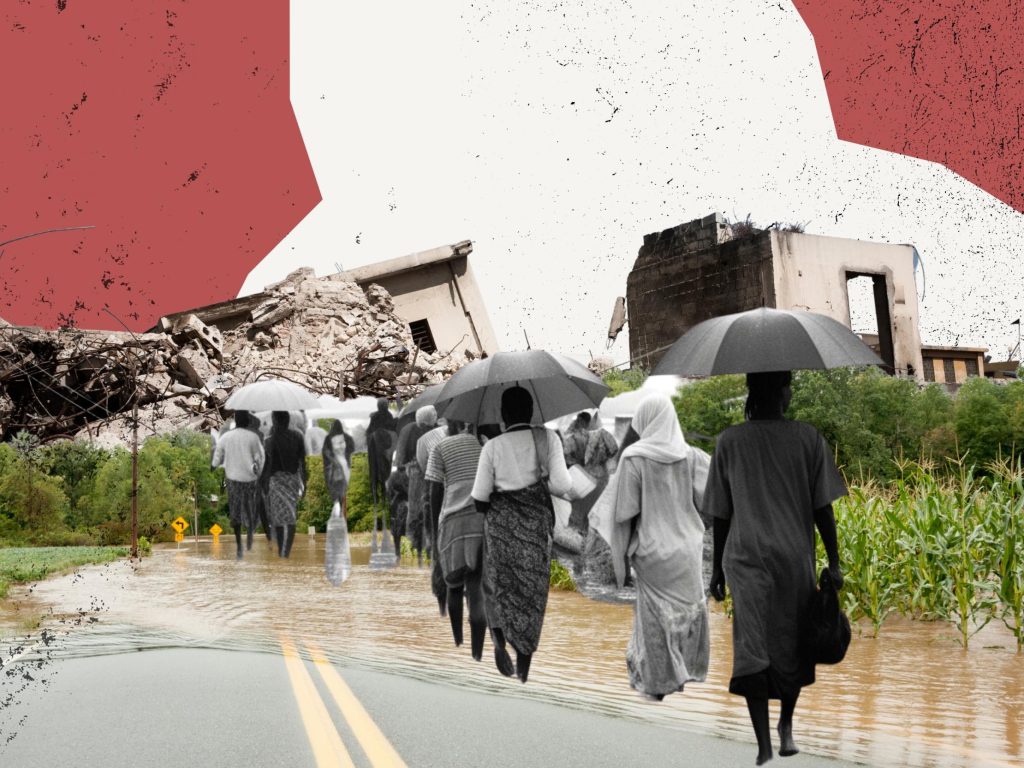
The consequence is visible across regions. Southern Africa experiences a pattern where droughts break into sudden floods, each undermining fragile rural economies. The Indo-Gangetic Plain sees a quieter but no less dangerous form of stress through groundwater depletion and rising temperatures that erode yields even in normal rainfall years. The Arctic faces a different disruption, where the thawing landscape destabilises the traditional food systems of Indigenous communities. Latin America confronts weather patterns that destabilise both tropical and temperate agriculture. The picture is varied but unified by one principle. Climate stress multiplies vulnerabilities, and these vulnerabilities are shaped by political and economic structures.
The recent surge in climate-induced shocks reveals how quickly environmental stress transforms into political stress. A failed harvest in one region can push global grain prices upward within days. When several regions experience concurrent climate shocks, as has happened in recent years, price volatility becomes unavoidable. Import-dependent nations face immediate pressure, and governments often respond with trade restrictions that further constrict global supply. The more prices rise, the more governments intervene, and the more the global system tightens. This feedback loop is becoming more frequent.
The growing interconnectedness of food systems is often described as a strength. Trade theoretically provides diversity, efficiency, and the smoothing of regional imbalances. Yet in practice, the same interconnectedness amplifies disruptions. The resilience of a domestic food system now depends not only on local production but on the stability of distant producers, shipping routes, and global markets. When environmental shocks occur simultaneously in multiple major producing regions, the international trading system becomes strained. This strain is most acute when exporting states prioritise domestic stability over commercial reliability.
Large producers such as India, Argentina, and Russia have already demonstrated that export controls are now treated as strategic tools rather than emergency exceptions. These restrictions destabilise the food security of import-dependent states across the Middle East, Sub-Saharan Africa, and parts of Southeast Asia. The global food system therefore no longer functions as a neutral marketplace. It behaves like a political theatre where governments balance domestic legitimacy against global responsibility. This tension becomes sharper in moments of climate stress, and climate stress is now a structural condition rather than an episodic event.
The geopolitical implications extend beyond price spikes. Climate pressure rewrites regional power dynamics. Nations that can maintain surplus production will possess leverage over those that cannot. The Gulf states, for example, are hedging through long-term farmland acquisitions in Africa and Asia, as well as large-scale investments in controlled-environment agriculture. China is expanding its food supply diplomacy, building strategic reserves and diversifying sources in ways that reshape trade patterns. The United States, despite its vast agricultural base, faces rising exposure due to water scarcity across key production zones. Europe, which has long relied on stable imports from both Africa and the Black Sea region, is beginning to understand that climate and conflict can intersect in ways that make planning far more uncertain.
This global repositioning is rarely discussed in open strategic terms, yet its implications are profound. Food is becoming an instrument of resilience and influence. States that secure their supplies can extend support to others in need. States that fail to secure their supplies will be forced into reactive politics. The more intense the climate pressure, the more intense these strategic asymmetries become. Food therefore becomes not only a humanitarian concern but a currency of political order.
The internal dynamics of nations facing food stress vary, but a clear pattern emerges. Climate impacts rarely stay confined to the agricultural sector. When harvests fail, rural incomes decline, labour migration intensifies, and tensions rise in cities where already vulnerable populations face rising food costs. Governments often respond with subsidies or emergency imports, but these measures place strain on fiscal systems. Over time the cycle becomes more costly, and political legitimacy erodes. In fragile states this erosion can lead to unrest or governance failure. In stronger states it creates a drag on long-term planning and undermines social cohesion. Food insecurity thus acts as both a symptom and a multiplier of political stress.
What complicates the challenge further is that climate assistance and development financing are not keeping pace with the scale of need. Although international institutions stress the importance of adaptation, their mechanisms remain slow, fragmented, and constrained by donor politics. Many of the most vulnerable states receive inadequate support, and much of the funding that does arrive is tied to narrow project frameworks that do not address systemic fragility. The result is a widening gap between the rhetoric of global solidarity and the reality of climate exposure.
In this context, innovation is often positioned as the main solution. Technological advances in crop genetics, precision agriculture, satellite monitoring, and climate-resilient infrastructure offer real possibilities. These innovations, however, do not distribute themselves automatically. They require political commitment, investment, and institutional capacity. Regions that lack these foundations risk falling behind even further as climate volatility intensifies. Moreover, technological solutions cannot replace the social and economic reforms needed to ensure equitable access to food. Without attention to inequality, innovations risk becoming tools that benefit a narrow segment of society while leaving others behind.
The deeper problem is that current governance frameworks treat food security as a matter of agricultural productivity rather than as an integrated system shaped by social, economic, and geopolitical forces. In many places, food systems are governed by ministries that operate in isolation from those responsible for climate, water, energy, trade, finance, and social protection. This siloed approach is a legacy of an era when climate variability was moderate and global markets were stable. Under present conditions it is insufficient. Climate stress forces interdependence. Governance structures must adapt to this reality.
One sees this mismatch in the way states respond to droughts or floods. Governments often deploy emergency relief or temporary price controls without addressing the structural issues that produce vulnerability. Even when adaptation strategies exist on paper, they are rarely integrated into national planning or rural development policy. Farmers receive information about climate risks but lack access to credit or inputs that would allow them to act on this information. Urban consumers are encouraged to diversify diets but face market conditions shaped by global supply volatility. In this fragmented environment, adaptation becomes a rhetorical ambition rather than a coherent strategy.
To move beyond this cycle, food security must be treated as a strategic domain akin to energy security. This requires a shift in how governments conceptualise risk. Agriculture cannot be treated simply as a sector that produces commodities. It must be understood as part of a social and geopolitical infrastructure that underpins national stability. This shift is beginning in some places where governments build climate-resilient supply chains, invest in regional storage, strengthen early warning systems, and integrate food planning with water and energy policy. But the pace of change remains slow compared to the speed of climate disruption.
The private sector also plays a decisive role in shaping the future of food systems. Multinational agribusiness firms command a significant share of global trade in grains, oilseeds, fertilisers, and livestock feed. These firms possess both the logistical capabilities and the market intelligence to anticipate climate disruptions before governments do. Their strategies influence global food availability and price formation. Yet their incentives do not always align with public welfare. Concentration within global commodity markets means that disruptions can generate substantial profits for firms while imposing severe costs on vulnerable populations. Without regulatory oversight and institutional checks, the global food economy risks drifting toward a system where resilience is available only to those who can afford it.
The issue of power concentration extends beyond private firms. States with the ability to influence maritime routes, control export volumes, or dominate fertiliser markets wield growing leverage over international food security. Russia’s position in global grain and fertiliser markets, for example, has become a central factor in how conflicts affect food availability across the Middle East and Africa. China’s dominance in agricultural supply chains, from inputs to consumption markets, shapes global pricing dynamics. These asymmetries reveal that food security is now deeply entangled with geopolitical strategy. In an age of climate stress, food becomes both a stabiliser and a tool of influence.
At the community level, the impacts are felt in more intimate ways. Climate stress alters household decisions regarding labour, migration, diet, and education. When agricultural livelihoods become unreliable, families may reduce food consumption or shift to foods that are cheaper but less nutritious. The long-term consequences are profound. Nutritional deficits in childhood diminish educational outcomes, reduce physical health, and weaken society’s economic potential. Food insecurity therefore becomes not only a humanitarian issue but a long-term development risk. Nations that fail to address it today will face a diminished labour force tomorrow.
Despite the complexity of the challenge, there are pathways that can build resilience. Some are technological, such as drought-tolerant seeds or water-efficient irrigation. Others are institutional, such as reforms to land governance or social protection systems. Many require changes in political imagination. Resilience is not achieved by reacting to crises but by lowering the structural conditions that generate vulnerability. This requires strengthening local food systems, supporting smallholder farmers, improving rural infrastructure, and ensuring that safety nets reach those who need them most. It also involves rethinking trade policy so that international markets do not collapse under stress.
A more resilient future depends on whether societies can transition from reactive crisis management to anticipatory governance. This shift requires treating data as a strategic resource, enhancing climate modelling, improving supply chain transparency, and recognising the social realities that shape food access. It also requires acknowledging that climate adaptation must be grounded in equity. If adaptation reinforces existing inequalities, it will produce a divided global food system where some regions remain permanently fragile.
The strategic challenge is clear. Climate change exposes the mismatch between the speed of environmental transformation and the slow pace of institutional adaptation. Food systems sit at this fault line. They reveal where societies are flexible and where they are brittle. They show the resilience of some regions and the vulnerability of others. They highlight the degree to which political stability depends on something as elemental as the reliability of rain.
Yet this moment is not merely a story of impending crisis. It is a transition in which choices still matter. Governments can invest in adaptive capacity. Markets can be governed to reduce volatility. Social protection systems can be designed to absorb shocks. Food production can become more sustainable, not only through technology but through practices that preserve soil, water, and ecosystems. Trade can evolve toward partnerships that recognise mutual vulnerability rather than narrow advantage.
Climate change forces a reconsideration of how societies value food. For decades, food was treated as a commodity whose price reflected efficiency, not vulnerability. That era is ending. Food is now a strategic resource whose availability reflects ecological conditions, political decisions, and social inequalities. In this new era, the measure of a resilient nation will be its ability to preserve food stability under conditions that challenge the foundations of its agricultural and economic systems.
The most important question is whether the world will treat food security as a shared responsibility or as a competitive struggle. A cooperative approach would mean coordinated efforts to stabilise markets, support vulnerable producers, and invest in shared adaptation technologies. A competitive approach would mean increasing nationalism in agricultural policy, expanding export restrictions, and deepening global inequality.
The future of food security will depend on which of these paths becomes dominant. Climate change will narrow the margin for error. It will test the capacity of governments, markets, and communities to adapt. But it also opens the possibility of redesigning food systems so that they are fairer, more resilient, and more capable of sustaining a growing population in a warming world.
Food security therefore stands at the intersection of environmental reality and political choice. The world is entering a period in which traditional assumptions about supply, stability, and sovereignty must be reconsidered. The coming decades will determine whether societies are capable of building food systems that withstand a climate that no longer behaves like the past. The decisions taken now will shape not only agricultural yields but the political and economic foundations of the twenty-first century.