
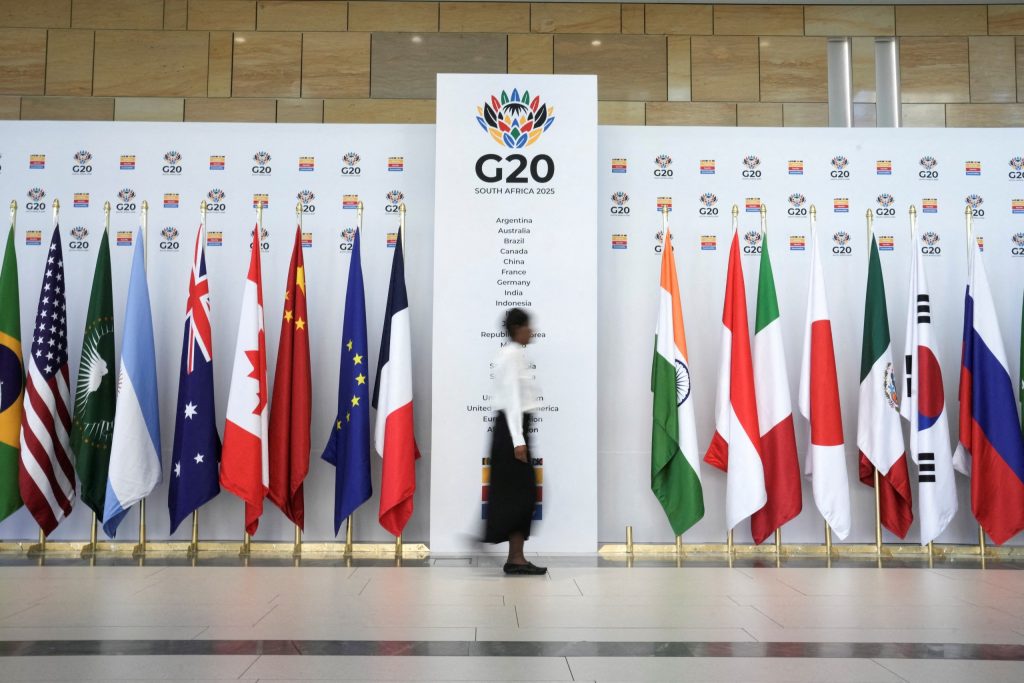
Johannesburg was not just another summit that Washington chose to skip. It was an experiment in rewriting what “global AI governance” means, and who gets to define it. In South Africa’s hands, the G20 agenda treated artificial intelligence as part of a wider development bargain. The leaders’ declaration framed AI, data governance, and digital public infrastructure as building blocks of inclusive growth, not as a niche technical topic. It ties AI explicitly to sustainable development, information integrity, and democratic resilience, and folds it into a broader push on digital public infrastructure and an “AI for Africa” agenda that promises support for compute, skills, and locally anchored AI models.
That language did not appear in a vacuum. It sits on top of a decade of work in the OECD and G7 that tried to pin down what “trustworthy” or “human centered” AI should look like. The OECD principles adopted in 2019 and endorsed by the G20 already spoke about inclusive growth, human rights, and democratic values as guiding ideas for AI systems. The Hiroshima process in the G7 took that further in the direction of safety, transparency, and risk management for advanced models.
Johannesburg modifies the balance. The declaration still repeats familiar words about human oversight and rights, but the centre of gravity moves toward distributional questions: who gets infrastructure, who sits at the table when standards are set, which languages and datasets are treated as legitimate inputs into global AI systems. By connecting AI to debt relief, climate finance, and digital divides across Africa, it embeds AI governance inside development politics rather than treating it as a specialised regulatory field.
The striking feature is not only the content, but who is doing the norm entrepreneurship. Commentators often read global tech governance through a binary lens of “the West versus China.” That is much too narrow for what happened in Johannesburg. India, Brazil, South Africa, Indonesia, and others used the summit to argue that AI rules should be designed around their own development strategies, and they backed that up with concrete initiatives, from calls for interoperable digital public infrastructure to regionally controlled data facilities.
The upcoming India AI Impact Summit in February 2026 is part of the same story. New Delhi is marketing the summit around three “sutras” and seven “chakras,” but behind the branding is an attempt to organise a Global South agenda on human capital, safe and trusted AI, democratized access to compute and data, and AI for social and economic inclusion. This is not a Chinese template rolled out across the South. It is a coalition of states trying to use AI governance to rebalance voice, access, and infrastructure in their favour, even as they remain deeply heterogeneous on domestic freedoms and data practices.
The United States sits in an awkward position relative to this new coalition. On paper, it is still the structural core of the AI ecosystem: home to most frontier model developers, dominant cloud providers, and a research base that continues to set benchmarks in machine learning. International bodies like the IMF openly tie part of projected productivity gains in the world economy to AI adoption, with US performance a major factor in those forecasts.
Yet normatively, Washington was literally and figuratively absent in Johannesburg. It did not send a delegation and refused to sign the declaration, a stance reported as a boycott driven by objections to the summit’s focus and to South Africa’s presidency. At home, US policy has moved toward an inward facing mix of industrial policy, security concerns, and selective bilateral deals. The domestic Genesis Mission, presented as a flagship AI competitiveness programme, fits this pattern: it channels resources into national innovation without embedding them in a wider multilateral governance project.
From a narrow balance of power perspective, it is tempting for Washington to assume that technological weight and market size will allow it to shape outcomes later. The history of digital governance suggests the opposite. Once norms are written into standards, procurement rules, and the lending practices of development banks, they become “sticky.” They shape how platforms are built, what kinds of products are financeable in low and middle income markets, and which safeguards become default. Latecomers can obstruct, but they rarely get to redesign the frame.
Johannesburg is therefore interesting less as a one off declaration and more as a rehearsal for a different architecture of AI governance. Several elements point in that direction. First, AI is explicitly tied to digital public infrastructure. That makes AI a question not just for communications regulators or science ministries, but also for finance, planning, and development agencies. Second, AI is framed in connection with information integrity and democratic resilience. This links content policy debates, which often sit in isolated “platform regulation” silos, to macro level questions about civic trust and electoral legitimacy. Third, AI is being woven into climate and debt discussions, from the AI for Africa initiative to broader financing tools for digital infrastructure.
Emerging and middle powers also appear increasingly comfortable using AI governance to invite outside financiers into their own strategies. The one billion dollar AI for Development initiative announced by the United Arab Emirates during the summit illustrates how non G20 actors are using the same language of inclusive AI for health, education, and climate adaptation to cement their own roles in Africa’s digital future. Similar rhetoric surrounds initiatives by multilateral banks that now speak in terms of AI readiness, skills, and compute access as part of their country diagnostics.
This should also temper any romantic view of a purely emancipatory Global South agenda. The governments that speak most loudly about data sovereignty and digital public goods often preside over constrained media environments and have strong incentives to use AI for surveillance or information control. South Africa itself has made notable advances on data protection and AI policy, but regional studies point to gaps between high level norms and actual implementation across Southern Africa. Brazil and India combine sophisticated constitutional traditions with political economies where both state and corporate actors have strong reasons to accumulate and centralise data.
In this context, US absence has a double effect. It deprives the negotiations of one of the actors most invested in civil society and academic oversight of digital policy, and at the same time it gives more latitude to domestic security establishments in other capitals to shape how “developmental AI” is implemented on the ground. A Johannesburg style declaration can be used to justify open, rights respecting systems, but it can also be used to badge closed, state centric infrastructures as inclusive simply because they serve social programmes.
For think tanks working on this field, the more interesting analytical question is not whether the emerging regime is “good” or “bad,” but how it might evolve under different political conditions. One plausible trajectory is gradual convergence. The India AI Impact Summit, if it succeeds, could translate the Global South’s development agenda into more specific standards and investment frameworks, and the US G20 presidency in 2026 could choose to carry that work forward instead of treating it as an irritant. In that scenario, the OECD and G7 principles on trustworthy AI would be combined with a more explicit commitment to infrastructure, skills, and access in low and middle income countries.
A second trajectory is structured bifurcation. The Johannesburg coalition continues to use AI governance as a language of development and equity, often relying on a mix of Chinese, Gulf, and Indian financing for data centres and digital public infrastructure, while the United States and some allies focus on safety regimes and export controls anchored in security concerns. Interfaces between the two systems would exist, but there would be growing friction over standards, data localisation, and market access for AI services.
A third path is messier: rules continue to proliferate in different forums, from UN bodies to regional organisations, with no clear centre of gravity. States and firms then pick and choose among overlapping frameworks depending on their interests. In that world, power rests less in formal declarations and more in the control of infrastructure, cloud markets, and development finance instruments. The risk here is that the rhetoric of “AI for development” remains, while the practical effect is to deepen dependency on a handful of infrastructure providers headquartered outside the countries that supposedly benefit.
For Washington, the strategic question is not simply whether to endorse or reject a particular G20 text. It is whether to accept that AI governance has become an arena of developmental politics and to compete within that frame, rather than trying to stay above it. That would require three shifts. First, treating multilateral AI negotiations as core statecraft, not as side events to domestic industrial policy. Second, aligning US backed safety and rights language with credible offers on infrastructure, open scientific collaboration, and capacity building in the Global South. Third, being willing to share agenda setting space with coalitions led from Johannesburg, New Delhi, Brasília, and Jakarta, even when their priorities cut across established US preferences.
The empty US chair in Johannesburg was a vivid image, but the more important question is whether that absence becomes a habit. If it does, the emerging rules of the AI age will be written in other capitals, with US technology and firms operating inside a normative framework they did not help design.