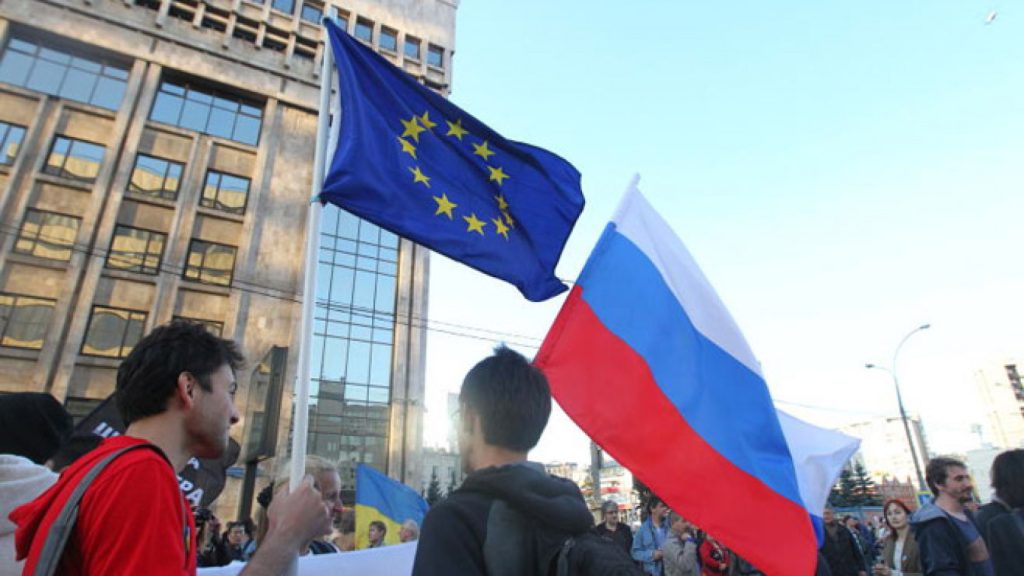
The war in Ukraine has frozen relations between Europe and Russia into open confrontation, but the balance of power between them is not fixed. It is being reshaped every year by sanctions, rearmament, demographic decline, political shocks and the reactions of the wider international system. Seen from late 2025, the picture is more complex than the triumphant narratives on either side suggest. Russia has avoided economic collapse and kept its regime stable while sustaining a long war. Europe has weathered an unprecedented energy shock, increased defence spending and kept political support for Ukraine broadly intact. At the same time both actors face structural constraints that will determine their room for manoeuvre up to 2030.
The following analysis builds on the Ifri net assessment of Europe and Russia and extends it with more recent data on sanctions, defence spending and global diplomatic trends. It looks first at the economic and energy foundations of power, then at the military balance and defence industrial base, then at domestic political and societal resilience, and finally at their respective alliance systems and standing in the wider world. The last part sketches several plausible trajectories for the relationship over the rest of this decade and highlights the factors that will decide which path becomes dominant.
When the full scale invasion began in 2022, both Moscow and European capitals entered a race to adapt. Russia had to survive unprecedented financial and technological sanctions while reorienting its exports away from Europe. The European Union had to end decades of energy dependence on Russian gas and oil without triggering a deep economic crisis. By 2025 it is clear that both have succeeded in the short term, but they have done so on very unequal structural foundations.
For Russia, hydrocarbons remain the central pillar of state power. Before the war, oil and gas provided around a third of federal budget revenues and a large share of export earnings. Western sanctions and the European embargo on seaborne crude and most refined products did not collapse exports overnight, but forced a rapid redirection toward Asia at steep discounts and through a costly shadow fleet. Studies of the oil embargo and price cap show that Moscow has preserved significant sales volumes, yet at the cost of lower margins, higher transport costs and growing dependence on a small group of buyers, above all China and India.
Pipeline gas tells a different story. Sales to Europe have fallen by about 80 percent since 2021, and the entire infrastructure built over decades to feed the European market, from Yamal to Nord Stream, has lost most of its value. Liquefied natural gas projects have been hampered by technology sanctions and financing constraints. The Ifri report is blunt on this point: even with massive political will, Russia will at best regain roughly half of its pre war LNG export potential by 2030, and cannot replace the loss of Europe as a premium nearby gas market.
In the short term, high global oil prices and forced import compression allowed Russia to avoid economic collapse. GDP grew by more than 3 percent in 2023 and by an estimated 3 to 4 percent in 2024, driven by military production, construction, and redirected trade. Yet the quality of this growth is poor. War spending crowds out investment in civilian sectors, sanctions limit access to advanced technology and capital, and the state has tightened control over strategic industries. The economy is increasingly militarised and state driven, with labour shortages, high interest rates and rising inflation eroding living standards. The oil and gas sector still brings in hard currency, but fiscal space narrows as energy revenues fall and social spending and war costs rise. The latest data on oil and gas receipts show a double digit decline in budget income in 2025 after new American sanctions on major Russian firms and lower global prices.
Europe has followed a mirror trajectory. The European Union paid a heavy price in 2022 for its sudden break with Russian pipeline gas. Energy prices spiked, heavy industry suffered and some member states feared a winter of shortages. Yet the shock also triggered a structural shift. Gas consumption fell, LNG imports from the United States and others surged, renewable deployment accelerated and the EU put in place mechanisms to share gas across borders. By 2024 Russian pipeline gas supplied only a small fraction of European demand. Longer term contracts with Norway, the United States, Qatar and others, combined with demand reduction and efficiency, are gradually turning a unilateral dependence into a more diversified portfolio.
The cost of this transition remains a political challenge. Higher energy prices feed populist narratives about Brussels neglecting ordinary households. Industrial firms complain about losing competitiveness relative to the United States or China. But from a power perspective, Europe has reduced a key Russian lever and gained options. Firms can still use some Russian LNG, and certain member states have preserved niches of dependence, yet Moscow can no longer credibly threaten to weaponise gas against the EU as it did before 2022.
Relative macroeconomic weight continues to favour Europe. The EU and United Kingdom together represent many times Russia’s GDP, even if growth in Europe is sluggish and fragmented. Russian GDP numbers flattered by war spending and statistical opacity cannot conceal its structural problems: an ageing population, chronic underinvestment outside the resource sector, low productivity and the exodus of skilled workers since 2022. The Ifri report underlines the demographic time bomb. Birth rates have collapsed to a two century low, war casualties and emigration have shrunk the working age male population and the political climate is hostile to large scale immigration.
Europe too faces demographic stagnation, but of a different kind. Populations are ageing, yet the continent remains an attractive destination for migrants. This creates social and political tensions but also offers a potential remedy for labour shortages and a source of long term economic dynamism that Russia lacks.
Innovation capacity reinforces this asymmetry. The Ifri study, supported by WIPO and OECD data, shows that Europe far outstrips Russia in educational attainment, R&D expenditure and patenting, especially in green technologies. The European debate since 2024 has shifted toward catching up with the United States and China, not with Russia. Reports by Letta and Draghi, along with the Budapest Declaration of November 2024, call for deeper capital markets, massive investment in strategic sectors and more integrated industrial policies. Implementation lags behind ambition, yet the direction of travel is clear. Russia, by contrast, is trying to offset demographic decline through automation while under sanctions that restrict access to critical components.
In short, by 2030 Russia is likely to remain a sizeable energy exporter and regional military power, but its economic base will be narrower, more dependent on Asian markets and more vulnerable to external shocks than before the war. Europe’s economy is less dynamic than that of the United States or parts of Asia, yet it rests on a much broader and more diversified foundation than Russia’s and retains far greater capacity for innovation and adjustment.
Military balance and the struggle to rebuild industrial capacity
War has highlighted that military power in Europe depends not only on existing arsenals but on the ability to produce weapons at scale. On the battlefield, Russia has leveraged its historical strengths in artillery, air defence and electronic warfare. The Ifri report notes that Russian ground forces enjoy a major advantage in tubes, rockets, short and medium range air defence systems and tactical electronic warfare, often deployed down to battalion level. This has allowed Moscow to sustain high intensity combat despite severe losses, although at the cost of enormous expenditure of matériel and human lives.
Reconstitution of these capabilities to 2030 is not guaranteed. Western analyses of Russian force generation suggest that Moscow can still mobilise recruits, expand drone output and maintain missile production, but only by devoting ever larger shares of the budget to the military, tapping into stocks built up over decades and relying on imports of components from China and other partners. North Korea and Iran have become key suppliers of artillery shells, rockets and drones. China so far avoids delivering complete high end weapon systems, wary of sanctions and reputational costs, but provides dual use goods and components that feed Russia’s war machine.
Europe has been forced to rediscover the hard reality of industrial warfare. For three decades after the Cold War, European defence industries shrank and specialised in small series of expensive platforms. Stockpiles of artillery shells, air defences and armoured vehicles were allowed to dwindle. When the EU and NATO began to send large quantities of ammunition and equipment to Ukraine, they quickly ran into production bottlenecks. The European defence technological and industrial base simply lacked the capacity to match Ukrainian needs in 2023 and 2024.
With some delay, that picture is now changing. Defence budgets across Europe have risen sharply. Sixteen EU members that belong to NATO are expected to reach or surpass the 2 percent of GDP benchmark in 2024, with Germany for the first time meeting and even slightly exceeding it, making Berlin the largest European defence spender. Major procurement programmes have been launched and joint EU instruments such as the European Peace Facility, the EDIRPA and ASAP have been created to support Ukraine and expand industrial capacity.
Actual output still lags behind political rhetoric, but the trend is notable. According to industry reports, European arms production has grown at roughly three times its pre war rate, and new investments in ammunition factories, including 155 millimetre shell production in countries like Bulgaria, aim to close the gap. The cost of non coordination remains huge. The European Parliament’s research service estimates that duplicated programmes and fragmented procurement waste tens of billions of euros each year. Yet the war has created new incentives for joint projects and long term contracts that can sustain industrial ramp up.
From an operational perspective, NATO’s posture on the eastern flank has been strengthened. Forward deployed forces in the Baltics and Poland have been reinforced, new regional defence plans adopted and the accession of Finland and Sweden has turned the Baltic Sea into a NATO inland sea. While the Ifri report concentrates on EU capabilities, the broader transatlantic context matters. Europe does not face Russia alone. Even under a Trump administration that is sceptical about multilateralism and demands greater European burden sharing, the United States remains indispensable for high end capabilities such as strategic lift, ISR, missile defence and nuclear deterrence.
At the same time, the war has pushed Europeans to think more seriously about autonomy. Policy papers at the Centre for European Reform and other think tanks argue that a de facto defence union will emerge if current trends continue, with more joint procurement, common standards and perhaps some shared assets. Whether this materialises by 2030 depends on political will and the depth of intra European divisions as much as on money.
Looking ahead, the military balance between Europe and Russia up to 2030 is likely to remain mixed. Russia will probably preserve certain advantages in massed firepower, air defence density and battlefield electronic warfare, though its ability to replenish these stocks could erode if sanctions tighten and partners grow more cautious. Europe will catch up in ammunition production and some enabling capabilities, but will still struggle to deploy large land forces quickly without American support. If Kyiv continues to receive substantial Western assistance, Russia will find it hard to gain a decisive battlefield advantage. If Western support weakens under political or budgetary pressure, the Russian military will retain the option of a grinding attritional strategy that slowly wears down Ukrainian forces while betting on fatigue in European capitals.
Political systems and societal resilience
Behind tanks and pipelines stand societies with very different political structures and narratives. The Ifri report describes two contrasting models. On one side stands an authoritarian, centralised Russian system that combines harsh repression with selective co optation and the promise of stability. On the other side stands a pluralistic, often chaotic European space where democratic institutions, rule of law and competitive politics impose constraints, but also generate resilience over time.
In Russia, the invasion has accelerated the evolution of the regime into full scale wartime authoritarianism. Independent media have been crushed or driven into exile. New laws criminalise dissent and even mild criticism of the war. Security services and loyalist elites control most levers of power. The state deploys a mix of coercion and welfare to keep society quiescent. War related industries and the security sector benefit from increased spending, while poorer regions supply disproportionate numbers of soldiers and receive modest material benefits in return.
The report notes that Russian society has adapted to the war through compartmentalisation. For many citizens in major cities, daily life continues in a strange normality. Casualties and destruction are kept at a distance. At the same time, war propaganda saturates television, schools and cultural production, framing Russia as a besieged fortress defending traditional values against a decadent and hostile West. The state leans heavily on conservative ideology, traditional family roles and hostility to LGBTQ+ rights, linking demographic concerns to moral narratives about national survival.
This mix has so far prevented mass protests. Opinion surveys from Levada show limited support for radical liberalisation or Western style democracy and a broadly conservative vision of the state, although such results must be treated cautiously in a repressive environment. Elite stability is more fragile than it appears. The war has intensified intra elite rivalries, and the Ifri report highlights the existence of technocratic and regional elites frustrated by the economic consequences of isolation. Occasional outspoken comments from figures inside the system, such as complaints about the war being stuck in a stalemate, hint at growing unease.
Yet there is little sign of organised opposition capable of challenging the Kremlin in the near term. The death of Alexei Navalny and the repression of protest networks have decapitated the main alternative leadership. Opposition circles in exile debate grand scenarios, including a democratic Russia integrated with Europe, but these ideas remain utopian in the mid 2020s. More realistic is the risk of a chaotic or hardline succession if something happens to Vladimir Putin before or after 2030, in which competing security and regional factions struggle for control and use nationalist rhetoric to legitimise themselves.
Europe’s vulnerabilities are of a different nature. The continent is politically fragmented, with multiple party systems, coalition governments and rising populist forces. Trust in institutions has been shaken by the financial crisis, the migration crisis, the pandemic and now the war. Populist parties of the radical right and left, some with pro Russian sympathies, have gained ground in several member states and in the European Parliament.
Even so, the war has created a surprising degree of unity on core questions. Eurobarometer and other polling since 2022 show that substantial majorities in most EU countries support aid to Ukraine and accept the costs of sanctions, even if enthusiasm and motivations vary. Support is strongest in countries closest to Russia and weaker in parts of southern and central Europe, but it has remained resilient despite inflation and energy price spikes. The Ifri report argues that the confrontation with Russia has helped Europe rediscover its foundational narrative of peace and democracy, and that this contrast with Russian authoritarianism has stabilised public support for the European project rather than undermined it.
Institutionally, the Union struggles to match this resilience with effective decision making. Moving from unanimity to qualified majority voting in foreign policy and sanctions remains contentious. Some governments see common social or energy policies as creeping centralisation that undermines national sovereignty. These tensions create room for obstruction and for Russian information operations that portray Brussels as an arrogant bureaucracy plotting regime change in member states. The Ifri report documents several recent disinformation campaigns, such as false stories about the EU planning a coup in Hungary, amplified via Telegram and X to feed eurosceptic narratives.
So far, however, the impact of this interference is limited. Democratic pluralism and free media, though messy, give European societies a capacity for self correction that authoritarian systems lack. Populist parties may slow or complicate policy, but they have not yet derailed support for Ukraine or caused an EU implosion. Opinion research in 2025 suggests that populist attitudes are widespread, but that most citizens remain attached to basic democratic norms and to EU membership.
The contrast, therefore, is not one of a brittle Europe facing an unshakeable Russia, but of two different types of resilience. Russia can absorb shocks by suppressing dissent and redistributing rents to strategic groups, but at the cost of long term legitimacy and adaptability. Europe is more open to internal conflict and electoral swings, yet its institutions, rule of law and alliances provide cushions that make systemic collapse unlikely in the medium term.
Alliances, the Global South and the contest for narrative power
Power in the twenty first century is anchored not only in domestic resources but also in relationships with other states and societies. Since 2022, Russia and Europe have engaged in a global struggle over partners, access to markets and narrative legitimacy.
The Russian approach combines an anti Western ideological posture with pragmatic, sometimes cynical partnerships. Official doctrine presents Russia as a leader of a post Western, multipolar order in which the United States and Europe are declining and the Global South is rising. In practice, Moscow relies on a core group of states that share grievances against the West or see benefits in working with Russia: China, Iran, North Korea, Syria, a handful of African juntas and some Latin American governments.
China is by far the most important partner. Its share in Russian oil imports has risen sharply since 2021, and it has become a key market for other commodities. At the same time, Chinese investment in Russia has fallen, reflecting caution about sanctions and doubts about the Russian business environment. Militarily, the partnership has deepened through joint exercises and technology transfers, but stops short of a full alliance. Mutual mistrust and diverging long term interests in Central Asia and the Arctic limit how far integration can go.
Iran and North Korea, by contrast, are operational allies in the war itself, supplying drones, missiles and artillery shells. These ties increase Russia’s resilience on the battlefield but reinforce its dependence on internationally isolated regimes and deepen its own pariah status.
Russia also courts a loose network of “facilitator” states that help it evade sanctions, from Turkey and the United Arab Emirates to post Soviet neighbours in the Caucasus and Central Asia. These relationships are transactional and fragile. Governments that host Russian capital or re export sanctioned goods also balance relations with the EU, United States and China and can adjust their stance if Western pressure or incentives change.
In the wider Global South, Moscow plays heavily on anti colonial and anti Western sentiments. It highlights past NATO interventions, criticises double standards and presents itself as a champion of sovereignty and non interference. UN General Assembly votes on Ukraine show that this narrative has traction in parts of Africa, the Middle East and Asia. Yet recent research indicates a more nuanced picture than the idea of a uniformly “neutral” Global South. Many democracies in Asia, Latin America and Africa have in fact condemned the invasion, while hedging on sanctions.
The EU starts from a different position. It remains the world’s largest provider of development aid and a central player in multilateral institutions. Its web of trade agreements and regulatory influence, the so called Brussels effect, gives it structural leverage in areas from data protection to green standards. Since 2022 it has combined this traditional soft power with hard security measures: unprecedented sanctions on Russia, large scale military assistance to Ukraine and efforts to secure critical raw materials and supply chains.
Transatlantic relations remain central. Under Trump 2.0, the United States is more transactional and impatient with European free riding, yet still deeply engaged in European security and in the Ukraine war, even if Washington and Brussels sometimes diverge on tactics or UN diplomacy. Trump’s public frustration with the stalemate in Ukraine and his use of sanctions on Russian energy to serve both strategic and economic aims illustrate this blend of pressure on Moscow and pressure on European allies to shoulder more of the burden.
Beyond the transatlantic axis, Europe has begun to rethink its relations with the Global South. It seeks to move from aid centred approaches to co investment in industrial value chains, particularly in green technologies and critical raw materials. Initiatives like Global Gateway or new strategic partnerships in Africa and Latin America aim to present a credible alternative to Chinese and Russian offers. Yet implementation often lags behind announcements, and persistent perceptions of paternalism or double standards limit European influence.
The Ifri report stresses that Europe will not “detach” the Global South from Russia or China through confrontation. What matters is the ability to offer reliable, long term commitments that address partners’ priorities, from energy access to climate adaptation and industrialisation. In this sense, Russia’s appeal is constrained by its limited economic resources and narrow focus on security assistance, while Europe’s challenge lies in matching its financial weight with strategic clarity and political cohesion.
Pathways to 2030: four plausible trajectories
The future of Europe Russia relations is not pre determined. It will be shaped by battlefield developments in Ukraine, the durability of Western support for Kyiv, economic pressures, domestic politics in Russia and in key European states, and the evolution of the US role. Rather than predicting a single outcome, it is more useful to sketch several plausible pathways for the period to around 2030 and indicate the variables that could push reality closer to one or the other.
One trajectory is a prolonged war of attrition that gradually hardens into a cold peace with a contested border. In this scenario, neither side achieves a decisive breakthrough. Ukraine stabilises a defensive line, keeps Russian forces at bay and retains control of most of its core territory, but lacks the capacity to liberate all occupied regions. Russian offensives make limited gains at high cost but fall short of their maximal objectives. Western support to Ukraine continues, though at fluctuating levels as political cycles in the United States and Europe generate moments of uncertainty. Russia maintains high military spending and a quasi wartime economy, while Europe institutionalises a permanent security commitment to Ukraine, including multi year financial packages, training missions and long term arms contracts.
In such a world, Europe and Russia remain locked in rivalry across all domains. The line of contact in Ukraine resembles other militarised frozen conflicts, but on a far larger scale. Sanctions stay in place, perhaps with some technical adjustments, and Russia deepens its reliance on China, Iran and other partners. Europe continues to decouple from Russian energy and tighten controls on sensitive technologies. Political fatigue grows on both sides, yet the absence of a clear victory entrenches confrontation rather than easing it. The risk of escalation remains, especially if either side misreads red lines or domestic crises tempt leaders into diversionary adventures.
A second trajectory involves a coerced settlement shaped heavily by external actors, above all the United States. Here, one can imagine a scenario in which a Trump administration, frustrated by the costs and stalemate of the war and focused on competition with China, pushes for a rapid deal. Washington might link sanctions relief for Russia to a ceasefire and some form of territorial compromise, while pressuring Kyiv by signalling limits to future US security guarantees and weapons deliveries. Some European governments, fearing abandonment and eager to reduce economic and political strain, might accept such a settlement, while others, particularly in the east and north, would resist.
Under this scenario, Russia would present any agreement that freezes its territorial gains as a victory and a vindication of its strategy. The Kremlin would claim that it had forced NATO to back down and that the West had accepted a new status quo. Ukraine would be left with painful choices about its security architecture, perhaps relying more heavily on European guarantees than on NATO membership if Washington is unwilling to champion accession. Internally, the EU would face divisive debates over reconstruction aid, security commitments and relations with a Russia that remains authoritarian, militarised and hostile. Europe’s leverage over Moscow would shrivel if transatlantic unity fractures and sanctions are lifted without robust enforcement mechanisms.
A third trajectory centres on instability inside Russia. The current system looks stable in the short run but rests on a narrow base. A mix of economic strain, elite rivalries, war weariness and unforeseen shocks could trigger a succession crisis or a broader regime crisis before 2030. This need not mean democratisation. History and the structure of Russian power suggest that a hardline successor, perhaps from the security apparatus, is as plausible as a pluralist breakthrough.
If a power struggle erupted in Moscow, Europe would face a difficult strategic dilemma. On the one hand, there would be an opportunity to recalibrate relations with a Russia that might be more inward focused, more fragmented or more open to reducing tensions. On the other hand, the risks of civil conflict, loss of control over nuclear weapons and unpredictable behaviour by rival factions would be real. In such a crisis, Ukraine’s position would be crucial. A capable Ukrainian state with strong Western backing could act as a stabilising buffer, while a weakened or divided Ukraine would be vulnerable to spillovers.
The Ifri report’s discussion of “after Putin” scenarios suggests that European publics and policymakers might be less willing to extend trust and resources to Russia after the war than they were after the Cold War. Memories of aggression and atrocities, as well as the consolidation of anti Western ideology in Russian discourse, will make a quick reconciliation difficult. Any opening would require credible changes in Russian policy toward Ukraine and its neighbours and probably a generational shift in elites. Still, the possibility of a post Putin transition, however messy, remains one of the few paths toward a less confrontational European security order.
A fourth trajectory is a more favourable outcome for Ukraine supported by sustained Western assistance and gradual Russian exhaustion. Here, continued deliveries of advanced systems, ammunition and economic aid allow Kyiv to regain the initiative on the battlefield, inflicting growing costs on Russian forces and degrading key capabilities such as artillery, logistics and air defences. Russian society becomes progressively more strained as casualties mount, regional discontent grows and living standards stagnate. China and other partners may begin to hedge, limiting exposure to sanctions and urging some form of de escalation.
Under such circumstances, Moscow might accept a phased settlement that includes withdrawal from parts of occupied territory in exchange for guarantees about NATO posture, phased sanctions relief and some recognition of Russia’s status as a great power. This would not be a return to partnership, but it could open space for arms control, incident management and a limited revival of economic ties. Europe’s role would be central in sustaining Ukraine through the long haul, providing integration through accession talks and reconstruction funds, and embedding Ukraine in its political and economic structures. Failure to deliver on these promises would threaten to throw Kyiv back into a grey zone where Russian pressure could again grow.
These scenarios are not mutually exclusive. Elements of each could appear in sequence or combination. A long war of attrition might precede a coerced settlement or a Russian internal crisis. A Ukrainian breakthrough could emerge from what originally looked like stalemate. The real value of scenario work is not to assign probabilities, but to clarify the levers that Europe can actually pull.
Across all trajectories, several variables stand out. First, the sustainability of European support to Ukraine, materially and politically, is decisive. Polling and fiscal data so far suggest that this support is both significant and broadly acceptable to European societies, but it will require constant political work to explain costs, combat disinformation and share burdens fairly among member states.
Second, the evolution of US policy matters. A United States that remains engaged in European security, even under a Trump administration that negotiates hard with allies, offers Europe time and cover to build its own capabilities. A sudden withdrawal or deep reduction in American involvement would force the EU and UK to make choices on defence integration and nuclear deterrence that have long been deferred.
Third, the internal trajectories of Russia and Ukraine will condition the regional order. A Russia that becomes more repressive and militarised while retaining enough resource income to fund its security apparatus would continue to pose a long term threat, even if it is weaker in relative terms. A Ukraine that emerges from war as a resilient democracy integrated in European structures would reshape the geopolitical map of the continent and help anchor security in Eastern Europe.
Finally, the way Europe and Russia engage with the Global South will help determine the broader legitimacy of their respective projects. Russia will keep trying to present itself as a champion of sovereignty against Western hegemony, but its limited economic offer and alignment with a narrow bloc of authoritarian regimes constrain its appeal. Europe will need to show that its rhetoric about partnership, climate justice and equitable development translates into real projects and predictable commitments rather than occasional crisis driven packages.
Strategic implications for Europe
Given these dynamics, Europe faces several strategic imperatives if it wants to maintain a favourable balance of power vis à vis Russia up to 2030.
First, the economic pillar must be reinforced not only through sanctions on Russia but through internal reforms. The innovation and investment agenda outlined in the Letta and Draghi reports points toward more integrated capital markets, coordinated industrial policies and a stronger focus on green and digital technologies. Delivering on this agenda would both support the energy transition and reduce vulnerabilities in critical supply chains, including those related to defence.
Second, defence efforts must move from headline figures to capabilities. Reaching 2 percent of GDP is a necessary condition for credible deterrence but not a sufficient one. Europeans need to reduce duplication, pool procurement, invest in enablers such as air defence, logistics and ISR, and anchor production growth in multi year contracts that give industry predictability. Lessons from Ukraine about the centrality of drones, electronic warfare, dispersed logistics and cheap precision munitions should be integrated quickly into force planning.
Third, political resilience inside the EU must be treated as a security priority. That means addressing legitimate social concerns about the cost of sanctions and rearmament, fostering public debate that explains the stakes of the confrontation with Russia, and investing in counter disinformation capabilities that do not slide into censorship. The Ifri report underlines that Russian psychological and information operations are a central part of its toolkit, aimed at amplifying divisions and undermining trust in democratic institutions. Robust media, education and civil society are as important in this contest as tanks and missiles.
Fourth, Europe must refine its diplomacy toward the Global South. Instead of lecturing partners or framing choices as a binary between West and Russia, the EU and its member states should build coalitions around concrete interests such as food security, climate adaptation, health and manufacturing. This requires patience, presence on the ground, and openness to genuinely shared governance of projects and institutions.
Finally, Europe should prepare intellectually and institutionally for different kinds of Russia. That means building deterrence and defence against a hostile and revisionist Russia, but also thinking ahead to how the EU would respond to a Russia in internal turmoil or to a leadership that signals genuine interest in de escalation and reform. Having a clear framework for conditional engagement, including benchmarks on withdrawal from Ukraine, respect for neighbours’ sovereignty and internal liberalisation, would help avoid the pendulum swinging between naive optimism and fatalistic pessimism.
Europe and Russia are engaged in a long confrontation that will define European security for years. The balance of material power, political resilience and alliances points to a gradual erosion of Russia’s position relative to a larger, wealthier and more innovative European system. But this outcome is not automatic. It depends on whether Europe can turn its latent advantages into sustained strategic action and whether Russia’s leadership continues to tie its fate to a war that drains its society and narrows its future options.