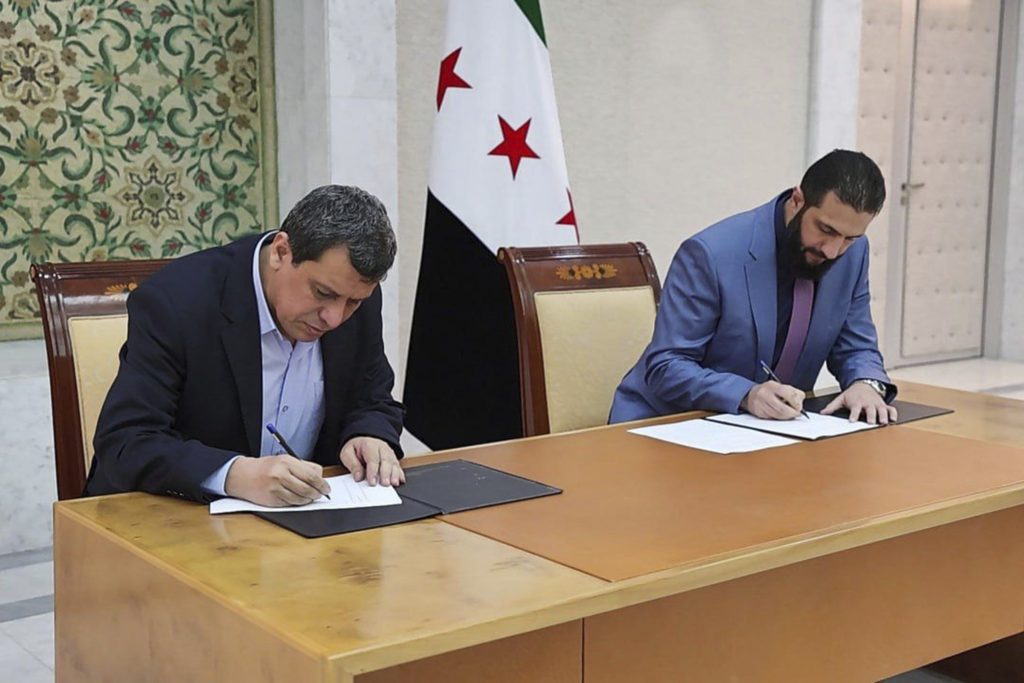
The October 2025 deal that begins folding the Syrian Democratic Forces into the national army looks, at first glance, like the beginning of a post-war normalization. A powerful non-state force moves into state institutions, foreign patrons bless the process, and Damascus regains at least formal control over a long-contested corner of the map. Beneath that surface there is a more complicated reality. The arrangement solves a security problem for the transitional authorities in Damascus and for Washington, yet it leaves the core political question in the northeast unresolved. Syria gets a pathway to a single army, but not to a shared idea of what kind of state that army serves.
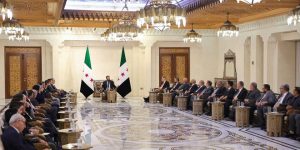
The structure of the deal is itself unusual. Rather than dissolving into individual enlistments, SDF units are to enter the army as intact formations under their own commanders. Syrian officials and SDF sources speak of new “national” divisions built around existing SDF brigades, with about seventy senior officers mapped into the restructured force, and of a special handling for women’s units that would in practice keep them in their home region. On paper this gives the new Syrian army a large boost in manpower and combat experience without an outright purge or humiliation of a force that fought the Islamic State for a decade. It also preserves, at least for now, the SDF’s internal solidarity and chain of command.
For Damascus, that balance has obvious appeal. Interim president Ahmed al Sharaa took power at the head of a movement whose roots lie in Hayat Tahrir al Sham and other Islamist factions that once battled both the Islamic State and the regime. His government needs to project that Syria is moving beyond warlordism and political fragmentation. A national army that visibly includes former regime units, ex rebel formations and the SDF is a strong symbol. At the same time, Sharaa is under pressure from his own base and from Turkey to prevent any Kurdish-led structure from hardening into a federal region.
The March 2025 framework already reflected this duality. It offered recognition of Kurds as integral to Syria, promised naturalization for those stripped of citizenship, and conceded local councils, language rights and Kurdish police forces. In exchange, airports, border crossings and oil fields in the northeast were to return under central government authority, and SDF forces were to be somehow integrated into the army. The vague language on that last point allowed each side to pretend its own model would eventually prevail. The October accord narrows that ambiguity in the military sphere while leaving the political article almost untouched.
From the perspective of the Autonomous Administration, now DAANES, the decision to accept integration on these terms is also a calculation born of pressure. The original Rojava project of 2012 rested on a belief that decentralised, bottom-up governance could survive between collapsing front lines. A decade on, its leaders face a very different landscape. The Assad regime has fallen, but a new central authority has emerged that speaks the language of national unity. Turkey has shifted from trying to overthrow Damascus to working with Sharaa on border security and joint action against what Ankara still calls “terrorist structures” across the line.
The SDF remains a large force by Syrian standards, still roughly one hundred thousand strong when auxiliaries are included, and continues to guard al Hol, al Roj and other detention sites that hold tens of thousands of Islamic State suspects and family members. It also continues to lose fighters to renewed Islamic State attacks in the Jazira and Deir ez Zor countryside. Without American support and air cover, that burden would be difficult to sustain. For Mazloum Abdi and his colleagues, refusing integration outright would risk facing Turkish strikes, Syrian centralisation and possible US disengagement at the same time. Going in as identifiable units inside the national army, rather than as scattered individuals, preserves a measure of leverage.
The timing of Abdullah Ocalan’s call from prison in early 2025 for the PKK to dissolve and lay down arms adds another layer. That move, combined with subsequent statements by Turkish officials that “whatever their name, all extensions” of the PKK should do likewise, was aimed squarely at Kurdish movements beyond Turkey’s borders. Ankara’s hope was clear: if the PKK hierarchy formally ends its insurgency and rebrands its struggle as political, the YPG and PYD in Syria might be corralled into similar concessions. Abdi’s insistence that Ocalan’s message does not apply to the SDF signals that northeast Syria is not ready to follow that script. Integrating into the Syrian army while retaining distinct units is, from this angle, a way to accommodate some Turkish demands without accepting dissolution.
Turkey’s own strategy toward the Sharaa government is a crucial part of the picture. After years of backing insurgent factions against Damascus, Ankara has used the fall of the Assad regime to normalise relations and to pivot from regime change to border management. Analysts tracking Turkish policy point out that Ankara now presents cooperation with the new Syrian authorities, Iraq and Jordan against Islamic State remnants as a reason for Washington to stop supporting the SDF and to work through states instead. At the same time, Turkish leaders continue to state that no autonomous Kurdish entity linked to the PKK will be tolerated along their frontier. From Ankara’s vantage point, SDF integration into a Syrian army tightly controlled from Damascus could be a useful tool to dilute or neutralise that entity over time.
This is where the specific form of integration matters. By granting the SDF distinct formations and allowing many of them to remain based in the northeast, the October deal preserves a regional military core that could underpin some future decentralised order. By insisting that these units fall within the national command and that control over borders, airspace and resources returns to Damascus, the same deal gives the centre the instruments with which to slowly reassert control. The transformation of the Popular Mobilization Forces in Iraq into a formally recognised part of the security apparatus but one that still answers to its own networks offers an obvious cautionary comparison. The Syrian case may evolve differently, but the structural tension is similar.
For Washington, the October agreement is both an insurance policy and a hedge. The United States still relies on SDF units to pursue Islamic State cells and to secure detention camps that contain several thousand high-risk militants. Islamic State attacks in the northeast increased again through 2024 and 2025, a trend confirmed by independent monitoring as well as SDF reporting. At the same time, the Trump administration has made clear that it wants to reduce open-ended military commitments and that it opposes any overt move toward a federal Syrian system. Public comments from Ambassador Thomas Barrack rejecting formal federalism, followed months later by more relaxed statements about the likelihood of decentralisation, capture that ambivalence.
By brokering a formula that moves the SDF into the national army while leaving DAANES’s political status unresolved, US officials are trying to achieve three things at once. They want to avoid a vacuum that Islamic State could exploit if their forces leave, to reduce friction with Turkey over support for a group Ankara regards as an extension of the PKK, and to keep the new Syrian leadership inside a loose Western orbit through military cooperation and sanctions relief. They also want to avoid owning the outcome of Syria’s internal constitutional debates. The result is a deliberately partial arrangement that stabilises the security file and postpones the sovereignty file.
In strategic terms, the integration deal creates a layered system in the northeast. On the surface there is now one Syrian army that includes former regime units, ex HTS formations loyal to Sharaa, and SDF brigades. Beneath that, there are still distinct chains of trust and ideology. Many SDF fighters are steeped in the egalitarian, bottom-up ideology that shaped the original Rojava experiment, with its emphasis on women’s participation and local assemblies. Many officers in Sharaa’s camp come from an Islamist background that is wary of these concepts. Turkey will watch closely for any sign that SDF units inside the army remain politically loyal to DAANES rather than to the presidency.
The risk is that each side sees integration as a temporary tactic rather than a shared project. For Sharaa and his allies, the long term goal may be to use the integrated army to gradually reassert central control, edging out the autonomy structures once the immediate threats have receded. For DAANES, the hope is likely to turn the presence of its formations inside the national army into a guarantee of continued local self rule, presenting itself as a legitimate regional pillar rather than a separatist challenge. For Turkey, the ideal outcome would be for those formations to shed their ideological distinctiveness and become just another set of army units under Damascus, with the PYD’s political ambitions contained or reversed.
The Islamic State insurgency interacts with this triangle in a complicated way. As long as IS cells remain active and detention facilities remain full, Damascus and Washington both need SDF derived units to do work that other formations are not well placed to handle. That gives DAANES leverage. If the IS threat were to decline sharply, or if a joint Syrian Turkish campaign against IS gained momentum, the calculations might shift. Pressure to rationalise command, standardise doctrine and align all units under a more uniformly national narrative would grow, and Kurdish claims to special status would be harder to defend.
There is also a wider regional precedent that shapes expectations. Iraqi Kurds entered the new Iraqi political order after 2003 with their own Peshmerga units recognised under federal structures and with a formalised autonomous region. Over time, disputes over budget transfers, security prerogatives and control of disputed territories such as Kirkuk produced repeated crises and a violent confrontation in 2017. The Syrian Kurdish leadership is acutely aware of this history. It knows that military recognition does not automatically lock in political gains, and that oil fields and border crossings, once ceded, are hard to win back.
Seen from this perspective, the October 2025 deal is less a solution than a new framework for bargaining. It removes the most immediate risk of open confrontation between the Syrian army and the SDF. It gives Turkey a path, at least in theory, to see YPG derived forces under a Syrian flag rather than under their own banners. It allows Washington to claim progress toward a unified Syrian state while keeping the one partner that has consistently fought Islamic State on the ground embedded in national structures.
What it does not do is answer the question of who governs the northeast in ten years’ time and on what basis. If the constitutional process that follows Syria’s transition produces a meaningful form of decentralisation, with DAANES transformed into a recognised regional authority inside a Syrian state that accepts multiple centres of power, today’s integration could look like the first step toward a workable settlement. If the process stalls or hardens around a highly centralised model, the presence of SDF formations inside the army might become a source of internal tension rather than a bridge.
The phrase “fragile integration” captures the situation well, but it should be understood not as a descriptor of Kurdish fighters joining the army, which they have done in large numbers, but of the political architecture that sits above them. In the short term, the merger reduces the number of active fronts and lowers the risk of an abrupt US exit turning into a free-for-all. In the medium term, it locks Syria, Turkey, the Kurdish movement and the United States into a new set of mutual dependencies that will be tested every time there is a flare-up along the border, an Islamic State prison break attempt, or a debate in Damascus about the shape of local government.
The real measure of the October agreement will not be the photographs of joint parades or new unit badges. It will be whether commanders in Qamishli and Raqqa still feel they have a stake in the Syrian state five years from now, whether local councils can legislate in Kurdish without fear of reprisal, whether Ankara believes cross border attacks have truly ceased, and whether US planners believe that SDF-rooted units inside the Syrian army can be trusted partners against common threats. For now, Syria has traded one set of uncertainties for another, moving from open duality of forces to a more subtle, institutionalised ambiguity.