
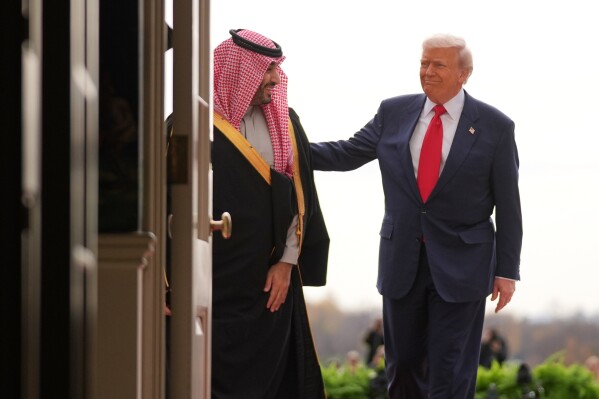
The second Trump administration has turned the United States–Saudi relationship into the central pillar of its Middle East strategy. By November 2025 that choice is crystallised in three big moves: a Strategic Defense Agreement and the designation of Saudi Arabia as a major non-NATO ally, a vast web of oil, investment and artificial intelligence partnerships, and a pattern of political coordination on regional crises from Gaza to Sudan.
None of this is happening in a vacuum. Mohammed bin Salman arrives in Washington carrying the legacy of Khashoggi, the memory of the 2019 Abqaiq attacks, the experience of a grinding Gaza war and the shock of Iranian missiles and Israeli strikes landing in the Gulf in 2025. Trump returns to office determined to prove that he can still deliver massive deals and to show that the United States, not China, sets the rules for security and technology in the Gulf.
The new bargain is not a clean break with the old oil-for-security compact. It is a more complicated trade. Saudi Arabia offers capital, energy management and alignment on some core security questions. Washington offers military status, privileged access to technology and political cover. Around this exchange sit uneasy questions about Iran, Israel, Pakistan, Qatar and the long term future of Gulf security.
The starting point is the diplomatic damage after Jamal Khashoggi’s murder in 2018. US intelligence agencies made clear that the Istanbul operation was unlikely to have happened without the crown prince’s approval, and for several years he was treated warily in Washington, especially under President Biden, who initially dealt formally with King Salman and kept meetings with MBS to a minimum.
Riyadh adapted by hedging. It deepened coordination with Russia inside OPEC+, welcomed Chinese infrastructure and telecoms projects, and eventually accepted Beijing as broker for a Saudi–Iranian understanding in 2023. None of that was a true substitute for the American security umbrella, but it signalled that the kingdom was willing to test alternatives.
By the time Trump returned to the White House, two events had convinced Saudi leaders that distance from Washington carried growing risks. The first was the prolonged Gaza war and its regional spillover, which showed how fast escalation could leap over borders despite local de-escalation in Yemen and along the Saudi–Iranian track. The second was the short but intense confrontation between Israel, the United States and Iran in June, followed by Israeli strikes on Hamas leaders in Doha in September. Those strikes and subsequent missile salvos across the Gulf shattered the idea that Gulf capitals could stay on the sidelines when Israel and Iran clash.
Trump’s executive order of 29 September, which declares that any armed attack on Qatar’s territory, sovereignty or critical infrastructure will be treated as a threat to US peace and security, underscored the point. The order commits the United States to take all lawful and appropriate measures, including military action if necessary, to defend Qatar in case of external attack. In Riyadh the signal was clear. When missiles begin to land, it is written guarantees and practical integration with US forces that matter, not general statements of friendship.
Mohammed bin Salman’s November 2025 trip is shaped by that memory and by a specific trauma. In September 2019 Saudi oil sites at Abqaiq and Khurais took serious damage from Iranian-linked drones and cruise missiles. The US response was cautious and tightly framed. For many in the Saudi leadership that episode illustrated how exposed the kingdom could be when Washington doubted the wisdom of escalation. The crown prince now wants written assurances and tangible capabilities that make a repeat far less likely.
The domestic context in Saudi Arabia is very different from the period of MBS’s early international charm offensive. When he first toured Washington and Silicon Valley he sold a story of social opening and futuristic mega-projects. Vision 2030 seemed far enough away to tolerate experiments and excess.
Seven years later the transition is more demanding. Foreign direct investment has lagged behind official targets. High global interest rates and tighter financial conditions have made long horizon projects harder to finance. Supply chain problems and cost overruns have forced Riyadh to scale back the most extravagant parts of The Line, turning it into a symbol of both ambition and strain.
Rather than retreat, the crown prince has tried to reorient the programme. The Public Investment Fund has shifted emphasis toward sectors that promise export revenue, strategic leverage or both: logistics, mining, sports and entertainment, and a rapidly expanding digital and AI ecosystem.
Humain, launched in May 2025 as a PIF-controlled AI champion chaired by MBS himself, embodies that pivot. The company is building large data centres in Riyadh and Dammam, each starting at about 100 megawatts, and has signed major deals for Nvidia’s latest Blackwell chips and a ten billion dollar partnership with AMD. It is positioning itself as a full stack AI player, from sovereign data centres and cloud infrastructure to Arabic large language models and applied solutions.
For MBS, success in this field is not a luxury. It is a central piece of how he intends to convert oil rents into lasting technological advantage and jobs for a very young population. That urgency is one reason why AI and digital infrastructure have moved from side issue to headline topic in his meetings with Trump. The United States has what Saudi Arabia needs: advanced chips, cloud platforms, leading AI firms and regulatory control over many of the standards and export rules that will shape the sector.
That asymmetry could be a vulnerability for Riyadh if relations sour again. The way to reduce that vulnerability is to become so deeply embedded in American AI supply chains, and to deploy so much capital into US technology firms and data centres, that it becomes costly in Washington to restrict access. The giant investment numbers that accompany every Trump–MBS encounter are part of that strategy. At the May 2025 Riyadh summit and again during the November Washington visit, Saudi officials touted plans to move Saudi investment in the United States toward the one trillion dollar mark across AI, energy, manufacturing and financial assets.
On 18 November Trump and MBS signed the US–Saudi Strategic Defense Agreement, presented by the White House as a historic upgrade of an eighty year security partnership. In parallel, Trump announced that Saudi Arabia would be designated a major non-NATO ally.
These two steps define the security core of the new bargain.
Major non-NATO ally status does not provide an automatic defense guarantee, but it does give Saudi Arabia privileged access to US military technology, easier arms transfers, and eligibility to host pre-positioned US equipment and join certain joint defence projects. It places the kingdom alongside states such as Israel, Jordan and Kuwait, with which Washington already maintains deep military ties.
The Strategic Defense Agreement adds political and operational flesh to that skeleton. The fact sheet published by the White House stresses joint planning, integrated air and missile defence, expanded exercises and streamlined defence industrial cooperation. The text avoids simple treaty language such as an Article 5-style clause, but it describes attacks on Saudi territory as threats to US interests and commits both sides to strengthen deterrence against Iran and other regional challengers.
One headline element is Trump’s stated intention to approve the sale of F-35 fighter aircraft to Saudi Arabia. On the eve of the November visit he repeated that he wanted the kingdom to acquire the stealth jets, despite concerns inside the US system about protecting sensitive technology and about maintaining Israel’s qualitative military edge. If this sale moves forward it will mark a significant shift in regional airpower, taking Saudi Arabia into a very small group of countries with fifth generation aircraft.
From Riyadh’s perspective these moves address three longstanding worries. First, they respond to the sense of vulnerability exposed in 2019 and again during the recent missile attacks associated with the Gaza and Iran crises. Second, they signal to Iran and its partners that Washington is willing to deepen military ties with the kingdom in a visible way, rather than quietly stepping back. Third, they reassure investors and domestic audiences that the strategic environment around Vision 2030 is being stabilised rather than left exposed.
From Washington’s side the package is supposed to achieve several aims at once. It reassures a key energy producer and investor so that it stays broadly aligned with US preferences. It offers a counter to Chinese and Russian overtures in the Gulf. It also supports a defence industrial base that benefits from large, long term contracts. But it does so without locking the United States into an explicit treaty commitment that would be difficult to change if Saudi behaviour becomes a political liability.
The contrast with the Qatar executive order is instructive. Doha received a direct presidential commitment that the United States would treat any external attack as a threat to international peace and security and respond with all appropriate measures. Riyadh receives a more complex arrangement, part political pledge, part status designation, part arms and integration package. For a much larger state that wants both reassurance and room for manoeuvre, that may be preferable, at least for now.
Saudi Arabia has not placed all of its security weight on Washington. On 17 September 2025 it signed the Strategic Mutual Defense Agreement with Pakistan. The pact states that aggression against one will be considered aggression against both and speaks the language of joint planning and reinforced deterrence.
This codifies decades of quiet security ties. Pakistani officers have long worked inside Saudi institutions. Pakistani forces have protected key facilities in the kingdom. The new agreement pushes that cooperation closer to a formal alliance. Analysts are divided on how far the text really goes, but the political message is straightforward. Riyadh does not intend to rely on a single external guarantor.
For Mohammed bin Salman the pact serves several purposes. It brings a nuclear-armed partner into the kingdom’s deterrence calculations without Saudi Arabia itself crossing any proliferation red lines. It signals to Iran that attacks on Saudi territory will now raise questions in Islamabad as well as Washington. It provides potential manpower and training resources if the kingdom wants to expand stabilisation or peacekeeping roles from Gaza to Sudan.
For Trump officials and many in the US security establishment, the agreement is both opportunity and concern. In the optimistic reading it means that a traditional US partner, Pakistan, will shoulder more of the security burden and may help manage crises where American ground deployments are politically sensitive. In the pessimistic reading it raises the spectre of a looser nuclear shadow in the Gulf and binds South Asian dynamics more tightly into Middle Eastern crises.
India watches uneasily, seeing the pact as part of a wider Saudi strategy that might at some point be used to pressure Delhi on issues from oil to Kashmir. Iran sees a tightening of what it already considers an encirclement strategy. China, which has cultivated both Pakistan and Saudi Arabia, may quietly welcome deeper security ties between two major recipients of its own arms and infrastructure financing, even if Washington frames the pact as sitting inside a US-led order.
The combined effect of the US–Saudi Strategic Defense Agreement and the Saudi–Pakistan pact is a layered deterrence network. At the top sits American power, with integrated air and missile defence, high end aircraft and naval presence. Alongside it stands Pakistani support, with its own conventional forces and nuclear status in the background. Beneath that Riyadh is accelerating its own domestic capabilities, including missile defence, cyber tools and unmanned systems.
This structure gives the crown prince more confidence to pursue regional diplomacy from a position of strength, but it also multiplies the channels through which miscalculation might spread. A clash in the Gulf could now drag in actors from Islamabad to Tel Aviv more quickly than before. Managing that complexity will require more than summit photographs.
Security guarantees are only one part of the new price of partnership. Technology and economic interdependence are equally important.
Since Trump’s visit to Riyadh in May 2025, the United States and Saudi Arabia have negotiated an intricate set of deals around AI infrastructure, nuclear energy and critical minerals. Reuters reported that during that tour Saudi Arabia agreed to buy large volumes of Nvidia chips for Humain, signed a ten billion dollar strategic partnership with AMD and committed 20 billion dollars to US AI data centres.
The November White House fact sheet and the US–Saudi Investment Forum in Washington added new layers: expanded partnerships between Humain and US cloud providers, chipmakers and software firms; commitments by Qualcomm and others to open AI engineering centres co-located with Humain in Riyadh; and Saudi led funding rounds for American and global AI companies. The US side, for its part, has signalled that it will approve the first formal export licences for the latest generation of AI chips to Humain, after months of internal debate about security and dual use risks.
These deals serve three strategic functions.
First, they lock in mutual dependence. Saudi AI ambitions depend on American hardware and software. US firms benefit from Saudi capital, energy subsidies for data centres and a rapidly growing market for their products. Both sides acquire a stake in keeping the relationship stable.
Second, they embed Saudi digital infrastructure in Western rather than Chinese standards and ecosystems, at least for now. Export approvals are tied to conditions on how technology can be used and with whom it can be shared. Washington hopes this will slow or reverse the spread of Chinese platforms and security technologies in the Gulf.
Third, they provide a narrative of shared opportunity that can soften criticism over human rights and regional conflicts. When Trump stands on stage with MBS and tech executives, the backdrop is not only arms and oil but also jobs, innovation and investment in both countries.
In parallel, the two governments have signed a framework on civil nuclear cooperation and a strategic framework for securing supply chains in uranium, metals and critical minerals. This reflects a recognition that the energy transition will tie global influence increasingly to control over fuel cycles for reactors, batteries and magnets as much as to control over oil fields.
For Saudi Arabia the nuclear and minerals deals offer three benefits. They support diversification of the domestic energy mix. They position the kingdom as a player in the supply chains that underpin new industries from EVs to advanced electronics. They also give it a latent hedge in the long running strategic competition with Iran, even as Riyadh insists on its commitment to non-proliferation.
For Washington these frameworks are also tools of exclusion. They aim to ensure that Russian and Chinese firms do not become the default partners for new reactors and mines across the region. They tie export licences and financing to safety, governance and alignment conditions. They bind key nodes in global supply chains to American regulatory influence.
The security and technology pillars of the Trump–MBS bargain sit inside a volatile regional political landscape.
On Israel–Palestine the picture is bleak. The war in Gaza produced enormous destruction and civilian casualties, and even after a hard fought ceasefire and hostage deal the territory remains shattered. Qatari mediation, backed at key moments by Washington and supported financially by Gulf states including Saudi Arabia, has lowered the temperature but not resolved the underlying conflict.
Saudi normalization with Israel, heavily advertised in Washington policy circles during earlier phases of the Abraham Accords, is now parked. MBS continues to insist that any formal recognition would require a credible path toward Palestinian statehood. Israeli politics is moving in the opposite direction, and the Gaza war has entrenched mistrust among Arab publics.
Trump still sees a Saudi–Israeli handshake as a possible crowning achievement. The current reality makes that a long term rather than near term prospect. Any move by Riyadh toward open normalization would now face intense domestic and regional scrutiny, far beyond what existed when the UAE and Bahrain signed their accords. For the crown prince the leverage that comes from holding back recognition is too valuable to give away cheaply.
In this environment Saudi Arabia has chosen to play a more cautious, transactional role. It provides funding for humanitarian relief and reconstruction. It coordinates discreetly with Egypt, Qatar and the United States on Gaza management and on containing spillover in Lebanon and the Red Sea. It keeps channels to Israel open on security matters, but avoids symbolic gestures that would be read as endorsement.
Qatar remains an essential mediator but also a reminder of vulnerability. The Israeli strike on Hamas leaders in Doha in September, carried out without US approval, shocked Gulf elites and exposed the limits of Washington’s control over its closest regional ally. The subsequent US executive order on Qatar was intended to rebuild trust and deter future attacks on the small state that hosts a major US base.
From a Saudi point of view that chain of events proves two things. Israel can still act in ways that drag the region toward escalation regardless of US diplomatic preferences. And when that happens, those with the clearest written assurances and integration into US military planning are best placed to weather the storm. This reinforces Riyadh’s determination to anchor its own status while accepting that it cannot fully insulate itself from crises triggered elsewhere.
The same logic applies to Sudan, Yemen and other arenas. Trump has already signalled US support for Saudi-led efforts to push the Sudanese parties toward a ceasefire and some form of political settlement, framing it as another case where the United States and Saudi Arabia work together as stabilisers. Yemen has moved into a messy, fragile calm rather than a neat peace, but the shift from open Saudi intervention to a mix of diplomacy and containment reflects MBS’s desire to reduce direct costs while maintaining influence.
Despite the personal chemistry between Trump and MBS the relationship is not free of structural constraints.
In Washington the Khashoggi killing and the Yemen war left a lasting mark on public and congressional opinion. Human rights groups and many lawmakers continue to argue that the crown prince’s record makes him an unreliable partner and that giving him advanced weapons and surveillance tools heightens the risk of abuses. Concerns about energy policy, particularly Saudi willingness at times to coordinate with Russia in ways that support higher oil prices, add another layer of scepticism.
Trump is much less interested in these normative critiques than his predecessor. His instinct is to view Saudi Arabia through the lens of jobs, deals and symbolic shows of loyalty. Nonetheless, he cannot entirely ignore Congress, regulatory agencies or the intelligence community. Large arms sales, including any F-35 package, can be delayed or blocked if opposition stiffens. AI and chip export licences are scrutinised by officials who worry about leakage to China and about dual use of powerful systems.
Inside Saudi Arabia checks are less formal, but constraints exist. The crown prince has concentrated power to a degree unseen in recent Saudi history, yet his position still rests on delivering prosperity, prestige and a degree of social stability. Vision 2030 has raised the expectations of a young and increasingly connected population. It has also disrupted old patronage networks and conservative norms. If living costs rise, unemployment persists or mega-projects visibly stall, domestic criticism will grow, even if it is suppressed in public.
Aligning too closely and visibly with one American administration carries its own long term risk. The kingdom remembers how sharply US tone shifted between different presidents on issues such as democracy promotion and the Arab uprisings. If the Trump era ends in 2029 and is followed by a leadership less sympathetic to MBS, the very intimacy of the current partnership could become a vulnerability. That is one reason Riyadh keeps channels open to Beijing, Moscow and European capitals even while it tightens its embrace of Washington.
The Trump–MBS model of foreign policy is intensely personalised. It privileges leader to leader deals, grand announcements and direct lines between courts, often leaving bureaucracies to catch up later. That style can produce rapid breakthroughs, such as the Qatar executive order or the AI chip approvals, but it can also leave gaps in implementation and institutional memory.
If a future US administration wants to revisit the Strategic Defense Agreement or tighten controls on AI exports, it will inherit a landscape shaped by handshake deals and political expectations rather than by carefully negotiated treaties alone. Similarly, if succession politics inside the Saudi royal family ever re-open, the dense network of agreements tied to MBS personally may complicate adjustment.
Outside the bilateral frame, the new arrangement has ripple effects.
Iran sees the combination of the US–Saudi Strategic Defense Agreement, major non-NATO ally status and the Saudi–Pakistan pact as confirmation that its adversaries are building a more formalised ring of containment. The memory of the June confrontation, in which its nuclear facilities were hit and its missiles fired at Gulf and US targets, makes Tehran wary of direct escalation for now, but it is unlikely to abandon its network of partners and proxies. That means more emphasis on deniable attacks, cyber operations and political influence campaigns rather than open missile barrages, at least in the short term.
Israel gains mixed signals. On the one hand, a more heavily armed and formally aligned Saudi Arabia reassures Israeli planners who want a regional bloc to balance Iran. On the other hand, even the possibility of F-35 sales to Riyadh raises questions about Israel’s qualitative military edge, a concept that has structured US arms export policy in the region for decades. Israel also notes that Saudi normalization is not on the immediate menu and that Saudi leaders are now more explicit about linking recognition to Palestinian statehood.
Smaller Gulf states must adjust to a landscape where Saudi Arabia is once again the main hub of US security planning and the primary focus of American capital and technology deals. The UAE, which previously marketed itself as the Gulf’s premium partner for advanced weapons and high tech, now faces a Saudi competitor with more demographic weight and a matching appetite for AI and defence projects. Qatar, recently given a security guarantee, wonders how that pledge fits alongside widening US commitments to its much larger neighbour. Kuwait, Oman and Bahrain navigate between these poles with less leverage.
China and Russia see both danger and opportunity. A tighter US–Saudi embrace complicates Chinese hopes of drawing the kingdom decisively into its techno-economic orbit. Yet Beijing still has cards to play. It remains a major customer for Saudi oil, a key investor in infrastructure and a supplier of some surveillance and telecoms technologies that Washington is reluctant to export. Moscow’s space is narrower, constrained by its own war in Ukraine and its limited economic toolkit, but its partnership with Riyadh in OPEC+ and its role as an alternative arms supplier give it a residual presence.
For Europe, Japan and India the new alignment is a mixed blessing. A more predictable US framework for Gulf security is welcome, since it lowers the risk of supply shocks and frees them from having to replicate those security functions. At the same time, they worry that American control over critical AI, nuclear and mineral partnerships could leave them squeezed between US rules and Saudi leverage.
By late 2025 Trump and Mohammed bin Salman have, in effect, renegotiated the terms of the US–Saudi partnership. The kingdom commits to channeling enormous capital into the American economy, to anchoring its AI and nuclear ambitions largely in US and allied technology, and to acting as a central partner in US approaches to Iran, Sudan and the wider region. The United States, in return, elevates Saudi Arabia’s military status, opens the door to top tier hardware and AI infrastructure and steps back from public criticism of its internal repression.
This is not a free lunch for either side.
For Saudi Arabia the new bargain brings heavier expectations. The more deeply it is woven into US security planning, the harder it will be to distance itself from US choices that are unpopular in the region, especially around Israel and Palestine. The deeper its AI and nuclear programmes depend on American technology, the more vulnerable they become to shifts in US regulatory mood. The more it courts Pakistani support and flirts with nuclear ambiguity, the more it invites scrutiny and potential blowback from India and the wider non-proliferation community.
For the United States the price includes reputational costs and strategic exposure. Embracing MBS so tightly weakens Washington’s ability to credibly champion human rights and accountable governance in the region, already a tough sell after decades of selective application. Betting heavily on Saudi capital and Vision 2030 projects ties American companies and jobs to the success of a single leader’s domestic agenda. Elevating the kingdom’s status militarily increases the risk that future crises in the Gulf could demand US responses at moments when domestic appetite for another intervention is low.
Yet, for now, both leaders judge that the benefits outweigh these risks. Trump can point to concrete business deals, a visible foreign policy success and an image of restored US primacy in the Gulf. Mohammed bin Salman can show his own public and ruling family rivals that he has turned a period of near pariah status into a role as indispensable partner for the world’s main power, while securing tools he believes he needs to deliver on his vision.
The real test of this arrangement will not be the carefully choreographed state dinner or the investment forum but the next serious shock. That could be a renewed Iranian attempt to rebuild its nuclear capability, another round of Gaza escalation, a dramatic cyber attack on energy infrastructure, or a sudden downturn in oil and gas prices that strains Saudi finances.
If the architecture built in 2025 channels such a crisis into coordinated responses that respect agreed limits, the Trump–MBS bargain will start to look like a durable, if uncomfortable, foundation for Gulf order. If instead it pulls the two countries toward conflicting expectations and contested obligations, the high price each side is now paying to keep the partnership close will look much harder to defend.