
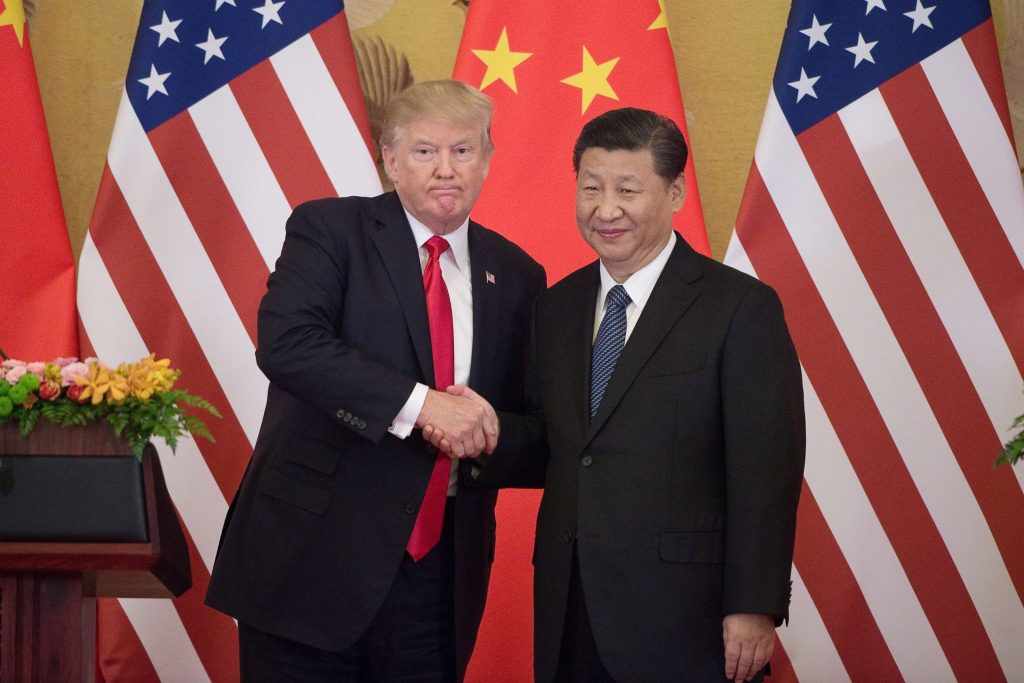
When Donald Trump sat down with Xi Jinping in Busan on 30 October 2025, he presented the encounter as a personal triumph. On his way out, he told the press the meeting had been “a twelve out of ten,” the kind of flourish that has become part of his political brand. The choreography was familiar: a made-for-television handshake, a few vague references to “tremendous progress,” and a promise of “amazing deals” on trade and security. Yet the context this time was very different from Trump’s first term.
Trump returned to the White House in January 2025 as the 47th president, with Republicans controlling both houses of Congress and a mandate built on resentment of globalisation, anger at migration, and fatigue with overseas wars. His second term has been marked by sweeping tariffs, an attempt to rewire the US administrative state, and a more open challenge to legal and constitutional constraints. China has been central to the narrative. Trump portrays Beijing as the main economic predator and his favourite foil, even as he insists he alone can “get a deal” with Xi.
Busan was the first extended in-person Trump–Xi encounter of this new term. It took place against the backdrop of Trump’s “Liberation Day” universal tariff, China’s retaliatory measures on key inputs, and a jittery global economy. According to contemporaneous accounts, the two leaders spoke for about an hour and a half, with a heavy focus on tariffs, technology restrictions and the war in Ukraine. The meeting did not reset the relationship, but it clarified the logic of “Trump 2.0” on China: an instinctively transactional approach that privileges visible economic wins and technology access over any coherent long-term strategy.
This article examines that approach as it has emerged in the first year of Trump’s second presidency. It argues that Trump’s China policy is best understood as a bargaining style rather than a grand strategy. It is driven by domestic political imperatives and the president’s belief that he can convert economic leverage into political concessions, with relatively little regard for alliance management or institutional process. Beijing, for its part, is trying to channel this improvisational style into a more structured framework that would curtail the United States’ description of China as its chief strategic rival and secure implicit acceptance of the new regional status quo. The result is a relationship in which both sides emphasise “deals,” but mean very different things by them.
Who makes China policy in Trump 2.0?
The cast around Trump has changed since his first term, but the decision-making pattern is recognisable. Formal China specialists are weaker than in any administration since the end of the Cold War. The State Department’s dedicated Asia hands have been sidelined, and in mid-2025 media reports confirmed that several senior South China Sea and Taiwan experts had been dismissed or pushed into marginal roles. The centre of gravity now lies in a cluster of economic and political loyalists whose expertise is functional rather than regional.
Treasury Secretary Scott Bessent and Commerce Secretary Howard Lutnick are at the core of this circle. Both come from finance, both have long-standing personal ties to Trump, and both describe themselves as pragmatists on China. They accept that China is a systemic competitor, but their instinct is to manage interdependence and extract concessions rather than pursue full decoupling. This sets them apart from first-term figures such as Robert Lighthizer, who treated the trade relationship as a front in a broader geopolitical struggle.
Jamieson Greer, the US Trade Representative, and Peter Navarro, now a White House counsellor rather than a cabinet official, continue to advocate high tariffs and industrial reshoring. Navarro in particular uses the language of economic warfare and has publicly argued that technology export controls should aim not just to protect US security but to “slow China’s rise” as such. Yet his influence appears more episodic than in the first term, partly because financial markets reacted badly to Trump’s attempts to weaponise tariffs across the board in spring 2025.
Overlaying this economic core are two political figures with strong China views: Secretary of State Marco Rubio and Vice President J. D. Vance. Rubio has built his career on a hawkish stance, combining support for human rights with calls for aggressive restrictions on Chinese access to advanced technologies. In May 2025 he announced a policy of “aggressively revoking” visas of Chinese students in sensitive fields and tougher screening of future applicants, signalling a hardening line on educational and research ties.
Vance, by contrast, mixes sharp rhetoric on China with a more restrained approach to US military commitments. On the campaign trail he called China “the biggest threat to our country,” but in his first major foreign-policy speech as vice president he told European leaders that their main danger came from internal decay rather than China or Russia. Vance has been wary of new security guarantees in Asia and has privately warned that a war over Taiwan would be “catastrophic for the American working class.” According to press reports, he has floated the idea of a “grand bargain” in which Washington would quietly narrow the scope of its Taiwan commitments in return for Chinese concessions on technology and trade.
This inner circle is reinforced and sometimes constrained by voices from the private sector. Semiconductor executives, Wall Street financiers and tech entrepreneurs shuttle through the Oval Office, lobbying against measures that would choke off access to the Chinese market or Chinese suppliers. Nvidia’s Jensen Huang has reportedly briefed Trump on the limits of current export controls for high-end chips, warning that overly broad sanctions would simply accelerate China’s efforts to build indigenous alternatives. Elon Musk has alternated between criticising and flattering Beijing, while Peter Thiel, an early advocate of treating China as a “civilisational rival,” remains close to Vance.
The overall pattern is a crowded and fragmented advisory ecosystem in which functionally defined interests compete for the president’s ear. China specialists provide background papers and talking points, but decisions often emerge from late-night phone calls with donors and business leaders. Trump is the arbiter, and he takes pride in defying the bureaucratic script.
A tariff engine without a roadmap?
The clearest expression of Trump 2.0’s China approach is the universal tariff policy unveiled on 2 April 2025. Trump declared that it was “Liberation Day” for American workers and invoked emergency powers to impose a 10 percent tariff on virtually all imports, with higher rates reserved for “cheaters” such as China. Markets plunged, and within days the White House announced a 90-day pause to renegotiate existing trade relationships.
China responded with targeted countermeasures on rare earth exports, critical pharmaceutical ingredients and certain agricultural products. The rare earth move was especially symbolic. Beijing had used this lever before, but this time it explicitly framed the measure as a response to what it called “economic coercion” from Washington. For a brief period, defence contractors and electric-vehicle manufacturers in the United States faced genuine uncertainty about supplies.
Tariffs also became the main talking point in the lead-up to Busan. A week before the summit, Trump threatened a 100 percent tariff on all Chinese imports if Xi did not make “major concessions” on intellectual property and fentanyl precursors. The Chinese government in turn signalled through state media that it was open to partial relief on agricultural tariffs and to modest purchases of US liquefied natural gas, but ruled out unilateral changes to its industrial policy.
What is striking in this pattern is not that tariffs are back. It is that they have become a substitute for broader strategy. Trump and his advisers talk about tariffs as an all-purpose instrument that can be dialled up or down to punish Beijing, reward US farmers, appease Midwest voters or force allies to choose sides. The administration has not articulated a clear end state beyond “better deals” and a reduction in the bilateral trade deficit. There is no evident attempt to map tariff policy onto coalition-building in Asia or Europe, nor to reconcile it with export-control regimes designed to slow China’s military-civil fusion.
This economic-first orientation has immediate domestic appeal. It allows Trump to tell voters he is fighting for American jobs and standing up to China. But it also risks confusing friends and adversaries. For Beijing, tariffs are both a problem and an opportunity. They hurt exporters and complicate macroeconomic management, yet they also create bargaining chips: China can suspend or reinstate its own retaliatory measures, shift purchases of soybeans and liquefied gas, and adjust informal regulatory pressures on US firms operating in China to influence the mood in Washington.
While tariffs and market access dominate the headlines, other strategic issues have slid down the White House agenda. Human rights, which had a modest though visible place in Biden’s China policy, are almost absent from Trump’s public comments. The internment of Uyghurs, the dismantling of Hong Kong’s autonomy and the tightening of control over civil society receive occasional mentions from Rubio and some members of Congress, but they rarely feature in presidential messaging. When pressed, Trump tends to treat these issues as irritants that should not get in the way of deals on trade or North Korea.
Taiwan is more prominent, but often in a tactical way. The administration has approved some arms sales and quietly encouraged Taipei to spend more on asymmetric capabilities. At the same time, Trump has publicly questioned whether US soldiers should ever fight for an island “ten thousand miles away,” and media leaks suggest that Vance has argued internally against any additional US security pledges. This ambivalence creates openings for Beijing. It can offer modest economic concessions in exchange for US statements that dilute support for Taiwan’s de facto autonomy, for example by reaffirming vague formulations about “one China” without matching them with concrete deterrent measures.
Technology controls are another area of half-finished policy. Biden-era restrictions on exports of cutting-edge semiconductor equipment remain in place, and some have been tightened. However, business lobbying and Bessent’s influence at Treasury have slowed proposals to extend controls into broader categories of hardware and software. Officials talk about “small yards and high fences,” but the yard’s perimeter is vague and contested.
The result is a patchwork. On some days, the administration sounds like it wants to separate the two economies completely. On others, Bessent and Lutnick reassure investors that the goal is “balanced interdependence,” not rupture. Rubio’s visa clampdown suggests a hardline posture on talent flows, yet other parts of the government quietly encourage US universities to maintain joint programmes that bring in full-fee paying Chinese students. These cross-pressures are not unique to Trump; previous administrations also struggled to align economic and security objectives. What is distinctive now is the absence of a clearly articulated framework to reconcile them.
Beijing’s play: from “incoherence” to issue linkage
The lack of a coherent US strategy has led many observers, including some of Trump’s domestic critics, to describe his China policy as chaotic. French and German commentaries after Busan complained that the White House veers between confrontation and conciliation without warning, leaving allies uncertain about how to position themselves.
Interestingly, several influential Chinese analysts have taken a different tack. Wu Xinbo, a prominent scholar of US–China relations in Shanghai, has argued that Trump needs what he calls a “China framework” in order to stabilise the relationship. In Wu’s account, the point of a framework is not to lock in US hostility, but to create a shared understanding that can anchor negotiations on trade, technology, Taiwan and maritime disputes.
Behind this call lies a classic great-power bargaining logic. A fragmented US policy that focuses only on individual issues allows Trump to claim wins at home, yet it also gives Beijing opportunities to link issues together in ways that serve its long-term goals. Chinese negotiators can, for instance, signal flexibility on rare earth exports and agricultural purchases while quietly seeking US statements that soften its security posture in the Western Pacific. A White House preoccupied with quarterly economic indicators may accept symbolic formulations on Taiwan or the South China Sea that appear harmless in Washington but are treated in Beijing as evidence of growing US acceptance of China’s “core interests.”
Xi’s language in Busan exemplified this approach. According to Chinese readouts, he repeatedly described the relationship as one of “partners and competitors,” with partnership as the primary identity and competition as a secondary, manageable feature. He urged the United States to “respect China’s chosen path” and to stop “defining China as its main strategic rival.” On the surface, this sounds conciliatory. In practice, it would mean US acquiescence in China’s self-definition as a rising power whose regional preeminence is no longer open to challenge.
From Beijing’s perspective, encouraging Trump to think in terms of deals without strategy has two advantages. It reduces the likelihood that the US will build durable coalitions in Asia and Europe, because allies struggle to align themselves with a moving target. It also makes it easier to deploy economic leverage on specific constituencies within the United States. Soybean farmers, tech firms, pharmaceutical companies and rare earth users can be alternately rewarded and punished, amplifying their lobbying in Washington for a more “reasonable” approach to China.
What, then, actually came out of Busan? Public statements from both sides were thin. Trump spoke of “tremendous progress” on trade and said Xi had agreed to “buy a lot more of our great products.” Xi emphasised the need to “properly handle sensitive issues” and “expand mutually beneficial cooperation.”
Subsequent leaks and analytical pieces fill in some of the blanks. According to several accounts, the two leaders endorsed a loosely defined “truce” on new tariffs: Washington would postpone the threatened 100 percent tariff on Chinese consumer goods, while Beijing would gradually roll back retaliatory duties on certain US agricultural products and accelerate approvals for a handful of US tech firms seeking licences to sell into China. A working-level process was set up to explore a possible understanding on fentanyl precursors and to resume limited military-to-military communication. There was also discussion of Ukraine, with Trump urging Xi to cut energy purchases from Russia and to support a notional ceasefire plan centred on a freeze of frontlines.
On Taiwan and the South China Sea, the pattern was more familiar. Trump reportedly repeated the formula that the United States “does not support Taiwan independence,” language consistent with decades of policy. Xi pressed for clearer statements that the US would “not interfere” in “China’s internal affairs,” which US officials rejected. No new commitments were made, but Beijing’s official commentary portrayed the exchange as proof that Washington was ready to “manage differences” rather than “contain China.”
For Trump, the meeting offered an opportunity to claim that his personal relationship with Xi had produced concessions that eluded Biden. For Xi, it was a chance to appear as a stabilising statesman without giving ground on core strategic issues. For the rest of the world, Busan underlined the volatility of a relationship that remains structurally competitive yet is managed by leaders who prioritise short-term political gains.
Trump’s China approach does not unfold in a vacuum. It has immediate implications for allies in Asia and Europe, as well as for states in the global South that are navigating between US and Chinese influence.
In Asia, treaty allies such as Japan and South Korea welcome any reduction in open US–China hostility that might lead to military escalation, but worry that an overly transactional Washington will neglect regional security architecture. They watched the Busan summit for signs that Trump might trade away support for Taiwan or ease technology controls in return for promises of Chinese purchases. Those fears were not fully realised, yet the absence of a clear US strategy reinforces hedging behaviour: deeper defence ties with the United States on some issues, parallel efforts to stabilise relations with China on others.
In Europe, the second Trump administration’s China policy sits atop existing frustrations about tariffs on European goods and criticism of NATO burden-sharing. Vice President Vance’s speech at the Munich Security Conference, in which he chastised European leaders for neglecting their “internal threats,” was widely interpreted as a sign that the White House sees Europe primarily as a source of money and political recognition, not as a partner in managing China. European Union efforts to “de-risk” economic relations with China proceed in parallel with Trump’s more confrontational tariff policy, but coordination is limited. Some European diplomats fear that Washington’s swings between tariff escalation and dealmaking undercut their own attempts to build a coherent China approach.
For middle powers and developing states, Trump 2.0 offers both opportunities and headaches. On one hand, a United States consumed by tariff brinkmanship may pay less attention to governance conditions or human rights when offering security partnerships. On the other, the unpredictability of US trade measures complicates planning for export-led growth. China seeks to capitalise on this by positioning itself as a more predictable economic partner, even as its own coercive economic practices become more visible. The tug-of-war between a transactional America and an increasingly self-assertive China creates a crowded bargaining space in which smaller states must constantly adjust.
Trump’s second term has put the “art of the deal” at the centre of US–China relations. The administration’s China policy is dominated by tariff threats, discrete bargains over market access and a belief that personal rapport between leaders can override structural tensions. The Busan summit captured this style: high on theatre, modest on substance, and framed as a personal victory regardless of the details.
This approach has some advantages. It allows flexibility. It permits rapid shifts when domestic or international conditions change. It keeps opponents off balance, at least in the short term. Yet as an organising principle for a generational rivalry between two major powers, it is profoundly limited. Deals without a strategy risk undercutting the very leverage they seek to exploit. When tariffs are imposed and lifted in quick succession, their signalling value erodes. When security commitments are questioned in public and reaffirmed in private, allies begin to doubt the durability of US guarantees. When human rights and rule-of-law concerns are consistently subordinated to transactional gains, the normative ground on which Washington criticises Beijing’s behaviour becomes shaky.
China’s leadership appears to understand both the strengths and the weaknesses of Trump’s style. It is attempting to steer Washington toward a framework in which the United States implicitly accepts China as a legitimate peer whose sphere of influence in Asia is no longer up for discussion. The language of “partners and competitors” that Xi used in Busan is part of this effort. So is the careful use of economic levers, from rare earths to tariff rollbacks, to influence specific segments of US opinion.
Whether Trump can turn his preference for dealmaking into a sustainable advantage remains uncertain. Doing so would require integrating economic tools, alliance management and military posture into a coherent strategy that recognises China as both a competitor and an indispensable interlocutor. It would also require rebuilding an inter-agency process that can weigh functional inputs from trade, technology and security officials against a long-term picture of US interests in Asia and beyond. There is little evidence so far that the administration is interested in that kind of discipline.
For now, Trump 2.0’s China policy remains what Busan revealed: a series of improvised bargains wrapped in superlatives, set against a strategic contest that is far more durable than any one summit. The risk is that in treating China policy as a sequence of discrete deals, Washington underestimates how those deals fit together in Beijing’s larger design for regional order. The art of the deal, on its own, is not a substitute for the art of strategy.