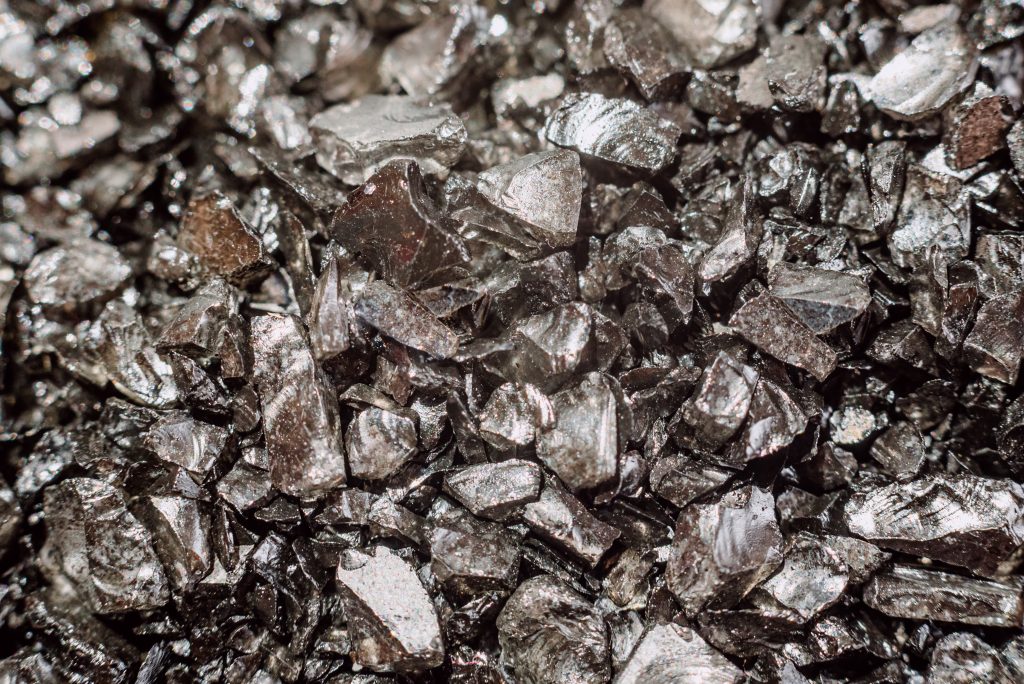
For most of the twentieth century, the map of power ran through oilfields and sea lanes. In the twenty first, it increasingly runs through processing plants that turn obscure ores into irreplaceable inputs for weapons systems and clean energy. Critical raw materials are not a side story in US China rivalry or in Europe’s search for strategic autonomy. They are one of the organising logics of the emerging order. Rare earths sit closest to the fault line.
China now accounts for roughly seventy percent of global rare earth mining and controls more than ninety percent of the downstream value chain, from oxide separation to metal refining and magnet production. The world has lived with commodity concentration before. What makes this different is the density of demand in a few sectors that happen to be central to both military power and the energy transition. High coercivity magnets for missiles and electric vehicles, gallium and germanium for semiconductors and sensors, battery grade nickel and lithium for cars and grid storage: these are not generic bulk goods that can be swapped out at short notice.
The International Energy Agency’s latest outlook projects that demand for critical minerals such as lithium, nickel, cobalt, graphite and rare earths grew strongly again in 2023, with lithium demand rising by about thirty percent in a single year. In its climate scenarios, total demand for energy transition minerals roughly doubles by 2040. The market for refining is even more concentrated than mining; by 2030, China is on track to account for around half of the global market value in refining key minerals. This concentration is not an accident. It is the cumulative result of Chinese industrial policy, Western complacency and the logic of cost minimisation.
China’s mineral power did not fall from the sky. In the 1990s and 2000s, Beijing pushed rare earth production through a mix of local state support, cheap credit and tolerance for environmental damage that would have been politically unacceptable elsewhere. Deng Xiaoping’s remark that “the Middle East has oil, China has rare earths” was not a slogan so much as an early description of a strategy that valued control of processing as much as control of ore.
By driving prices down and flooding global markets, Chinese producers helped bankrupt or marginalise competitors in the United States, Australia and elsewhere. As mines and separation plants closed, the physical skills and institutional memory associated with them decayed. Western firms were happy to outsource the messy parts of the chain and treat rare earths as cheap, ubiquitous inputs. The production map that resulted created precisely the kind of leverage that export controls and licensing regimes can now exploit.
Beijing has long understood that leverage. In 2010, during a crisis over the Senkaku or Diaoyu Islands, Japanese importers experienced what amounted to a sudden halt in rare earth shipments that was never officially acknowledged but was felt immediately in ports and factories. Export quotas were also cut sharply. Japan reacted with methodical urgency, restructuring its supply chains, investing in alternatives and reducing its dependence on Chinese rare earths from close to ninety percent to nearer sixty percent in a decade. The episode was short. It succeeded less in punishing Japan than in concentrating the minds of every defence planner and trade ministry watching from afar.
A decade later, with US China competition open and explicit, that pattern has matured into a comprehensive regime. In 2023, Beijing imposed export licence requirements on gallium and germanium, citing national security. Those metals are essential for compound semiconductors, night vision systems and advanced radar. In October 2025, the government went further. New rules expanded controls to a broad list of rare earth elements, technologies for mining, processing, recycling and magnet manufacturing, and, crucially, products made outside China that either contain Chinese origin rare earths or were made using Chinese rare earth technologies. Chinese nationals and firms also face tighter restrictions on providing technical assistance for rare earth projects overseas.
The details matter. Exporters and foreign users must now navigate an opaque licensing system that gives Beijing significant discretion over who receives approvals and how fast. In 2024 China exported around 58 thousand tonnes of rare earth magnets, enough to equip millions of vehicles and a large share of global wind turbines and military systems. Prolonged delays or denials could disrupt employment and revenues across automotive, aerospace and electronics value chains far from Chinese territory.
This is not a blanket embargo. It is a set of valves that can be opened or narrowed in response to political and security developments. It gives Beijing an instrument that sits below the threshold of war yet above the level of symbolic sanctions. It can be targeted at particular firms or countries, used as a signal in the run up to summits or as a response to new Western restrictions on semiconductors and data flows.
At the same time, China is not immune to counter leverage. Its own industries depend on imported iron ore, copper, lithium, nickel and bauxite from Australia, Latin America and Africa. It still relies on Western markets for much of its high technology manufacturing exports and on access to advanced lithography equipment, aircraft engines and design software. A sweeping minerals embargo would accelerate diversification efforts elsewhere and call into question China’s reliability as a supplier in a way that could not easily be repaired.
The pattern that has emerged is calibrated coercion. Beijing uses the threat and reality of export controls to raise the price of Western technological restrictions and to remind others of its centrality, but it stops short of systematic cut offs. That restraint is not altruism. It reflects the simple fact that rare earth power is strongest in a world of dense trade, not in one of complete decoupling.
In Washington, the political mentality has shifted more slowly. For three decades the United States trusted that open markets and military primacy would suffice to protect access to most inputs. Rare earths were treated as a niche concern, and when the Mountain Pass mine in California shut its processing operations in 2015, there was little sense of crisis. Only after the 2010 Japan episode, the 2018 2019 trade war and the intensifying competition over advanced semiconductors did rare earth dependency migrate from specialist briefings to the heart of strategic debate.
Between 2020 and 2023, roughly seventy percent of US imports of rare earth compounds and metals came from China. Virtually every advanced weapons system the Pentagon fields, from F 35 fighter jets and Virginia class submarines to precision guided munitions, depends on rare earth magnets and alloys. Department of Defense reports became increasingly blunt about a “single point of failure” at the separation and magnet stages of the chain.
The response since 2020 has been more than rhetorical. Using Defense Production Act authorities and appropriations approved by Congress, the Pentagon has now invested more than half a billion dollars in domestic and allied critical minerals projects, concentrating heavily on rare earths. The centrepiece is a multibillion dollar partnership with MP Materials, operator of Mountain Pass and the leading non Chinese producer.
In July 2025 the Department of Defense agreed to take a 400 million dollar equity stake in MP Materials, becoming its largest shareholder with around 15 percent of the company, and extending a 150 million dollar loan for heavy rare earth processing capacity. The deal commits MP to build a large magnet manufacturing facility, often described as the “10X” plant, that should come online around 2028 and to sell all of its magnet output under a decade long offtake agreement to defence and commercial buyers. The Pentagon, in turn, provides a price floor of roughly 110 dollars per kilogram for neodymium praseodymium, shielding the project from price undercutting by Chinese competitors.
For a political culture that still pays lip service to free markets, this is an extraordinary step. The US government is no longer simply a regulator or customer of last resort; it is an active shareholder in a critical mineral producer, underwriting its economics in exchange for supply security and restrictions on sales to China and other countries deemed hostile. The structure looks more like the industrial policy long associated with Beijing than with Washington.
Private firms are adapting accordingly. Apple signed a separate 500 million dollar deal with MP Materials to secure domestic magnet supply for its devices and to support recycling facilities in California and manufacturing in Texas. Automotive companies, defence contractors and wind turbine manufacturers are all reexamining their materials exposure. Rare earths have moved from the procurement department’s files to the boardroom.
Yet even with generous subsidies and strategic contracts, structural obstacles remain. Opening new mines in the United States routinely takes a decade or more given permitting, litigation and community opposition. Processing facilities face environmental scrutiny after previous contamination incidents. Some of the same constituencies that demand “made in America” clean energy hardware are deeply sceptical of new extractive projects on US soil. That tension will limit how fast domestic capacity can scale.
The likely outcome is not full self sufficiency but a layered system. Military and space programmes will be insulated as far as possible by dedicated domestic and allied supply. Civilian sectors will continue to rely on a mixture of US, allied and Chinese materials, diversified enough to survive shocks but not entirely decoupled. Washington’s real ambition is to shrink the range of scenarios in which Beijing can hold a knife to the throat of its defence industrial base, not to recreate a closed American minerals economy.
Europe’s position is more precarious and more conflicted. The European Union has a large automotive and wind industry, ambitious climate targets and a relatively small domestic mining sector. It imports the overwhelming majority of its critical minerals and is heavily exposed to Chinese processing and magnets. At the same time, it has built its identity around stringent environmental and social standards and a refusal to copy the open power politics of Washington or Beijing.
The Critical Raw Materials Act adopted in 2024 attempts to reconcile these tensions. It identifies a list of critical and strategic raw materials for the green, digital, defence and space sectors and sets numerical benchmarks for 2030: at least 10 percent of annual EU consumption of each strategic raw material should be extracted within the Union, at least 40 percent processed in the EU, at least 25 percent sourced from recycling, and no more than 65 percent of any strategic material should come from a single third country.
Those targets are ambitious bordering on aspirational. The Commission has selected around sixty strategic projects across extraction, processing and recycling and is offering streamlined permitting and access to finance. But local resistance to mines in Portugal, Sweden and elsewhere is intense. National security arguments that resonate in Washington have less traction with European publics who see themselves as consumers of security rather than producers. The EU’s environmental rules, which it wants to export through trade agreements and supply chain due diligence laws, also raise the cost and complexity of doing projects inside the Union.
Externally, Brussels is trying to use trade and development instruments to lock in partnerships. New agreements with Chile and other Latin American states explicitly mention critical minerals. The Global Gateway initiative promises infrastructure and finance to producer countries that commit to environmental and governance standards. European officials present this as an alternative to what they characterise as China’s extractive model and the United States’ transactional security framing.
For resource rich governments in Africa and Latin America, this is an attractive pitch on paper. In practice they are faced with concrete offers from Chinese companies that can mobilise capital and build processing plants quickly, and more complex Western consortia that move slowly but may bring higher standards and more local value addition. The result is a world in which Canberra, Brussels, Washington and Beijing are all competing for influence in the same provinces of the Democratic Republic of Congo or the same lithium salars of the Southern Cone.
Resource states are not passive in this game. Indonesia has used export bans on nickel ore to force foreign firms to build smelters and battery plants on its territory. Chile and Mexico have moved to assert greater public control over lithium. Namibia and other African producers are debating restrictions on raw ore exports to encourage domestic processing. Calls for OPEC style coordination among lithium producers are still more rhetoric than reality, but they underline the new confidence of states that see the energy transition as a chance to renegotiate their place in global value chains.
The risk is that these legitimate development ambitions intersect with great power rivalry in ways that produce unstable bargains. If Chinese companies dominate upstream projects while Western governments pour money into alternative processing hubs, states in between may be squeezed by competing governance demands, sudden shifts in demand or politicised sanctions. A mismanaged contract dispute or a coup in a major producing region could have cascading effects far outside its borders.
Taken together, these trends amount to a shift from globalisation underwritten by the illusion of apolitical supply chains to a geo economic order where materials systems are openly instrumentalised. The fashionable phrase is “friendshoring”. In practice, what is emerging looks more like overlapping clubs: US centred chains that treat Chinese content with growing suspicion; China centred chains that seek to insulate against Western controls; European attempts to maintain some flexibility while leaning closer to Washington on security.
Rare earths sit at the intersection of all these clubs. They are enablers of hard power. They are also enablers of solar inverters, offshore wind farms and electric buses. That makes them a test case for whether the world can pursue strategic rivalry and decarbonisation at the same time. The International Energy Agency’s commentary on China’s new export controls is blunt. It warns that concentration risks “are becoming reality”, and that sustained licensing delays would threaten industrial competitiveness and employment well beyond the defence sector.
Three medium term trajectories are credible.
In the first, rivalry is intense but managed. Beijing continues to refine its export control regime and uses it to send signals and impose costs, but avoids wide sweep embargoes that would trigger full scale decoupling. The United States and Europe build out their own processing and magnet capacity, mainly for defence and strategic industries, while accepting continued commercial interdependence in less sensitive sectors. Prices are higher, redundancy is built into supply chains, and mineral politics become a permanent feature of alliance diplomacy.
In the second, confrontation overshoots. A sharp crisis in the Taiwan Strait, a new round of sanctions on Chinese financial institutions or an incident around critical infrastructure could push Beijing to test the system more aggressively. A licensing freeze on rare earth magnets or separation technologies, even for a few months, would expose the fragility of electric vehicle, aerospace and weapons production across the G7. The United States and its partners would respond with counter sanctions, export bans on high end chips and potential restrictions on Chinese access to key ores or maritime routes. The resulting scramble would turbocharge resource nationalism and undermine the credibility of clean energy transition timelines.
In the third, reluctant multilateralism takes root. Recognising their mutual exposure, major producers and consumers move, perhaps through the G20 or ad hoc coalitions, to introduce a degree of transparency and coordination into minerals markets: better data on stockpiles, voluntary rules on export controls, shared standards for environmental and labour performance. This would not replicate the institutions built around oil, and it would not eliminate coercive tools. It would simply accept that certain levels of unpredictability are in nobody’s interest.
None of these trajectories is predetermined. All are being shaped now by decisions that look technical or local: how fast a given permit is processed, how a single offtake contract is written, whether a mining project aligns with the expectations of indigenous communities. For policymakers, the lesson is that critical raw materials policy cannot remain a narrow technocratic file. It belongs at the centre of national security and foreign policy planning.
Several strategic priorities follow.
First, governments need to see processing and magnet manufacturing as infrastructure, not just industry. Stockpiles can cover short disruptions, but the real buffer against coercion lies in diversified, redundant processing networks that cross allied borders. That requires public money, clear long term purchase commitments and a willingness to accept higher unit costs as the price of resilience.
Second, social licence is not a soft add on. If Western democracies outsource the environmental pain of their energy transitions and defence build up to other countries, they will have little credibility when they complain about others’ practices. Bringing some extraction and processing home means confronting communities honestly about trade offs, sharing benefits and investing in remediation. The alternative is to remain permanently exposed to the political choices of others.
Third, recycling and substitution must move from the margins to the core of strategy. Targets in the EU Critical Raw Materials Act that call for meeting a quarter of demand from recycling by 2030 will not be met without aggressive product design changes, collection systems and new technologies for recovering materials from magnets, batteries and wind turbines. Recycling will never eliminate the need for new mining, but it can stretch resources and ease the pressure on conflict prone regions.
Finally, the diplomatic framing around critical raw materials matters. Producer states are acutely aware of the history of extractive relationships. If Washington and Brussels present their engagement purely through the lens of competition with China, they will repeat old mistakes. A more sustainable approach would treat producer countries as partners in industrial development, not just as pits of ore, and would accept that they, too, will sometimes use export controls and ownership rules to pursue their own interests.
In the end, the politics of critical raw materials are not separate from the broader story of geopolitical change. They are one of the places where that change becomes tangible: in contracts, in regulatory codes, in the fate of towns that sit above ore deposits. Rare earths are a prime example not because they are mystical, but because they force the major powers to confront the reality of mutual dependence in a strategic environment that increasingly rewards separation. How they manage that tension will tell us a great deal about the kind of international order that emerges from this period of contestation.