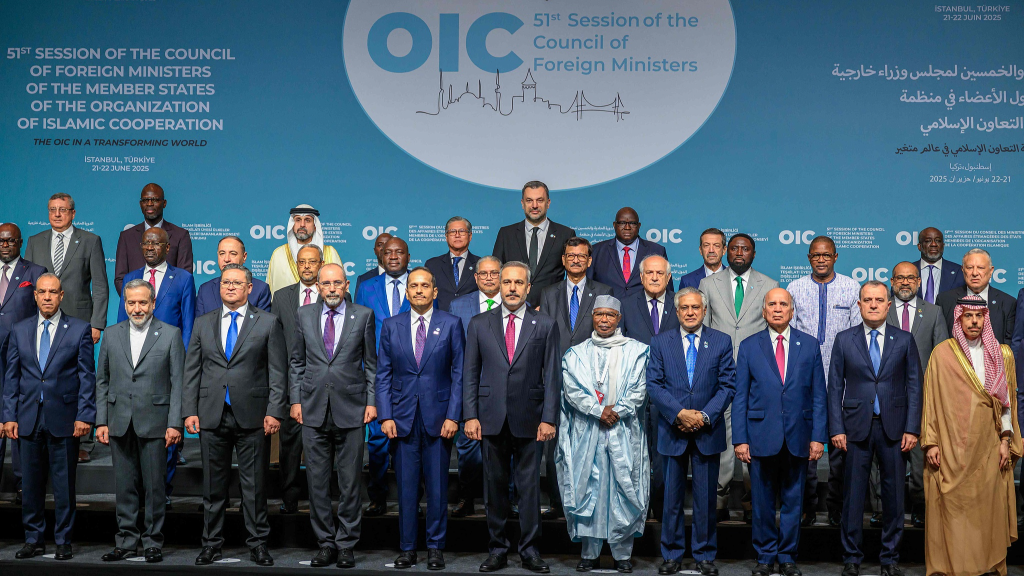
Türkiye’s current stewardship of the Organisation of Islamic Cooperation is less a ceremonial turn in the chair and more an attempt to redefine what the OIC is for. Behind the official slogan of “The OIC in a Transforming World” lies a bid to convert an often reactive, declaratory body into a forum that can aggregate resources, standardise policies and project collective agency on behalf of Muslim-majority states.
The starting point is structural. The OIC sits at the intersection of several overlapping crises: protracted wars in Palestine, Syria, Yemen, Sudan and Afghanistan, repeated shocks to food and energy markets, and a visible rise in religiously framed hatred, especially Islamophobia, in non-member states. Many of these problems expose the limits of existing multilateral formats. The UN Security Council is paralysed on Palestine, climate negotiations move slowly relative to vulnerability in Sahelian and Asian OIC members, and Western domestic debates often instrumentalise Muslim minorities. Against this backdrop, it is not surprising that Ankara presents the OIC as a platform that needs to move from communiqués to instruments and from moral protest to policy coordination.
Türkiye’s ability to make that case rests on a dense institutional footprint inside the OIC system. It is not only a founding member; it also hosts a cluster of OIC organs in Ankara and Istanbul: COMCEC on economic and commercial cooperation, SESRIC on statistics and training, IRCICA on history and culture, SMIIC on standards and metrology, and the OIC Arbitration Centre.These bodies already handle data, standard setting and dispute resolution across the membership. By emphasising them, Turkish diplomacy signals that its leadership is grounded in existing institutional muscle rather than in a purely rhetorical appeal to unity.
The three priorities that Ankara associates with its one-year chairmanship are revealing: deeper cooperation among member states, more systematic protection of Muslim minorities and diaspora communities, and capacity building with knowledge transfer. Taken together, they outline an attempt to reposition the OIC simultaneously as an economic bloc, a normative actor on rights and discrimination, and a provider of technical public goods.
On the economic side, Türkiye is using trade statistics as a political argument. According to recent OIC data, the share of intra-OIC trade in members’ overall foreign trade rose from 19.16 percent in 2023 to 20.36 percent in 2024, with roughly thirty member states already above the long-stated target of 25 percent. On its own, that increase is modest. As an instrument of narrative, however, it allows Ankara to claim that decades of work through COMCEC and related mechanisms have produced measurable integration, and that a more activist phase could push the numbers further. Here Türkiye’s own economic profile matters. With exports of roughly 265 billion dollars in 2023 and a diversified industrial base, it can present itself as both a beneficiary and an engine of trade within the OIC space.
The hosting of the second OIC Transport Ministers Conference in Türkiye, and the choice to frame connectivity as a priority, fit the same logic. Turkey’s geography, linking Europe, the Black Sea, the Caucasus, the Middle East and the Eastern Mediterranean, is turned into a template for broader OIC connectivity. Discussion of transport corridors, regulatory harmonisation and logistics is meant to shift the organisation’s work on economic issues away from generic “cooperation” language and toward projects that remove concrete bottlenecks in trade and humanitarian response.
There is an external dimension to this economic activism. Ankara has pushed to revitalise dialogue formats between the OIC and the European Union, and to institutionalise tripartite consultation among the OIC, the Arab League and the African Union, especially around the Palestinian file. The underlying calculation is that an OIC that can present coordinated positions and credible economic figures will be harder to ignore in debates on sanctions, reconstruction, migration or climate finance. For Türkiye itself, this reinforces a longstanding ambition to be viewed as a bridging power that translates between Western frameworks and the preferences of the broader Muslim world.
The second pillar, centred on the protection of Muslim minorities and diasporas, addresses a long-standing ambiguity in the OIC’s identity. The organisation is a club of states, but it claims to speak for a global community, a significant share of which resides in non-member countries. Rising Islamophobia in parts of Europe, North America and Asia has therefore become both a moral concern and an identity marker for the OIC. Türkiye has seized on this theme and sought to give it institutional form.
The appointment of Ambassador Mehmet Paçacı, a Turkish diplomat, as the Secretary General’s Special Envoy on Islamophobia at the Banjul summit in 2024 was the key move.This post is designed to monitor incidents, engage with governments and international organisations, and coordinate responses to discriminatory policies and acts of violence that target Muslims. It also anchors the Islamophobia agenda in a specific office rather than dispersing it across resolutions and ad hoc statements. For Ankara, the fact that the envoy is Turkish reinforces its claim to intellectual and diplomatic leadership on questions of religious intolerance.
This initiative is explicitly connected to the Istanbul Process that grew out of UN Human Rights Council Resolution 16/18 on combating intolerance and negative stereotyping on religious grounds. Türkiye’s commitment to convene the ninth meeting of that Process under its OIC chairmanship is not only about internal coordination among Muslim states. It is also a way to embed OIC concerns within the broader UN normative architecture, which in turn makes it easier to frame Islamophobia as a matter of international obligation rather than of bilateral grievance. This is significant for think tank analysis because it shows the OIC trying to move away from a purely oppositional stance towards the West and toward a strategy that uses existing global rights frameworks to push for change.
Whether this will result in substantive policy shifts in non-OIC states is far from guaranteed. Enforcement of Resolution 16/18 has always depended on domestic politics and judicial culture. The Special Envoy’s office will need to avoid becoming a symbolic platform that produces reports without leverage. It will also have to navigate internal OIC contradictions, since several member states have poor records on the rights of their own religious minorities. Here Turkey’s activism cuts both ways. On the one hand, its experience with a large European diaspora and long engagement with debates on headscarves, mosque construction and integration gives it familiarity with the issues. On the other hand, its own domestic contests over freedom of expression and the treatment of critics and non-Sunni communities invite scrutiny that can weaken its authority when it speaks in universal terms.
The third pillar, capacity building and knowledge exchange, is perhaps the most technocratic part of Türkiye’s agenda, yet it is central to any attempt to alter the OIC’s reputation as a talking shop. Ankara has deliberately tied its chairmanship to an expansion of training, simulation exercises and technical workshops. The “Mediation for Peace” certificate programmes run by the Turkish Diplomacy Academy, which bring together diplomats from member states and staff from the OIC Secretariat, signal an effort to normalise preventive diplomacy and structured negotiation skills across the organisation’s bureaucracy.
Similarly, Türkiye’s Disaster and Emergency Management Presidency (AFAD) has been used to pass on lessons from the February 2023 earthquakes to other OIC members through workshops and joint exercises. That knowledge transfer goes beyond seismology; it covers coordination between civilian and military responders, use of digital tools in search and rescue, and planning for large scale displacement. By casting these activities as OIC events rather than purely bilateral cooperation, Ankara ties its own high-visibility crisis management experience to a collective resilience narrative.
Capacity building also folds into economic modernisation. Turkish officials have been vocal about sharing expertise on digital infrastructure, e-government and cybersecurity, themes that intersect with OIC discussions on trade facilitation, financial cooperation and critical infrastructure protection. If this strand of the agenda is sustained, it could gradually produce a thicker layer of working-level ties among regulators, central banks and line ministries across OIC members, which would outlast any given chairmanship.
From an analytical standpoint, Türkiye’s project is both an expression of genuine multilateral ambition and a vehicle for national interest. The same moves that strengthen the OIC also extend Turkish influence. Hosting secretariats and training academies gives Ankara long term access to cadres from other member states. Leading on Islamophobia positions Turkey as a primary reference point for Muslim communities beyond its borders, which resonates with domestic political narratives that present Ankara as a patron of global Islam. Steering trade and connectivity initiatives through Turkish territory aligns with commercial interests in logistics, construction and services.
There are also clear constraints. The OIC’s membership is heterogeneous in regime type, external alignment and economic structure. Türkiye’s assertive regional policies in the last decade produced frictions with several Gulf and Arab capitals, some of which have only recently been patched up. Not all members share Ankara’s appetite for activist diplomacy, especially where it might complicate their bilateral ties with major powers. In economic terms, intra-OIC trade still hovers around one fifth of members’ total external exchanges, and much of that is driven by a handful of large exporters. Raising the ratio significantly will require structural adjustments and reductions in non-tariff barriers that are politically sensitive.
There is also the question of absorption. Many OIC members have limited bureaucratic capacity. An expanding menu of conferences, action plans and mechanisms risks overwhelming administrations that already struggle with implementation. Without careful prioritisation, Türkiye’s energetic chairmanship could leave behind a trail of declarations that are difficult to translate into practice, which would reproduce the very pattern it claims to overcome.
For outside partners, the current phase offers both opportunities and challenges. A more coherent OIC could be a useful interlocutor on issues that require regional coordination, such as migration routes, climate adaptation finance or standards for humanitarian access. The emphasis on aligning Islamophobia work with UN mechanisms presents a channel for dialogue that is more legalistic and less rhetorical. At the same time, a more assertive OIC may complicate bilateral dealings with individual member states when it insists on collective positions, especially on highly polarising issues such as Palestine.
For other influential OIC members, particularly in the Gulf and Southeast Asia, Türkiye’s activism raises strategic questions. They can choose to support and co-shape the emerging agenda, allowing Ankara to do much of the organisational heavy lifting while ensuring that their own priorities are reflected. They can also respond with parallel initiatives that dilute Turkish influence, for instance by building alternative training hubs or economic frameworks. The Istanbul Declaration adopted at the 51st CFM commits the organisation to a broad set of political and socio-economic goals; how many of these are pursued with genuine burden sharing will indicate whether Türkiye’s project has been internalised by others or remains primarily a Turkish script.
Seen from a think tank perspective, Türkiye’s vision for a “unified and active” OIC should therefore be read less as a finished blueprint and more as a stress test. It probes how far an organisation that has often been long on rhetoric and short on enforcement can move toward becoming a provider of public goods, a coordinator of economic strategies and a structured advocate for Muslim minorities. The answer will depend on whether Ankara can convert its year at the helm into lasting institutional changes that survive future chairmanships, and on whether other member states are willing to invest political capital and financial resources in the same direction.